Ireland Drought Deepens as Farmers Face €3 Million Daily Losses and No Rain in Sight
Ireland's agricultural sector is haemorrhaging more than €3 million per day as the country's most severe drought in decades continues to devastate pasture and crop yields across the south and east, with Met Éireann forecasting little prospect of meaningful rainfall for the worst-affected counties in the coming days and the Irish Farmers' Association calling for an emergency meeting with the government's food security committee to address what it describes as an unprecedented crisis.
Background
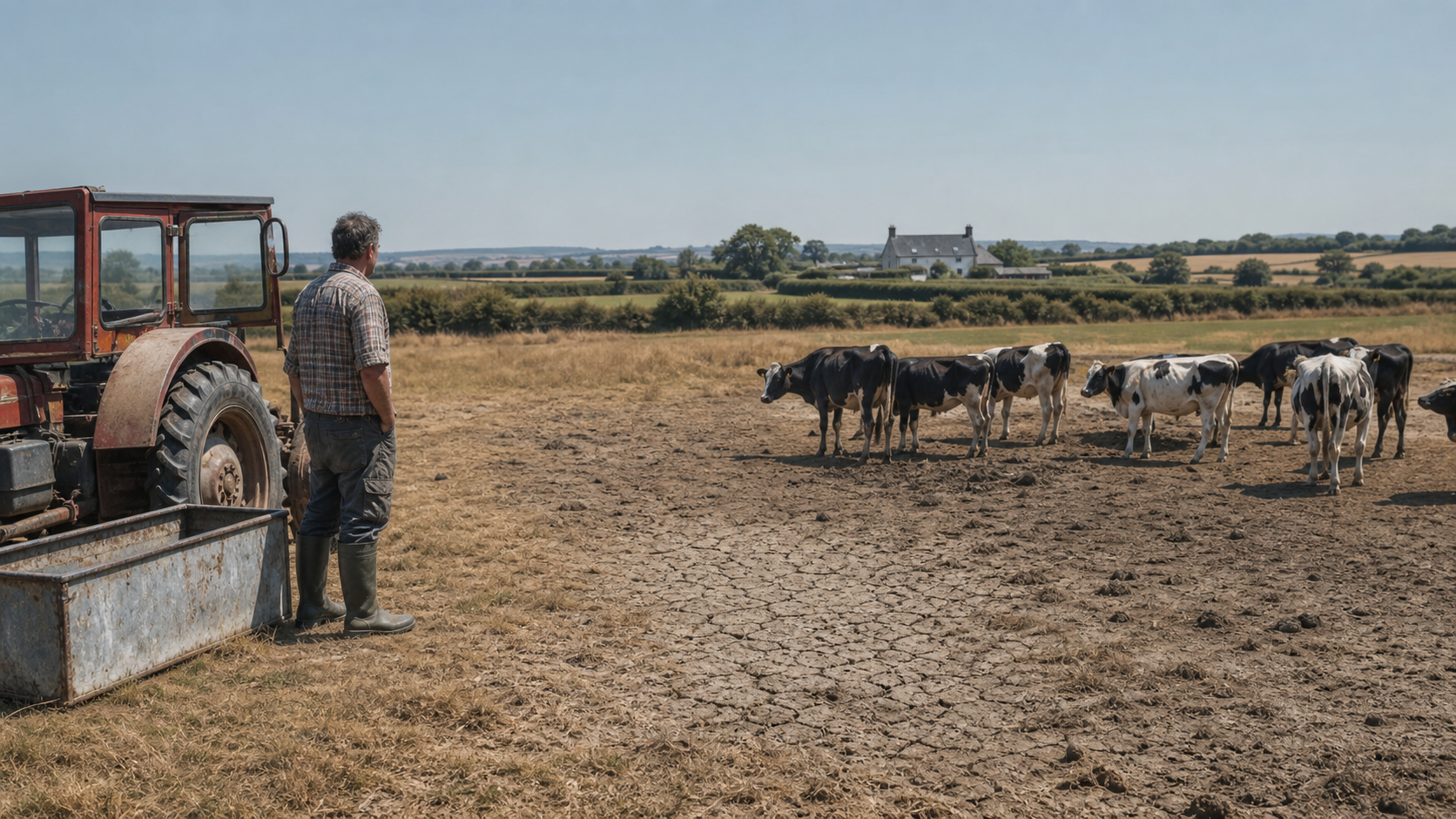
The drought of summer 2026 has its roots in the driest July on record for Ireland, a month in which some areas of the south and east received less than 20% of their normal rainfall. The prolonged dry spell has continued into August, with soil moisture deficits of between 70mm and 100mm recorded across south Leinster and east Munster — figures that represent a level of dryness that the land has not experienced in living memory for many farmers.
The consequences for agriculture have been severe and are worsening. Grass growth — the foundation of Ireland's predominantly pasture-based livestock farming system — has effectively ceased across large parts of the country. Livestock farmers who would normally be grazing their animals on fresh pasture through August are instead drawing on winter silage reserves that were intended to sustain their herds through the cold months ahead. Some farmers in the worst-affected areas are already on full supplementary feeding, a situation that would normally not arise until November or December.
The crisis is not confined to livestock farming. Tillage farmers are reporting significantly reduced yields for potatoes and vegetables, with some crops failing entirely in the driest areas. The economic impact is being felt across the entire agri-food supply chain, from farm gate to processing plant to retail shelf.
Key Developments
The Irish Farmers' Association has formally requested an emergency meeting with the government's food security committee, describing the situation as "unprecedented" and calling for a package of emergency support measures including accelerated access to the Agri-Taxation Relief scheme, emergency fodder assistance, and a review of the conditions attached to the Basic Income Support for Sustainability scheme to reflect the exceptional circumstances.
Tirlán, one of Ireland's largest dairy co-operatives, has extended a support package for dairy farmers, acknowledging that milk production volumes and protein percentages are tracking below seasonal expectations. The company confirmed it was working with affected farmers to manage the financial impact of reduced output.
Met Éireann's latest forecast, published on Friday morning, offered little comfort to farmers in the worst-affected areas. While temperatures are expected to recede from their peak levels — with highs of around 22°C forecast for the weekend — the outlook for rainfall remains poor, with only a fraction of normal precipitation expected for the eastern and southern counties over the next ten days.
Why It Matters
Agriculture is not merely an economic sector in Ireland — it is the foundation of the country's food system, its rural communities, and its cultural identity. The farming families facing losses of thousands of euros per week are not abstract statistics; they are the custodians of land that has been farmed for generations, and the financial pressure they are under threatens not just their livelihoods but the viability of family farms that have survived recessions, disease outbreaks, and market collapses. The drought of 2026 is, in the assessment of the IFA, the most serious threat to Irish farming in a generation.
The broader implications for food security and grocery prices are also significant. Ireland is a major exporter of dairy and beef products, and a sustained reduction in output will have consequences for export revenues and for the competitiveness of Irish agri-food in international markets. Domestically, reduced yields for vegetables and potatoes are already beginning to push prices upward in supermarkets, a development that will add to the cost-of-living pressures facing Irish households.
Local Impact
The drought is being felt most acutely in Counties Wexford, Wicklow, Carlow, Kilkenny, Waterford, and Tipperary, where soil moisture deficits are at their most severe. In these counties, farmers are reporting that rivers and streams that would normally be flowing strongly in August have been reduced to a trickle, and that wells serving both livestock and domestic properties are running low. The HSE has issued guidance on water conservation, and Irish Water has confirmed that it is monitoring reservoir levels closely. In Cork and Kerry, the situation is somewhat less severe, but farmers in these counties are also reporting significant stress on their operations.
What's Next
The government's food security committee is expected to respond to the IFA's request for an emergency meeting within days. The Department of Agriculture has indicated that it is monitoring the situation closely and is in contact with farming organisations about the range of supports available. A formal government response — potentially including emergency fodder assistance and accelerated access to existing support schemes — is expected before the end of August. Met Éireann will publish updated forecasts on a daily basis, with the next significant weather system expected to bring some rainfall to the west and north of the country by the middle of next week, though the south and east are likely to remain dry for longer.