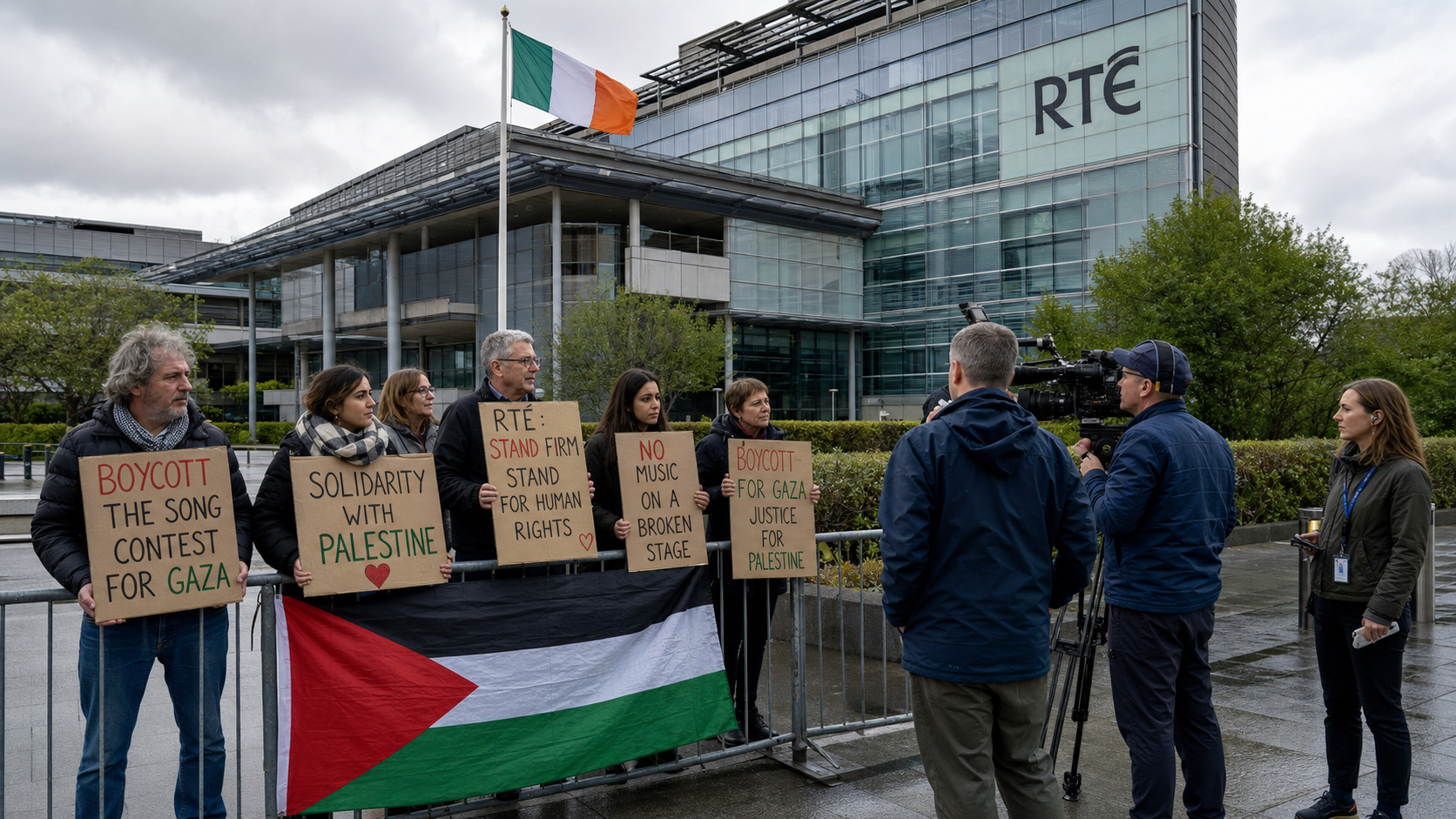
Ireland Among Five Nations Boycotting Eurovision as RTÉ Stands Firm on Gaza Solidarity
Ireland was among five countries that boycotted the 2026 Eurovision Song Contest in Vienna, with RTÉ stating that participation was 'unconscionable' given the ongoing humanitarian crisis in Gaza, as the European Broadcasting Union faced its most serious institutional challenge in the competition's seven-decade history.
Background
The decision by RTÉ and the Irish government to withdraw from Eurovision 2026 was the culmination of a process that began in earnest during the 2025 contest, when allegations of coordinated social media campaigns by the Israeli government to boost their entry generated widespread calls for reform of the competition's voting and participation rules. The EBU, which organises Eurovision, implemented new rules for 2026 including stricter limits on promotional activity and enhanced technical safeguards, but several member broadcasters concluded that these measures were insufficient to address the fundamental issue of Israel's participation while the conflict in Gaza continued.
Ireland has a long and distinguished history with Eurovision, having won the contest seven times — more than any other country — and having hosted the competition on multiple occasions. The decision to withdraw was therefore not taken lightly, and it represented a significant departure from Ireland's traditional approach to the contest. Taoiseach Micheál Martin supported RTÉ's decision, describing it as an act of solidarity with those affected by the conflict in Gaza and consistent with Ireland's long-standing commitment to international humanitarian law.
The five boycotting nations — Ireland, Spain, the Netherlands, Slovenia, and Iceland — represented a significant portion of the EBU's membership, and Spain's withdrawal was particularly consequential given that it is one of the "Big Five" financial contributors to the organisation. The EBU maintained that Eurovision is a non-political event and that its members are broadcasters rather than governments, but the scale of the boycott made it impossible to dismiss the political dimension of the controversy.
Key Developments
RTÉ followed through on its commitment to neither participate in nor broadcast the Eurovision grand final, which took place in Vienna. In place of the contest, RTÉ broadcast an episode of the classic sitcom Father Ted titled "A Song for Europe" — a meta-commentary on Eurovision that drew both praise for its wit and criticism from those who felt the choice was flippant given the seriousness of the underlying issue. The episode's creator, Graham Linehan, was among those who criticised the decision, though his objections were directed at the boycott itself rather than the programming choice.
The 2026 contest in Vienna was not without its own controversies. The EBU issued a formal warning to the Israeli broadcaster KAN after promotional material encouraged viewers to "vote 10 times" for their contestant, a violation of competition rules that reinforced the concerns of those who had argued that Israel's participation was incompatible with the contest's stated values. The contest proceeded without the five boycotting nations, and the result was determined by the votes of the remaining member countries.
The boycott has prompted a broader debate within the EBU about the governance of Eurovision and the criteria for participation. Several member broadcasters that did not join the boycott have nonetheless called for a review of the rules governing the exclusion of countries involved in armed conflicts, and it is expected that the EBU's general assembly will address the issue at its next meeting.
Why It Matters
Ireland's decision to boycott Eurovision 2026 is significant both as a statement of foreign policy values and as a marker of how the country's relationship with the contest has evolved. For decades, Eurovision was a source of national pride and cultural identity in Ireland, and the seven victories between 1970 and 1996 are woven into the fabric of Irish popular culture. The willingness to forgo participation — and the broadcasting revenue and cultural visibility that comes with it — in solidarity with the people of Gaza represents a meaningful expression of Ireland's commitment to humanitarian principles. It also reflects the growing influence of public opinion on Irish foreign policy, with surveys consistently showing strong support among Irish people for a more assertive stance on the conflict in Gaza.
Local Impact
For RTÉ, the boycott decision had practical as well as symbolic consequences. The broadcaster foregoes the audience and advertising revenue associated with Eurovision coverage, which is typically one of the most-watched events of the year. The decision also required RTÉ to develop alternative programming for the grand final evening, a challenge that the Father Ted broadcast addressed with characteristic Irish humour. For Irish Eurovision fans — and there are many, given the country's deep connection to the contest — the boycott was a source of genuine disappointment, even among those who supported the principle behind it. The Irish Eurovision community, which includes dedicated fan clubs and annual viewing parties, found itself in the unusual position of watching the contest through foreign broadcasts rather than RTÉ's coverage.
What's Next
The EBU is expected to conduct a review of the 2026 contest and the boycott in the autumn, with the findings informing the rules for the 2027 competition. RTÉ has indicated that it will assess its position on Eurovision participation for 2027 in light of developments in Gaza and the EBU's response to the concerns raised by the boycotting nations. The Irish government's position, as articulated by the Taoiseach, is that participation in Eurovision should be consistent with Ireland's values and its commitments under international humanitarian law — a standard that will continue to be applied to future decisions about the contest.