INMO Members Vote 99% for Industrial Action as Nurses and Midwives Demand New Pay Deal Ahead of Budget 2027
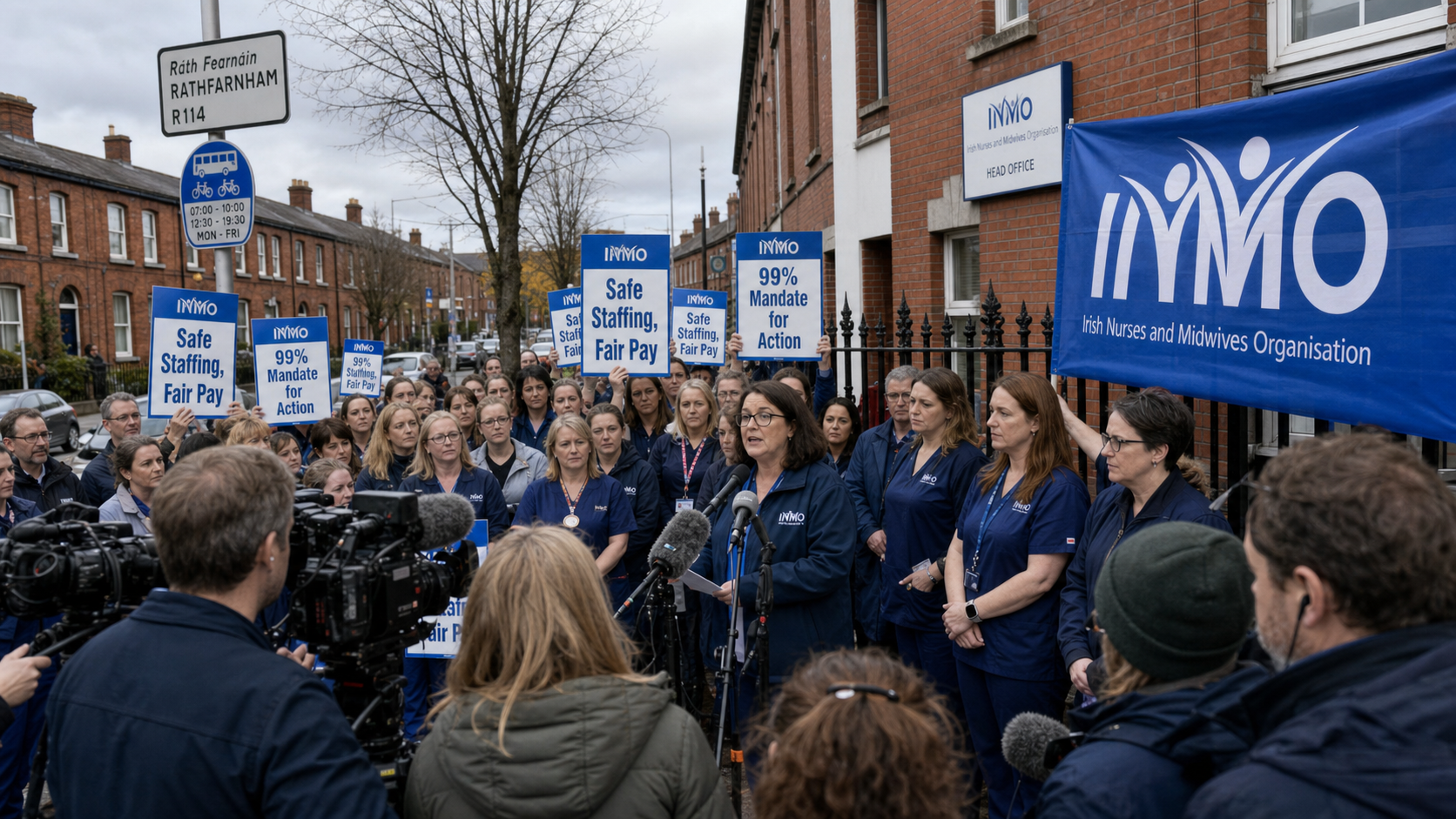
More than 99% of Irish Nurses and Midwives Organisation members have voted in favour of industrial action in a ballot that concluded on Tuesday, delivering a powerful mandate for the union's leadership to pursue a new public sector pay agreement and intensifying pressure on the government as Budget 2027 negotiations enter their critical phase.
Background
The INMO ballot was triggered by the expiry of the previous public sector pay agreement on June 30, 2026, and the subsequent failure to make meaningful progress toward a successor deal. The union represents approximately 45,000 nurses and midwives working across the HSE, voluntary hospitals, and private nursing homes throughout the Republic of Ireland, making it one of the most significant players in the public sector pay landscape.
The INMO has a history of industrial action that has produced significant results. The 2019 nurses' strike, which lasted for several weeks, resulted in a pay agreement that included a new career framework and improved pay scales. However, the union has argued consistently that the gains made in 2019 have been eroded by inflation and that the cost of living pressures facing nurses and midwives — particularly in relation to housing, childcare, and commuting — have made recruitment and retention increasingly difficult.
The broader public sector pay landscape is also relevant. The expiry of the Building Momentum agreement on June 30 has left a significant portion of the public sector workforce without a current pay deal, and the INMO's ballot is part of a wider pattern of industrial unrest that includes ballots by Fórsa, SIPTU, and Unite. The government faces the challenge of negotiating successor agreements with multiple unions simultaneously, against the backdrop of Budget 2027 preparations.
Key Developments
The ballot, which was conducted over six weeks through in-person voting, concluded on September 9 with a 99% vote in favour of industrial action. INMO General Secretary Phil Ní Sheaghdha described morale among members as "extremely low," citing challenging working conditions including understaffing, overcrowding in emergency departments, and the ongoing pressure of managing patient care with insufficient resources.
Ní Sheaghdha highlighted the cost of living pressures facing nurses and midwives as a central issue, noting that rising expenses for housing, childcare, fuel, and commuting were making it increasingly difficult for members to sustain their careers in the health service. She said the union was seeking a "fair and sustainable" pay agreement that reflected the value of nursing and midwifery to Irish society.
Fórsa, the largest public sector union, has separately announced that its members in the health sector will initiate a work-to-rule beginning September 30, involving measures such as refusing to work overtime or cover the duties of colleagues. The combination of INMO industrial action and Fórsa's work-to-rule creates a significant risk of disruption to health services in the autumn.
Minister for Public Expenditure Jack Chambers maintained that industrial action was "unnecessary" and called on unions to return to the negotiating table without preconditions. The Department of Public Expenditure has stated its willingness to engage in "constructive and sustained" negotiations for a successor agreement.
Why It Matters
A 99% vote in favour of industrial action is an extraordinary mandate that reflects the depth of frustration among nurses and midwives. The INMO's membership is not typically given to radical industrial action — the 2019 strike was the first by nurses in Ireland in nearly two decades — and a vote of this magnitude signals that the union's leadership has a genuine mandate to pursue its demands aggressively.
The timing is significant. Budget 2027 is scheduled for October 6, and the government will be acutely aware that a nurses' strike in the weeks before or after the budget would be politically damaging and would focus public attention on the state of the health service at a moment when the government is seeking to present a positive economic narrative. The pressure on Minister Chambers and Health Minister Stephen Donnelly to reach a settlement before industrial action begins is considerable.
The broader public sector pay situation is also a concern. If the INMO proceeds to strike action, it is likely to embolden other unions in their own negotiations, potentially triggering a wider wave of industrial unrest across the public sector in the autumn and winter.
Local Impact
Across the Republic's hospital network — from the Mater and St Vincent's in Dublin to Cork University Hospital, University Hospital Galway, and University Hospital Limerick — the prospect of industrial action has prompted contingency planning by hospital management. Emergency departments, which are already operating under significant pressure, would be particularly affected by any withdrawal of nursing labour.
In the community nursing sector, which provides essential services to older people and those with chronic conditions in their homes, the impact of industrial action would be felt by some of the most vulnerable members of Irish society. The HSE has indicated that it would seek to maintain essential services in the event of a strike, but the definition of "essential" in a nursing context is contested.
What's Next
The INMO's executive council will meet in the coming days to determine the form and timing of industrial action. The union has indicated that it will give the government a period to respond to its demands before announcing specific action dates. The Workplace Relations Commission is expected to be involved in any mediation process. Budget 2027 on October 6 will be a critical moment: if the government announces a pay framework that the INMO considers adequate, industrial action may be averted; if not, strikes could begin before the end of October.