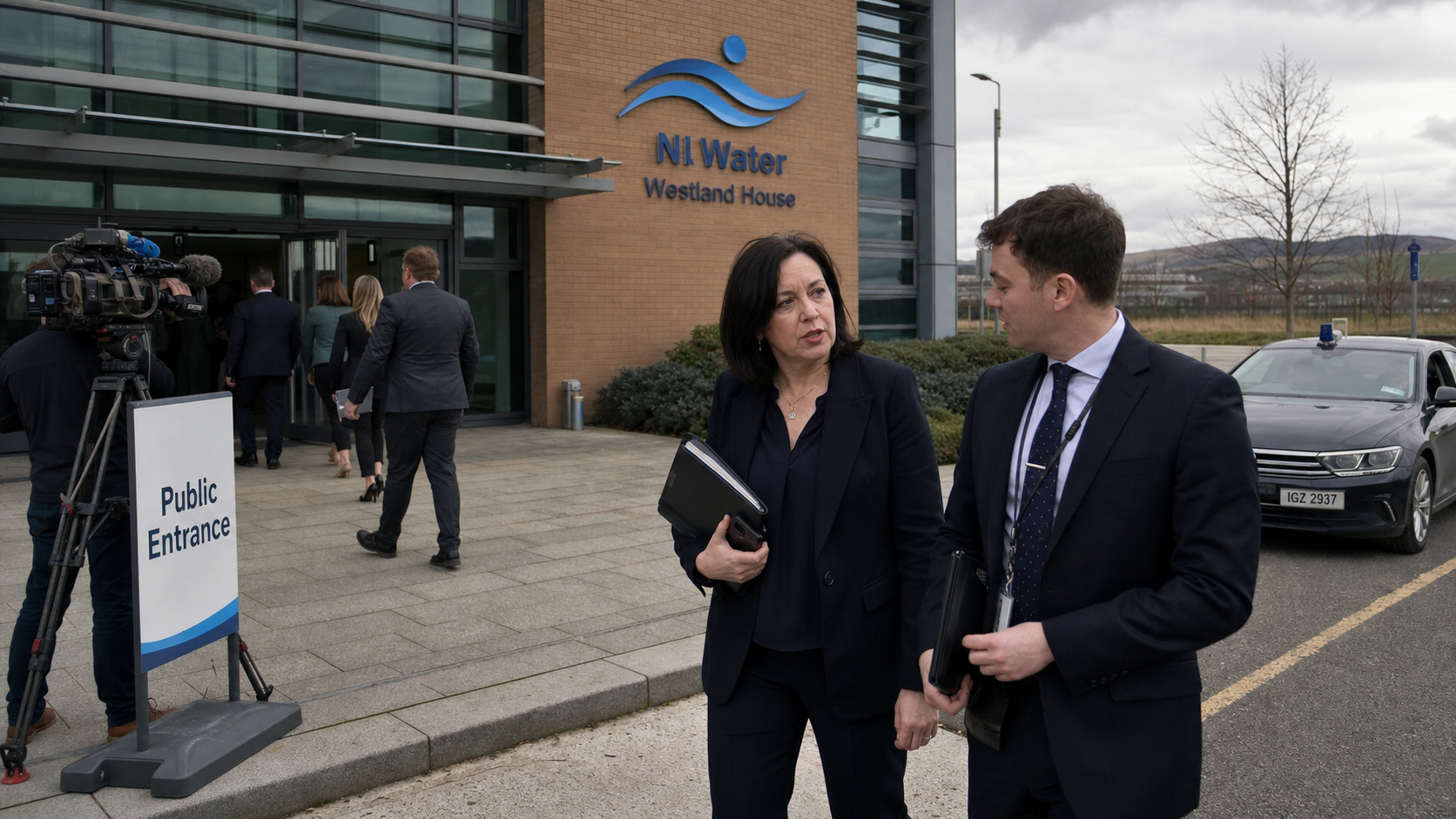
Infrastructure Minister Orders Forensic Audit of NI Water Governance as Scale of Internal Problems Prompts Urgent Intervention
Infrastructure Minister Liz Kimmins has commissioned a forensic audit of NI Water's governance and internal systems, telling the Northern Ireland Assembly that the scale, volume, and severity of ongoing problems within the publicly funded utility have reached a point where direct ministerial intervention is necessary — with the audit to be conducted by NICS Internal Audit Services and its terms of reference currently being finalised.
Background
NI Water is the publicly owned company responsible for providing water and sewerage services to approximately 1.8 million people across Northern Ireland. It receives more than £500 million in annual funding from the Department for Infrastructure — making it one of the largest recipients of public money in the region — and operates critical infrastructure including reservoirs, treatment works, pumping stations, and the wastewater network that underpins housing development and business activity across all six counties.
The organisation has faced a series of difficulties in recent years. Financial management concerns led to an investigation in 2025, and the organisation has been under sustained pressure regarding its wastewater network, which has been identified as a significant constraint on housing development and business expansion in parts of Northern Ireland. Planning authorities in areas including Belfast, Derry, and parts of Antrim and Down have been unable to approve new developments because the existing wastewater infrastructure cannot accommodate additional connections — a problem that has contributed to the housing supply crisis in the region.
Internal investigations into various aspects of NI Water's operations have been ongoing, and the organisation has been required to produce action plans in response to previous findings. However, concerns have grown within the Department for Infrastructure and among Assembly members about the pace and rigour of these internal processes, and about whether the organisation's governance structures are adequate to address the problems it faces.
Key Developments
Minister Kimmins informed the Assembly of her decision through an urgent written statement on 4 September 2026. She cited the "scale, volume and severity" of ongoing issues within NI Water as the primary justification for commissioning the forensic audit, noting that some of these issues had already been the subject of internal investigations that had required the creation of action plans — suggesting a pattern of recurring problems rather than isolated incidents.
The audit will be conducted by NICS Internal Audit Services, the internal audit function of the Northern Ireland Civil Service. The terms of reference are being finalised and will be published once agreed. The Minister emphasised that the audit is intended to assess whether NI Water's internal systems, processes, and checks and balances are functioning correctly, robust, and effective — a formulation that suggests the investigation will look at structural and systemic issues rather than individual incidents.
The announcement drew immediate support from SDLP MLA Patsy McGlone, who described the intervention as "long overdue" and called for the audit to be rigorous and capable of establishing clear accountability. McGlone warned against the investigation becoming a "toothless tiger" and called for its findings to be acted upon decisively. Other Assembly members across the party divide have also welcomed the announcement, reflecting the cross-party concern about NI Water's performance.
Why It Matters
The forensic audit of NI Water matters for several reasons that go beyond the immediate governance concerns. The organisation's wastewater capacity constraints have become one of the most significant practical obstacles to housing development in Northern Ireland, at a time when the region faces a severe housing shortage. Until NI Water can demonstrate that it has the governance and operational capacity to plan and deliver infrastructure improvements effectively, the housing crisis will be difficult to address.
The scale of public funding involved — over £500 million per year — also makes accountability essential. Unlike water utilities in England, which are privately owned and regulated by Ofwat, NI Water is a government-owned company, meaning that its failures are ultimately failures of public administration. The Assembly has a direct responsibility to ensure that this money is being managed effectively and that the organisation is delivering value for the people of Northern Ireland.
For context, the Republic of Ireland's equivalent utility, Uisce Éireann, has faced similar governance and capacity challenges since its establishment in 2014, and the comparison is instructive: both utilities have struggled with the legacy of decades of underinvestment in water infrastructure, and both have faced political pressure to demonstrate that they can manage large-scale capital programmes effectively.
Local Impact
The practical consequences of NI Water's difficulties are felt across Northern Ireland. In Belfast, planning applications for new housing developments in areas including north Belfast, east Belfast, and parts of south Belfast have been delayed or refused because the wastewater network cannot accommodate additional connections. Similar problems affect Derry, Newry, Antrim, and parts of Fermanagh and Tyrone. The audit's findings will be closely watched by local councils, housing associations, and developers who are waiting for clarity on when and how these constraints will be addressed.
Translink, which operates bus and rail services across Northern Ireland, has also been affected by NI Water's infrastructure limitations in some depot and maintenance facility planning applications. The broader economic impact of the wastewater constraint — which affects not just housing but commercial and industrial development — is significant and growing.
What's Next
The terms of reference for the forensic audit will be published once finalised, and the audit itself is expected to take several months to complete. The Minister has indicated that the findings will be shared with the Assembly and acted upon. NI Water's board and senior management will be expected to cooperate fully with the audit process. Assembly members have indicated they will seek a debate on the findings once they are published, and the Infrastructure Committee is expected to take evidence from both the Minister and NI Water's leadership in the coming weeks.