IFAC Warns of Sizeable Budget Overruns as Taoiseach Urges Caution Despite €60 Billion Tax Take
The Irish Fiscal Advisory Council has issued a stark warning about "sizeable" budgetary overruns as exchequer data for the first seven months of 2026 reveals government spending rising 7.4% to €65 billion — even as income tax receipts surged 12.7% in July and the overall tax take reached €60 billion, prompting Taoiseach Simon Harris to urge caution ahead of Budget 2027 despite the headline strength of the public finances.
Background
Ireland's public finances have been in a remarkable position for the past several years, driven by a combination of strong employment growth, rising wages, and the extraordinary contribution of multinational corporations to the corporate tax base. The implementation of the OECD's global minimum corporate tax rate of 15% has, contrary to some predictions, not significantly reduced Ireland's attractiveness as a location for foreign direct investment, and the additional revenue generated by the new rate — approximately €1 billion in extra payments from multinationals in July alone — has added further strength to the exchequer position.
The Irish Fiscal Advisory Council (IFAC) is the independent body responsible for assessing the government's fiscal plans and providing an objective assessment of the state of the public finances. Established in the aftermath of the financial crisis, IFAC has consistently played an important role in providing a counterweight to the natural tendency of governments to present their fiscal position in the most favourable possible light. Its warnings about budgetary overruns carry significant weight, both domestically and in the context of Ireland's obligations under EU fiscal rules.
The tension between strong revenue performance and rising expenditure is not new in Irish fiscal policy. The government has faced persistent criticism from IFAC and others for allowing spending to grow at a pace that exceeds what can be sustained in the medium term, particularly given the concentration of corporate tax receipts in a small number of large multinational companies whose future tax payments cannot be guaranteed.
Key Developments
Exchequer data published this week shows that government spending in the first seven months of 2026 reached €65 billion, a 7.4% increase on the same period in 2025. The increase reflects higher spending across a range of departments, including health, housing, and social protection, as well as the ongoing costs of capital investment programmes in infrastructure and education.
On the revenue side, the picture is considerably more positive. Income tax receipts in July rose 12.7% compared to July 2025, reflecting the continued strength of the labour market and rising wages. The overall tax take for the first seven months of the year reached €60 billion, a figure that would have seemed extraordinary just a few years ago. The new 15% corporate tax rate contributed an additional €1 billion in multinational payments in July, providing a further boost to the exchequer.
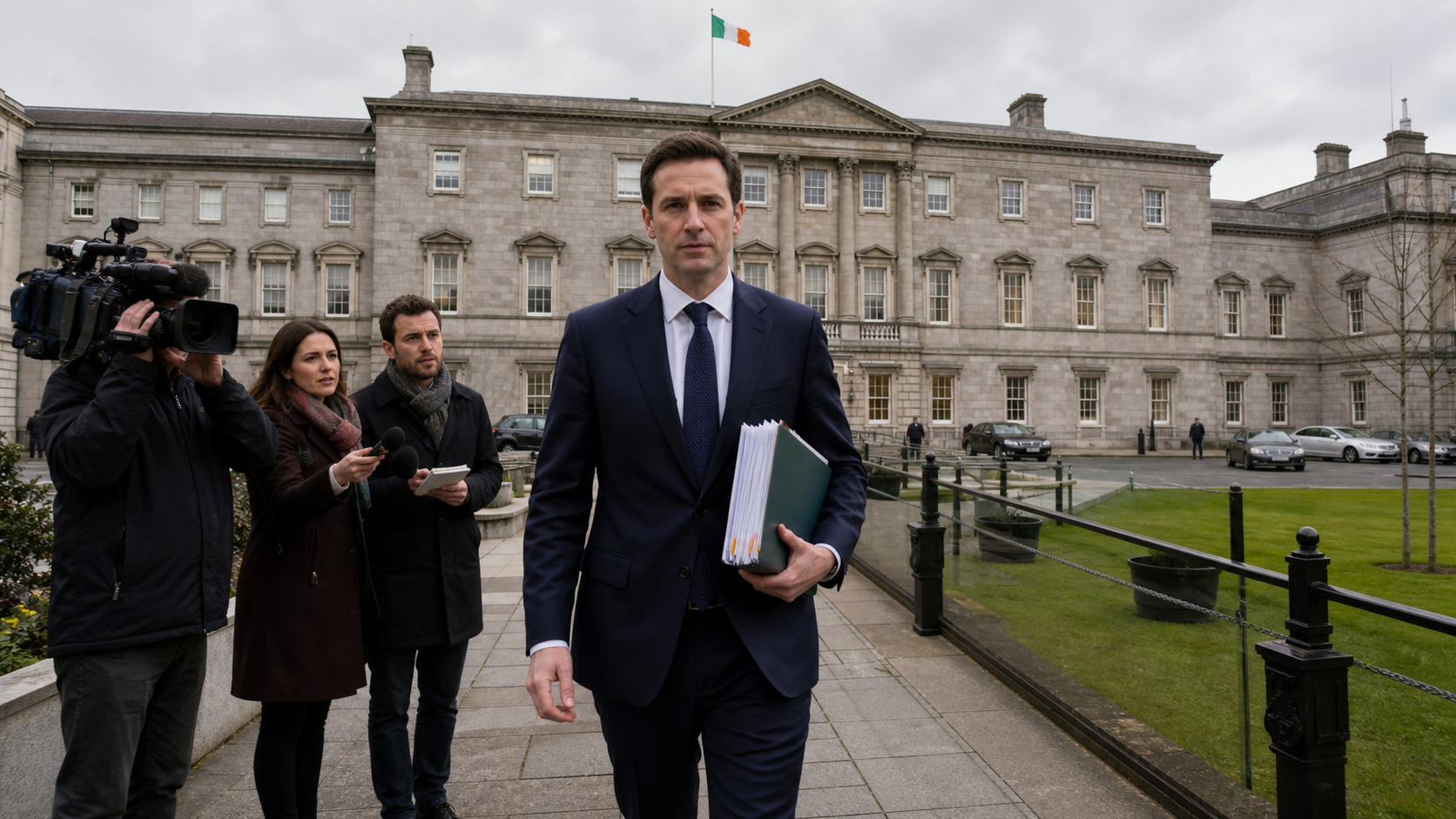
Taoiseach Simon Harris, speaking on Friday, acknowledged the strength of the revenue figures but urged caution about drawing premature conclusions. "We have strong public finances, and that is something to be proud of," he said. "But we also have significant obligations — to invest in housing, in health, in infrastructure — and we need to ensure that our spending plans are sustainable over the medium term. Budget 2027 will be approached with that discipline in mind."
Why It Matters
The IFAC warning about budgetary overruns is significant because it comes at a moment when the political pressure to increase spending is intense. Housing remains the dominant domestic political issue, with the government under sustained pressure to accelerate the delivery of social and affordable homes. Health spending continues to rise as the population ages and demand for services grows. And the costs of Ireland's EU Presidency, which runs until the end of 2026, are adding further pressure to the exchequer. The risk identified by IFAC is not that Ireland is in immediate fiscal difficulty — the public finances are, by any objective measure, in good shape — but that the pace of spending growth is creating structural commitments that will be difficult to unwind if revenue performance deteriorates. Ireland's dependence on a small number of large multinational companies for a disproportionate share of its corporate tax receipts remains a significant vulnerability, and IFAC has consistently warned that this concentration of risk should inform a more cautious approach to spending commitments.
Local Impact
The fiscal debate has direct implications for public services across Ireland. In Dublin, where housing costs are highest and demand for public services most acute, the government's spending decisions will determine the pace at which new social housing is delivered, the speed at which hospital waiting lists are reduced, and the quality of public transport and other infrastructure. In rural Ireland, the allocation of capital investment between urban and regional priorities is a perennial source of tension, with communities in the west and northwest arguing that they have historically received a disproportionately small share of public investment. The Budget 2027 process, which will begin in earnest in September, will be the arena in which these competing demands are adjudicated.
What's Next
Budget 2027 is scheduled to be presented to the Dáil in October 2026. The Department of Finance will publish its summer economic statement in the coming weeks, setting out the fiscal parameters within which the budget will be framed. IFAC is expected to publish its pre-budget assessment in September, providing an independent evaluation of the government's fiscal plans. The Taoiseach has indicated that the government will engage in a series of pre-budget consultations with stakeholders across the public and private sectors before finalising its plans.