HSE to Close Dublin CAMHS Unit Despite National Bed Shortage as Nurses' Union Condemns Decision
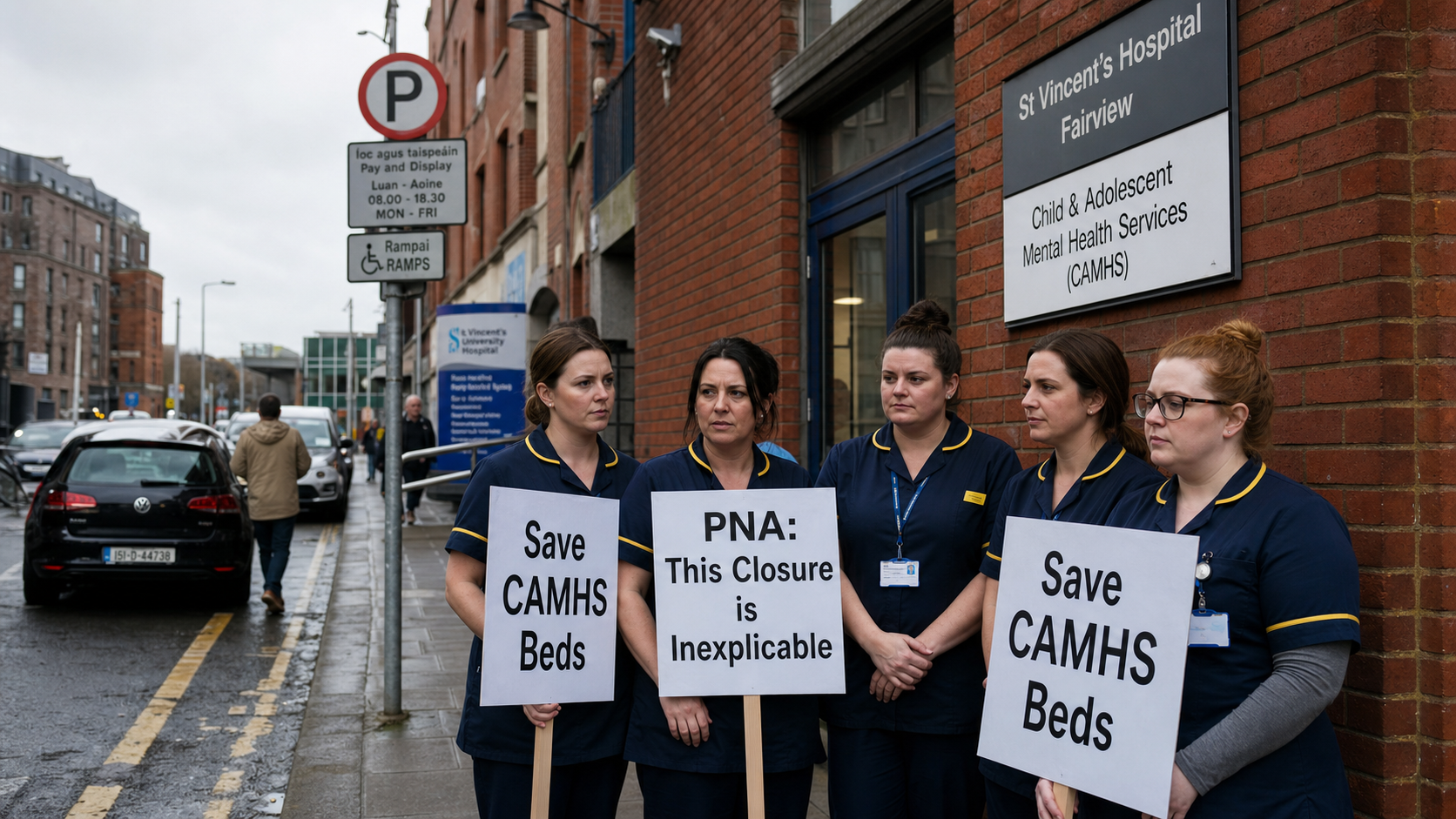
The Health Service Executive has confirmed it will close a 10-bed Child and Adolescent Mental Health Services inpatient unit at St Vincent's Hospital in Fairview, north Dublin, in the third quarter of 2026 — a decision that the Psychiatric Nurses' Association has condemned as "inexplicable" given the severe national shortage of CAMHS beds and the fact that the unit is reportedly operating with near-full staffing levels.
Background
Child and Adolescent Mental Health Services in Ireland have been in a state of chronic underdevelopment for decades. The number of inpatient beds available for young people experiencing acute mental health crises is among the lowest per capita in Western Europe, a situation that has been documented in successive reports by the Mental Health Commission, the Ombudsman for Children, and various Oireachtas committees. The consequences are severe: young people in acute mental health crisis are regularly admitted to adult psychiatric wards — a practice that is internationally recognised as harmful and that Ireland has repeatedly committed to ending — or are left without appropriate care altogether.
The St Vincent's Hospital unit in Fairview has been part of the CAMHS inpatient network for a number of years, providing a small but significant number of beds for young people from the Dublin area and beyond. The unit's location in north Dublin, close to the Mater Hospital and within the catchment area of the Dublin North City and County Community Healthcare Organisation, has made it an important resource for families in the north city and county who would otherwise face long journeys to access inpatient care.
The HSE's decision to close the unit comes against a backdrop of significant change in the CAMHS inpatient landscape. The new National Children's Hospital, currently under construction at St James's Hospital in Dublin, will include a dedicated CAMHS inpatient unit when it opens. The HSE has also been developing the Linn Dara CAMHS facility in Cherry Orchard, west Dublin, as a specialist centre for child and adolescent mental health. The closure of the Fairview unit is being presented as part of a rationalisation of services in advance of these new facilities becoming operational.
Key Developments
The HSE confirmed the closure plan on 30 June, stating that staff from the Fairview unit would be redeployed to Linn Dara and to the National Children's Hospital when it opens. The health executive argued that the consolidation of CAMHS inpatient services in purpose-built specialist facilities would ultimately improve the quality of care available to young people.
The Psychiatric Nurses' Association rejected this framing in strong terms. The union described the decision as "inexplicable," noting that the unit is almost fully staffed — a rarity in a sector that has been plagued by recruitment and retention difficulties — and that closing a functioning, staffed unit while the replacement facilities are not yet operational will create a gap in provision that will directly harm vulnerable young people.
The PNA's concerns are shared by a number of child mental health advocates and clinicians who have spoken privately about the risks of the closure. The transition period — between the closure of the Fairview unit and the opening of the new facilities — is likely to last at least 12 to 18 months, during which the already-stretched CAMHS inpatient network will have 10 fewer beds available. Given that the waiting list for CAMHS inpatient admission is already significant, the removal of these beds will inevitably result in some young people not receiving the care they need.
Why It Matters
The closure of the Fairview CAMHS unit is a decision that will be felt most acutely by the most vulnerable young people in Irish society. Children and adolescents who require inpatient mental health care are, by definition, in acute crisis — they are at risk of self-harm, suicide, or severe deterioration in their mental health. The availability of an inpatient bed at the right time can be the difference between a young person receiving the intensive support they need and a family being told that no bed is available.
Ireland's CAMHS inpatient capacity is already critically low. The Mental Health Commission's most recent annual report identified a significant shortfall in the number of beds relative to the population of young people with mental health needs. The closure of 10 beds in Fairview, even temporarily, will worsen this situation. The HSE's assurance that staff will be redeployed to other facilities does not address the immediate reduction in bed capacity.
The comparison with Northern Ireland is instructive. The NI mental health strategy, launched in 2021, has been largely shelved due to lack of funding, with 80% of its planned actions paused indefinitely. Both health systems on the island are failing to meet the mental health needs of their youngest and most vulnerable citizens, a failure that will have long-term consequences for individual wellbeing and for the broader social fabric.
Local Impact
For families in north Dublin — in areas like Drumcondra, Glasnevin, Finglas, Ballymun, and Swords — the closure of the Fairview unit will mean longer journeys to access CAMHS inpatient care, at a time when their children are in acute crisis. The nearest alternative facilities — Linn Dara in Cherry Orchard and the existing unit at St Joseph's in Portlaoise — are significantly further from north Dublin, creating practical barriers for families who may not have access to private transport. The impact on families in north County Dublin, including Swords, Malahide, and Balbriggan, will be particularly acute.
What's Next
The HSE has indicated that the closure will proceed as planned in the third quarter of 2026, subject to the completion of the redeployment process for staff. The Psychiatric Nurses' Association has indicated it will pursue the matter through the industrial relations machinery and has not ruled out taking further action if the closure proceeds without adequate alternative provision being in place. The issue is expected to be raised in the Dáil, where TDs from Dublin constituencies have already expressed concern. The Mental Health Commission has been asked to monitor the impact of the closure on CAMHS inpatient capacity and to report to the Minister for Health.