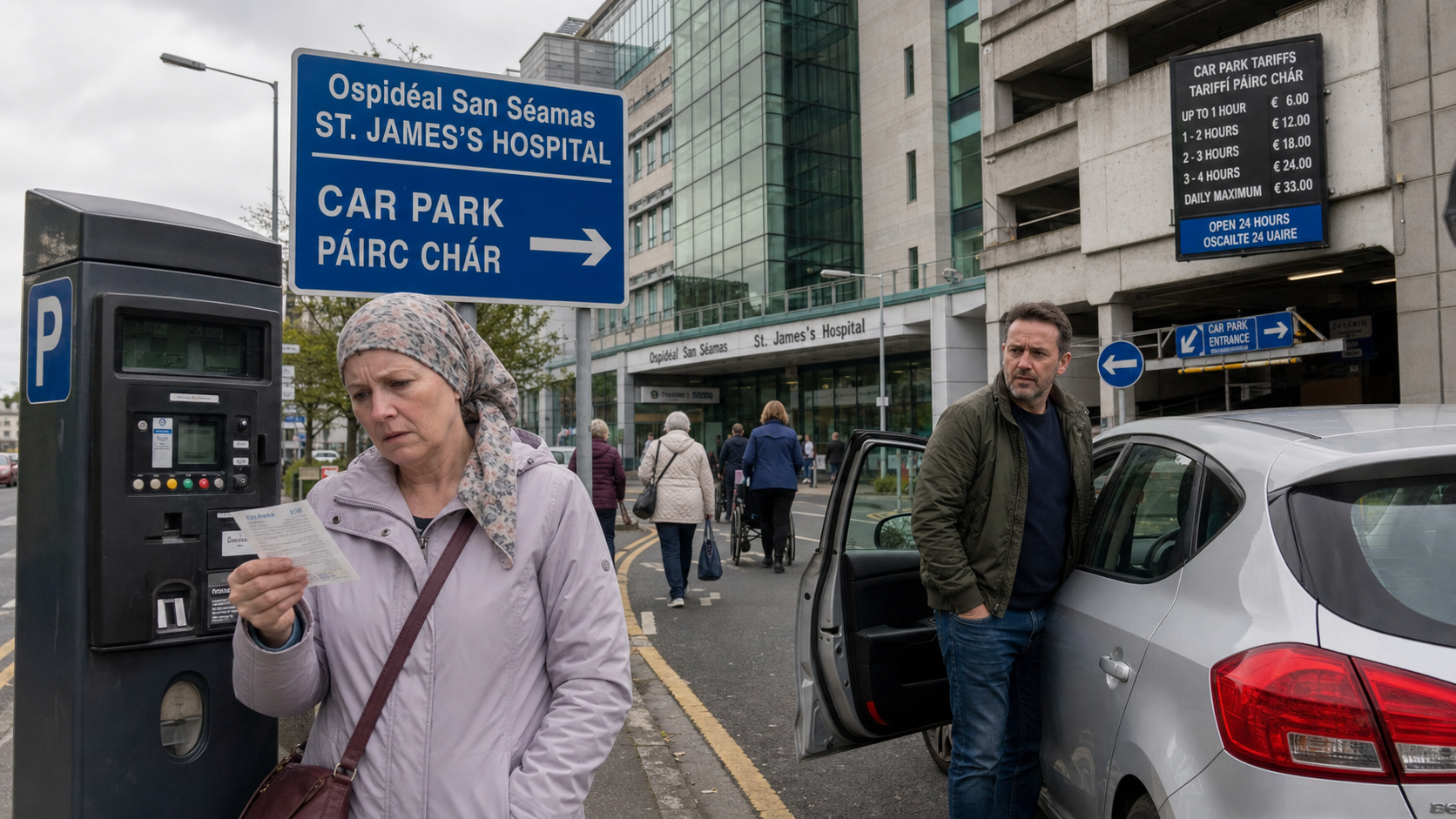
Hospital Parking Fees Double in Four Years as Cancer Patients Pay Up to €300 a Month
Revenue from car parking charges at public and voluntary hospitals in Ireland reached a record €17.76 million in 2025, a 140% increase on the €7.39 million collected in 2021, with the Irish Cancer Society calling for the immediate abolition of fees for cancer patients who can pay up to €300 per month while accessing life-saving treatment. Since the beginning of 2020, a total of €73.5 million has been collected through hospital parking charges, a figure that patient advocacy groups describe as a scandal.
Background
Hospital parking charges in Ireland have been a source of controversy for many years, but the scale of the revenue now being generated has brought the issue to a new level of political urgency. The charges vary significantly between hospitals and between health regions, with some facilities operating flat-rate daily fees and others using time-based tariffs that can accumulate rapidly for patients attending lengthy outpatient appointments or visiting relatives in long-term care.
The HSE attributes the increase in parking revenue primarily to the return of normal hospital activity following the Covid-19 pandemic, during which many hospitals reduced or waived parking charges as part of their emergency response. The post-pandemic recovery in patient volumes, combined with increased demand for parking services as the health system processes its accumulated waiting lists, has driven revenue to record levels.
The Programme for Government, agreed between Fine Gael, Fianna Fáil, and the Green Party in 2025, includes a commitment to explore ways to reduce hospital parking charges, particularly for patients with long-term conditions who attend hospital frequently. However, no specific timeline or mechanism for delivering on that commitment has been announced, and patient groups have grown increasingly frustrated with what they describe as a lack of urgency.
Key Developments
The figures, published by RTÉ News on Tuesday, reveal that the €17.76 million collected in 2025 represents the highest annual total since the HSE began tracking parking revenue. The total collected since 2020 — €73.5 million — is a figure that has prompted sharp criticism from opposition politicians and patient advocates alike.
The Irish Cancer Society has been particularly vocal, noting that cancer patients attending for chemotherapy, radiotherapy, or other treatments can face parking costs of up to €300 per month — a significant additional burden for people who are already dealing with the financial consequences of a serious illness, including reduced working hours, increased medication costs, and the expense of travelling to specialist centres that may be far from their homes.
The HSE has acknowledged that the system is "unfair and inconsistent" and has indicated that it is engaging with the Department of Health to identify opportunities to ease the financial burden on patients. However, the agency has also noted that parking revenue contributes to the operational costs of hospital facilities and that any reduction in charges would need to be offset by alternative funding.
The political response has been predictably critical. Several opposition TDs have called for an immediate cap on hospital parking charges, with some arguing that parking should be free for all patients attending for medical treatment. The Department of Health has not indicated when it expects to bring forward proposals.
Why It Matters
The hospital parking issue is a microcosm of a broader tension in Irish healthcare: the gap between the aspiration to provide universal, equitable access to health services and the reality of a system that continues to impose significant out-of-pocket costs on patients at every stage of their care. The €300 monthly parking bill faced by some cancer patients is not an isolated anomaly — it sits alongside prescription charges, consultant fees, and the cost of private health insurance in a landscape where the financial burden of illness falls disproportionately on those least able to bear it.
For context, the Republic's approach to hospital parking contrasts sharply with that of NHS hospitals in Northern Ireland, where parking charges are also a source of controversy but where the political pressure to address the issue has historically been more intense. The HSE's six-region restructuring, which was intended to improve consistency in service delivery, has not yet produced a uniform approach to parking charges, with significant variation persisting between hospitals in different regions.
Local Impact
The impact of hospital parking charges is felt most acutely by patients attending the major acute hospitals in Dublin — St James's, the Mater, Beaumont, and Tallaght — where parking costs are highest and where the concentration of specialist services means that patients travel from across the country. Patients from rural areas, who may have no alternative to driving to hospital, are particularly affected. In Cork, the Mercy University Hospital and Cork University Hospital are among the facilities where parking revenue has grown significantly in recent years. The HSE's South/South West region has indicated that it is reviewing its parking tariff structure, but no changes have been announced.
What's Next
The Department of Health is expected to publish a review of hospital parking charges before the end of 2026, as part of its commitment under the Programme for Government. The Irish Cancer Society has called for the review to include a specific recommendation on free parking for cancer patients, and has indicated that it will maintain public pressure on the issue until a concrete commitment is made. Budget 2027, due in October, is seen as a potential vehicle for announcing a reduction in charges, though the Department of Finance has not indicated whether this is under active consideration.