Hosepipe Ban Extended Until End of September for 13 Counties as Drought Conditions Persist
Uisce Éireann has extended the hosepipe ban until the end of September for 13 counties — including Dublin, Cork, Limerick, Kildare, and Waterford — while lifting restrictions in the remaining 13 counties from Wednesday, 26 August, as the national water utility responds to continued pressure on water sources in the east and south of the country following a prolonged period of hot, dry weather.
Background
Ireland's summer of 2026 has been defined, in meteorological terms, by an extended period of high pressure that has brought above-average temperatures and significantly below-average rainfall to much of the country since late June. The Irish Meteorological Service has recorded rainfall deficits of between 40% and 60% across the east and south of the country over the three-month period, with some weather stations in Dublin, Kildare, and Wexford recording their driest summer since records began in the 1940s.
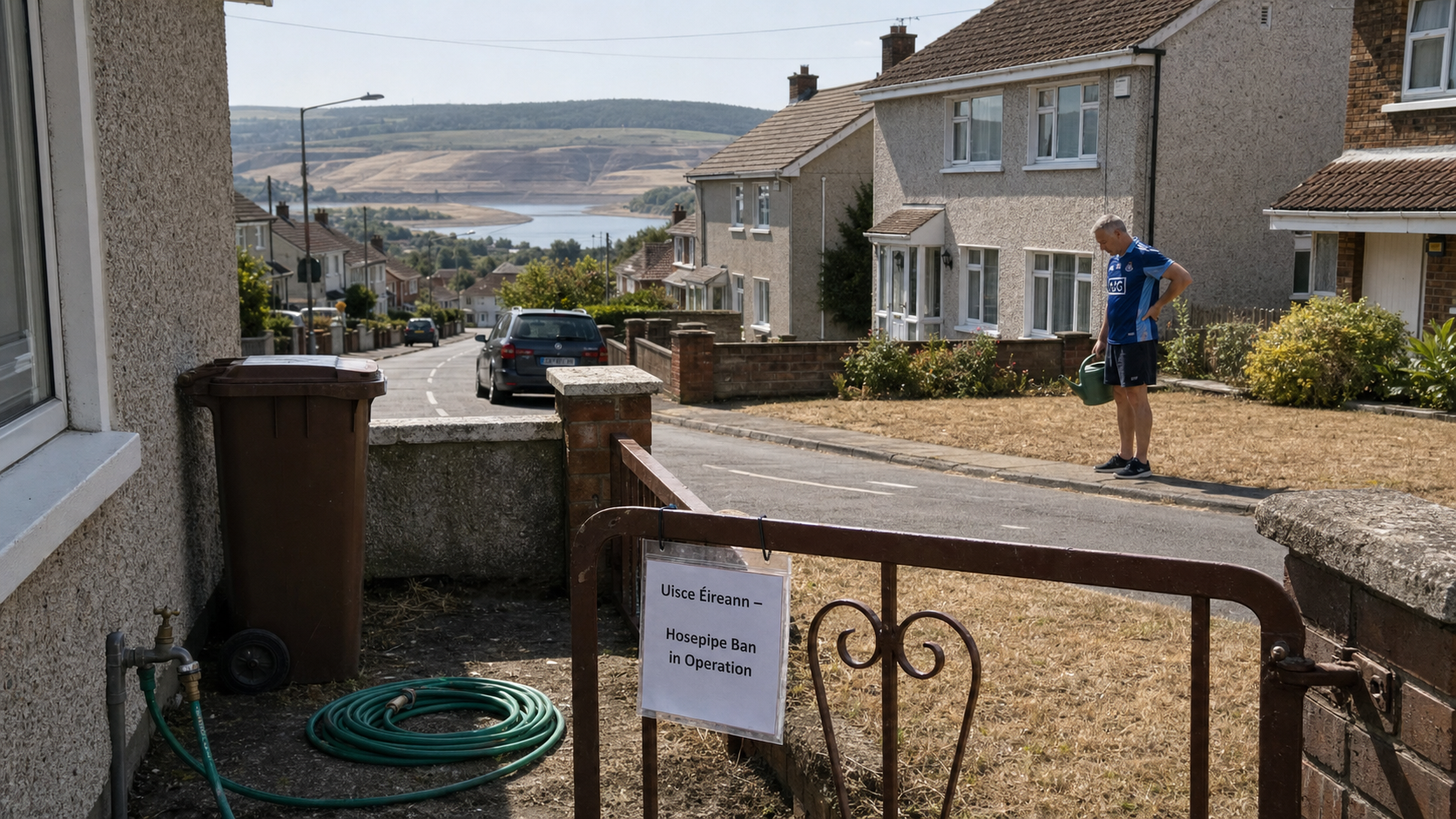
Uisce Éireann, the national water utility, issued a nationwide Water Conservation Order in late July as reservoir levels and groundwater sources came under increasing pressure. The order prohibited the use of hosepipes for a range of domestic activities, including watering gardens, washing private motor vehicles, filling paddling pools and ornamental ponds, and cleaning hard surfaces. The restrictions applied to all 26 counties of the Republic and were accompanied by a public awareness campaign urging households and businesses to reduce water consumption.
The response from the public was broadly positive, with Uisce Éireann reporting a measurable reduction in demand in the weeks following the introduction of the order. However, the utility noted that the recovery of water sources in the east and south of the country was proceeding more slowly than in the west and north, where recent rainfall had provided some relief to reservoirs and groundwater levels.
Key Developments
On 24 August, Uisce Éireann announced the outcome of its review of the Water Conservation Order ahead of its scheduled expiry on 26 August. The utility confirmed that the ban would be lifted in 13 counties — Cavan, Clare, Donegal, Galway, Kerry, Leitrim, Longford, Louth, Mayo, Monaghan, Roscommon, Sligo, and Westmeath — where water sources had recovered sufficiently to allow the restrictions to be removed.
For the remaining 13 counties — Carlow, Cork, Dublin, Kildare, Kilkenny, Laois, Limerick, Meath, Offaly, Tipperary, Waterford, Wexford, and Wicklow — the ban has been extended until the end of September. Uisce Éireann cited the continued pressure on water sources in these counties, particularly the Vartry Reservoir in County Wicklow, which supplies a significant portion of Dublin's water, and the Lee Road Water Treatment Plant in Cork, which has been operating at reduced capacity due to low river levels.
The utility emphasised that the extension was a precautionary measure and that it would continue to monitor water source levels throughout September, with the possibility of an earlier lifting of restrictions if conditions improve significantly. Households in the 13 affected counties are reminded that breaching the Water Conservation Order carries a fixed penalty of €125.
Why It Matters
The extension of the hosepipe ban to the end of September is a significant development that reflects the structural vulnerability of Ireland's water infrastructure to prolonged dry weather. Ireland is not typically associated with water scarcity — its reputation as a wet, green island is well founded in the long-term climate record — but the summer of 2026 has demonstrated that even a relatively modest deviation from normal rainfall patterns can place the water supply system under serious stress.
The concentration of the extended ban in the east and south of the country reflects the geography of Ireland's water infrastructure. The greater Dublin area, which is home to approximately 1.4 million people, relies heavily on a small number of large reservoirs and river abstraction points that are particularly sensitive to rainfall deficits. The Vartry Reservoir, which was built in the 1860s and has been a cornerstone of Dublin's water supply ever since, has been operating at below 50% capacity for much of the summer — a level that triggers conservation measures under Uisce Éireann's operational protocols.
Climate scientists have warned that summers like 2026 are likely to become more frequent as global temperatures continue to rise, and that Ireland's water infrastructure will need significant investment to cope with the increased variability in rainfall patterns that climate change is expected to bring. The current hosepipe ban is a short-term response to an immediate problem; the longer-term challenge is to build a water system that is resilient to the conditions that are becoming the new normal.
Local Impact
For households in Dublin, Cork, Limerick, and the other 10 counties where the ban has been extended, the restrictions will remain in place for a further five weeks. Gardeners, car owners, and those with swimming pools or water features will need to continue to observe the limitations on hosepipe use. Uisce Éireann has urged households to report any leaks or wastage they observe, noting that leakage from the public network remains a significant source of water loss. In Dublin, the utility estimates that approximately 30% of treated water is lost to leakage before it reaches customers — a figure that underscores the scale of the infrastructure investment required to address the city's water challenges.
What's Next
Uisce Éireann will conduct a further review of water source levels in mid-September to assess whether the ban can be lifted earlier than the end of the month in any of the 13 affected counties. The utility has indicated that it will provide an update to the public at that point. Met Éireann's seasonal forecast for September suggests a return to more typical rainfall patterns for the time of year, which would assist the recovery of water sources. However, the utility has cautioned that even a return to normal rainfall will take several weeks to translate into meaningful improvements in reservoir levels.