History Made at London Marathon as Sabastian Sawe Becomes First to Break Two-Hour Barrier
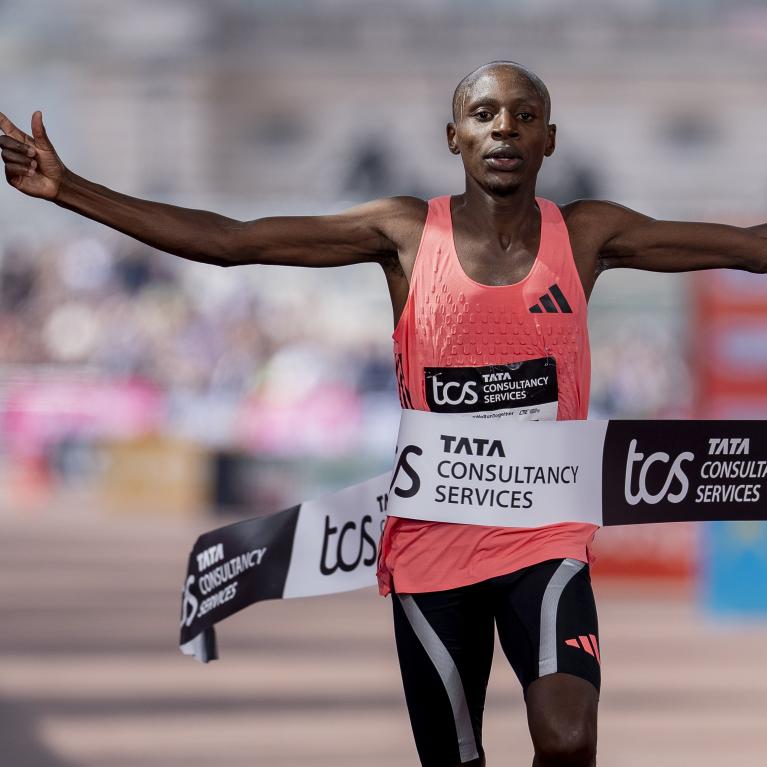
In one of the most extraordinary moments in the history of athletics, Kenyan runner Sabastian Sawe crossed the finish line of the 2026 London Marathon in 1 hour, 59 minutes and 30 seconds on Sunday 26 April, becoming the first person to officially break the two-hour barrier in a competitive race and rewriting the boundaries of human endurance in front of a global audience.Background
The two-hour marathon has been athletics' equivalent of the four-minute mile — a barrier that seemed to define the limits of human physical capability, a target that the world's greatest runners have been chasing for decades. When Roger Bannister broke the four-minute mile in Oxford in 1954, it was considered by many to be physiologically impossible. Within a year, the barrier had been broken again. The sub-two-hour marathon has occupied a similar place in the sporting imagination: a goal that seemed tantalizingly close yet perpetually out of reach.
The previous official men's world record of 2:00:35 was set by the late Kelvin Kiptum at the 2023 Chicago Marathon — a performance that itself seemed to push the boundaries of what was possible. Eliud Kipchoge, widely regarded as the greatest marathon runner in history, had run 1:59:40 in Vienna in 2019, but that performance was achieved under specially controlled conditions — with pacemakers, a flat course, and other optimisations — and was not eligible for official record purposes. The question of whether the barrier could be broken in a genuine competitive race, under standard conditions, remained open.
Sabastian Sawe, 31, from a remote village in Kenya, had been identified as one of the most promising marathon talents of his generation. Encouraged by a teacher who recognised his potential, he had developed into a world-class performer with a reputation for exceptional late-race strength. His preparation for the 2026 London Marathon was meticulous, and his sponsor, Adidas, had invested in enhanced testing arrangements to ensure the integrity of his performance.
Key Developments
Sawe's performance on 26 April 2026 was a masterclass in pacing and execution. He passed the halfway mark in 60 minutes and 29 seconds before accelerating to complete the second half in a blistering 59 minutes and 1 second — a negative split that demonstrated extraordinary physical and mental discipline. His decisive move came late in the race, with a 5km split of 13 minutes 42 seconds between the 35km and 40km marks — a pace two seconds faster than the parkrun world record. He wore a new, lightweight model of the Adidas Adios Pro 3 "supershoes," reportedly weighing only 97 grams.
The 2026 London Marathon was historic not just for Sawe's achievement but for the extraordinary depth of performance it produced. Ethiopia's Yomif Kejelcha finished second in his marathon debut with a time of 1:59:41 — also breaking the two-hour mark. Uganda's Jacob Kiplimo, the half marathon world record holder, placed third in 2:00:28. Three athletes finishing under the previous world record in a single race is without precedent in marathon history. In the women's race, Ethiopia's Tigst Assefa defended her title with a new women's-only world record of 2:15:41.
Why It Matters
Sawe's achievement has been compared to Bannister's sub-four-minute mile, and the comparison is apt. Like Bannister's run, it demonstrates that barriers which seem absolute are often psychological as much as physiological. The fact that three athletes broke the previous world record on the same day suggests that the two-hour barrier was not a hard physiological limit but a performance frontier that the sport was approaching from multiple directions simultaneously. For athletics, the achievement opens a new chapter: the question is no longer whether the two-hour barrier can be broken, but how much faster the marathon can go. For London, the achievement cements the city's status as the home of the world's greatest marathon — a race that has now produced the most historic performance in the event's history. The London Marathon's combination of a fast course, world-class organisation, and the energy of hundreds of thousands of spectators creates conditions that are uniquely conducive to record-breaking performances.
Local Impact
For the tens of thousands of runners who participated in the 2026 London Marathon — including thousands from across the UK and Ireland — the experience of running the same course on the same day as Sawe's historic performance will be something they carry with them for the rest of their lives. The London Marathon is one of the most popular mass participation events in the world, with over 50,000 runners completing the course each year, and the community of runners who share the experience creates bonds that transcend national boundaries. For Irish runners in particular — many of whom travel to London specifically for the marathon — the event has a special significance. The marathon also raised millions of pounds for charity, with runners from across the UK and Ireland fundraising for causes ranging from cancer research to mental health support. The Belfast City Marathon, taking place on 3 May, will undoubtedly be inspired by the events in London.
What's Next
Sawe's achievement will now be submitted to World Athletics for ratification as the new official world record. The ratification process involves verification of the course measurement, timing systems, and anti-doping procedures, and is expected to be completed within weeks. The achievement will also trigger a reassessment of marathon training methods and performance targets across the sport, as coaches and athletes absorb the implications of what has been achieved. Watch for the World Athletics ratification announcement and the reaction from the global athletics community, which will provide the definitive confirmation of Sawe's place in sporting history.
Sources: The Guardian — Sawe London Marathon, 26 April 2026; BBC Sport — London Marathon 2026 results