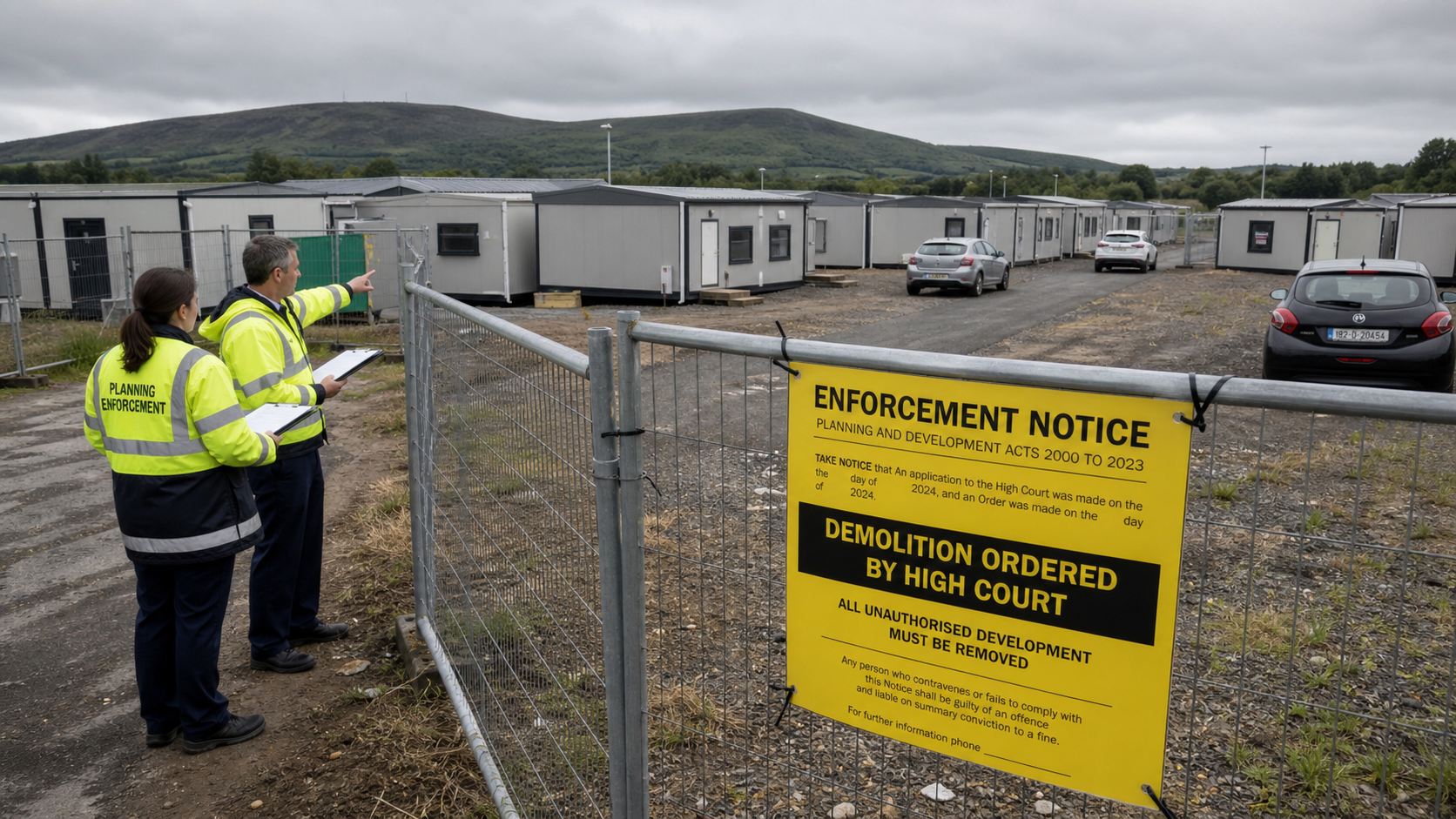
High Court Orders Demolition of 29 Illegal Modular Homes Near Dublin-Wicklow Border in 'Egregious' Planning Case
The High Court has ordered the demolition of 29 modular homes at Chianti Park, Raheen, near the Dublin-Wicklow border, after Mr Justice Richard Humphreys rejected developers' arguments that the structures were exempt from planning permission, describing the case as "egregious" and criticising the "unbelievable chutzpah" of Branach Developments Limited, which continued construction despite repeated warnings from South Dublin County Council.
Background
The Chianti Park case has been one of the more unusual planning disputes to come before the Irish courts in recent years — a development of 29 modular homes constructed in a high-amenity Dublin mountains zone without planning permission, whose developers subsequently offered the units to the state as social housing when enforcement action was initiated. The offer was declined, and the case proceeded to the High Court.
The site at Raheen sits within an area zoned for "high-amenity Dublin mountains" under the South Dublin County Development Plan 2022-2028, a designation that imposes strict limitations on residential development. The zoning reflects the area's environmental sensitivity, its importance as a recreational resource for the greater Dublin area, and the absence of the infrastructure — sewage treatment, public transport, water supply — that would be required to support a residential community of any scale.
Branach Developments Limited, the company behind the development, argued that the modular structures were an exempted development under the Planning and Development Act — specifically, that they constituted improvements to existing mobile home structures rather than new development requiring permission. That argument was rejected by South Dublin County Council, which initiated enforcement proceedings, and has now been definitively rejected by the High Court.
Key Developments
Mr Justice Humphreys was unsparing in his assessment of the developers' conduct. He described the case as "egregious," noting that construction had continued despite clear warnings from the council that the development was unauthorised. His reference to the "unbelievable chutzpah" of the developers reflected a judicial frustration with what he characterised as a deliberate disregard for planning law.
The developers' offer to donate the 29 units to the state for use as social housing was considered by both South Dublin County Council and the Department of Housing, but ultimately declined. The council's position — supported by the Department — was that accepting the units would set a dangerous precedent, effectively rewarding developers who build without permission in the expectation that the state will absorb the consequences. Sinn Féin housing spokesperson Eoin Ó Broin was among those who supported the council's decision, arguing that planning rules must be applied consistently.
The demolition order means that the 29 structures — which had been occupied by residents during the legal proceedings — must be removed. The timeline for demolition has not been specified in the court order, and it is expected that the developers will have an opportunity to appeal before enforcement action begins.
Why It Matters
The Chianti Park case raises fundamental questions about the integrity of Ireland's planning system at a moment when housing supply is the dominant political issue in the country. The temptation to accept the 29 units — in a context where the state is desperately short of social housing — was real, and the decision to refuse them was not without political cost. But the alternative — accepting that developers can build without permission and then negotiate their way to legitimacy — would have been far more damaging to the planning system's credibility.
The case also highlights the particular vulnerability of high-amenity zones to unauthorised development. The Dublin mountains, which provide green space, biodiversity, and recreational amenity for the capital, are under sustained pressure from development interests. The High Court's robust response sends a signal that the courts will not be sympathetic to arguments that circumvent the planning process, however creative those arguments may be.
For the residents who occupied the units during the legal proceedings, the outcome is deeply disruptive. Their situation — caught between a developer's legal strategy and a planning system that cannot accommodate the development — illustrates the human cost of planning disputes that drag on through the courts.
Local Impact
South Dublin County Council, which brought the enforcement action, has welcomed the court's decision as a vindication of its approach. The council's planning enforcement team has faced criticism in the past for slow responses to unauthorised development, and the Chianti Park case — while protracted — demonstrates a willingness to pursue enforcement through the courts when necessary.
For communities in the Dublin mountains area — from Tallaght and Rathfarnham to Brittas and Saggart — the ruling provides reassurance that the high-amenity zoning that protects their environment has legal teeth. Local residents' associations had been closely following the case, concerned that a favourable outcome for the developers would open the door to further unauthorised development in the area.
What's Next
Branach Developments Limited is expected to consider an appeal of the demolition order. If no appeal is lodged, or if an appeal is unsuccessful, South Dublin County Council will move to enforce the demolition. The timeline for that process is likely to extend into 2027. The residents who occupied the units will need to find alternative accommodation, and the council has indicated it will work with relevant agencies to support those affected.