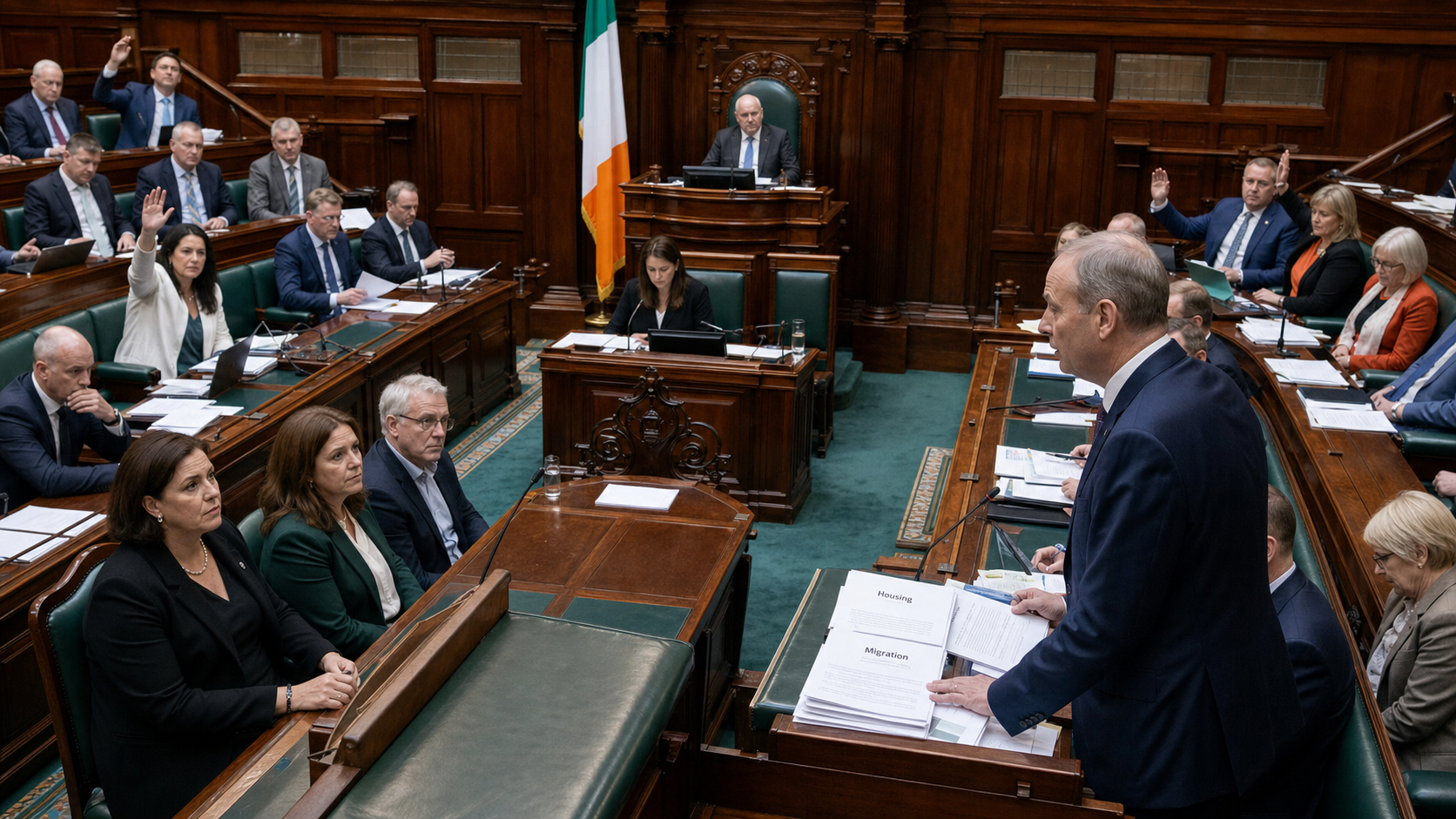
Government's Housing and Migration Agenda Faces Dáil Scrutiny as Opposition Demands Accountability
The Fianna Fáil-Fine Gael coalition is navigating a turbulent period in the Dáil as opposition parties intensify their scrutiny of the Government's housing and migration legislative agenda, with the social housing residency bill, the derelict property tax, and the Government's response to the Northern Ireland riots all generating heated exchanges in Leinster House this week.
Background
The current Dáil Éireann is governed by a coalition of Fianna Fáil, Fine Gael, and nine independent TDs, formed in January 2025 following the November 2024 general election. Fianna Fáil, as the largest party with 48 seats, holds the Taoiseach's office, with Micheál Martin leading the Government. Fine Gael, with 38 seats, holds the Tánaiste's office and several key ministries. The coalition governs with a working majority, though the reliance on independent TDs means that the Government must manage its legislative agenda carefully to avoid defections on contentious votes.
Sinn Féin, with 39 seats, leads the opposition and has been an effective critic of the Government's housing record, consistently arguing that the coalition's approach to housing delivery is too slow, too reliant on the private market, and insufficiently focused on social and affordable housing. The Social Democrats, with 22 seats, have positioned themselves as a progressive alternative to both the Government and Sinn Féin, focusing particularly on housing, health, and social justice issues. People Before Profit and the Labour Party complete the main opposition groupings.
The Government's legislative agenda for the current Dáil term is dominated by housing — a reflection of the political reality that the housing crisis is the issue that most directly affects the lives of the largest number of voters. The Programme for Government commits to the delivery of 300,000 new homes by 2030, a target that most independent analysts regard as extremely ambitious given current construction rates and planning system capacity.
Key Developments
This week's Dáil business has been dominated by three interconnected issues. The social housing residency bill, which is advancing through committee stage, has generated the most heat, with the Social Democrats' Rory Hearne accusing the Government of introducing "knee-jerk" legislation in response to anti-immigrant sentiment rather than genuine housing policy considerations. Taoiseach Martin defended the bill as a necessary clarification of existing policy, but acknowledged that the Government would consider amendments to address the concerns raised by the Irish Human Rights and Equality Commission.
The derelict property tax, which will transfer collection responsibility from local authorities to the Revenue Commissioners, has received a more positive reception across the Dáil, with most parties welcoming the principle of more effective enforcement while raising questions about the rate of the tax and the timeline for implementation. Sinn Féin's housing spokesperson Eoin Ó Broin called for the tax to be set at a level that would genuinely incentivise action, warning that a rate that is too low will simply be absorbed as a cost of ownership by wealthy property speculators.
The Government's response to the Northern Ireland riots has also been scrutinised in the Dáil, with questions about the Common Travel Area, the bilateral returns agreement, and the adequacy of the Irish government's engagement with the UK in the aftermath of the disorder. Taoiseach Martin defended the Government's position, reiterating that the open border is non-negotiable while acknowledging the need for enhanced cooperation on immigration data sharing.
Why It Matters
The Dáil debates of this week reflect a broader political reality: the Government is governing in a period of acute social pressure, with the housing crisis, immigration, and the fallout from the Northern Ireland riots all demanding simultaneous attention. The risk for the coalition is that it is seen to be reactive rather than proactive — responding to events rather than shaping them. The social housing residency bill, in particular, has been criticised as a measure that addresses the symptoms of public anxiety about immigration rather than the underlying causes of the housing crisis.
The Government's defenders argue that the legislative agenda is coherent and that the combination of the derelict property tax, the planning reforms, the social housing residency bill, and the continued investment in social and affordable housing represents a comprehensive approach to the housing crisis. The test of that argument will come in the delivery of actual homes — a metric on which the Government's record to date has been mixed, with construction starts falling short of the targets set in the Housing for All plan.
Local Impact
The Dáil debates have direct implications for communities across the Republic. In Dublin, where the housing crisis is most acute, the combination of the derelict property tax, the hotel levy increase, and the planning reforms could, if implemented effectively, begin to shift the development landscape in favour of residential construction. In Cork, Galway, and Limerick, where housing pressures are also severe, the Government's legislative agenda is being watched closely by local authorities, housing charities, and community groups who are dealing with the daily reality of homelessness, overcrowding, and unaffordable rents. The social housing residency bill will be felt most directly by the most vulnerable people in Irish society — those who are already on the margins of the housing system and who can least afford to be excluded from the supports they need.
What's Next
The Dáil is expected to rise for the summer recess in mid-July, leaving a compressed legislative timetable for the remainder of the term. The social housing residency bill is expected to complete its Dáil stages before the recess, with the Seanad stage to follow in September. The derelict property tax legislation is expected to be published before the recess, with a view to enactment before the end of 2026. The Government has also indicated that it will publish a mid-term review of the Housing for All plan before the summer, providing an assessment of progress against the 300,000 homes target and setting out any adjustments to the delivery strategy.