Glenveagh Calls for Escalating Land Hoarding Tax as Developer Warns Housing System Is 'Failing'
One of Ireland's largest housing developers has called on the government to significantly strengthen penalties for land hoarding, arguing that the existing Residential Zoned Land Tax is too weak to deter speculation and that the housing system is fundamentally failing to deliver the homes the country needs, in a report that has been welcomed by housing advocates but also scrutinised given Glenveagh's own substantial landbank of approximately 19,000 units.
Background
Ireland's housing crisis has been one of the defining political and social issues of the past decade. The combination of a severe shortage of supply, rapidly rising prices, and a rental market under extreme pressure has created a situation in which homeownership is increasingly out of reach for many Irish people, particularly younger generations and those on middle incomes. The government's Housing for All plan, and its successor Delivering Homes, Building Communities 2025-2030, have set ambitious targets for new housing delivery, but progress has been uneven and the gap between supply and demand remains substantial.
One of the most persistent criticisms of the housing system is that significant quantities of residentially zoned land are being held by developers and landowners without being developed, either because the economics of development are not yet sufficiently attractive or because landowners are speculating on future price increases. The Residential Zoned Land Tax, introduced in 2022 and set at 3% of the market value of undeveloped residentially zoned land annually, was intended to address this problem by making it financially costly to sit on land without developing it.
However, critics have argued that the RZLT is too low to change behaviour significantly, particularly in a market where land values are rising rapidly. A 3% annual levy on land that is appreciating at 5-10% per year is, in effect, a net gain for the landowner — hardly a compelling incentive to develop.
Key Developments
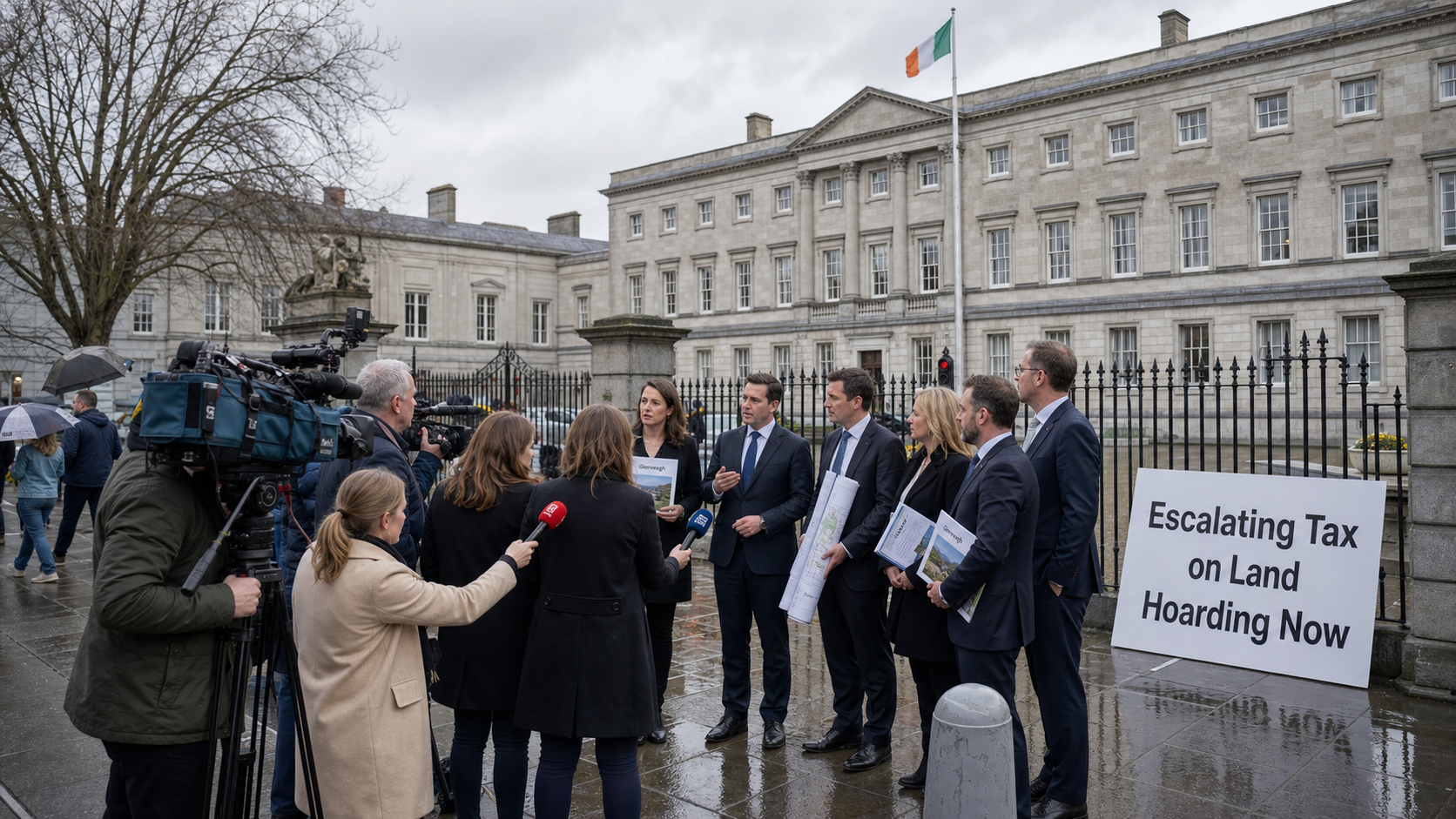
Glenveagh's Homebuilding Horizons report, published on Monday, makes a series of recommendations for strengthening the policy framework around land use and housing delivery. The most significant is a call for the RZLT to be replaced with an escalating tax — one that increases year on year for land that remains undeveloped, creating a growing financial pressure on landowners to either develop or sell. The company also advocates for the introduction of Land Value Sharing, a mechanism that would capture 25% of the uplift in land value that occurs when land is rezoned for residential development, with the proceeds directed towards infrastructure and affordable housing.
Glenveagh chief executive Stephen Garvey said the report was intended to "candidly identify where the housing system is failing and where policy improvements are required". He acknowledged that the company itself holds a substantial landbank but argued that Glenveagh's approach to land management — actively developing its sites rather than holding them speculatively — was fundamentally different from the behaviour the report was seeking to address.
Why It Matters
The question of land hoarding goes to the heart of why Ireland's housing crisis has proved so resistant to resolution. Even when planning permission is granted and the economic conditions for development are broadly favourable, the pace of delivery has consistently fallen short of what is needed. The government's own analysis suggests that Ireland needs to build approximately 50,000 homes per year to meet demand — a target that has never been achieved and that current delivery rates fall well short of.
Strengthening the RZLT, as Glenveagh proposes, would be a meaningful step towards unlocking land that is currently sitting idle. However, the measure would need to be carefully designed to avoid unintended consequences — for example, forcing the sale of land to developers who lack the capacity to build on it quickly, or creating financial distress for smaller landowners who are not in a position to develop but also cannot afford to pay an escalating tax.
Local Impact
The land hoarding problem is most acute in the Greater Dublin Area, where Glenveagh's own landbank is primarily concentrated and where the gap between zoned land and actual housing delivery is most pronounced. In Dublin, Kildare, Meath, and Wicklow, there are significant quantities of residentially zoned land that have remained undeveloped for years, even as housing costs in the region have reached levels that are among the highest in the EU. The introduction of an escalating land tax would, in theory, create a strong incentive for landowners in these areas to either develop or sell, potentially unlocking a significant pipeline of new homes.
What's Next
The government's Tax Strategy Group is expected to consider the RZLT as part of its pre-budget deliberations, and Glenveagh's report will add to the growing body of evidence and advocacy calling for a strengthening of the measure. Budget 2027, due on 6 October, is widely expected to include some adjustment to the RZLT, though the scale of any change remains to be seen. Housing Minister James Browne has indicated that the government is open to strengthening land use measures, but has stopped short of committing to the specific escalating tax model proposed by Glenveagh.