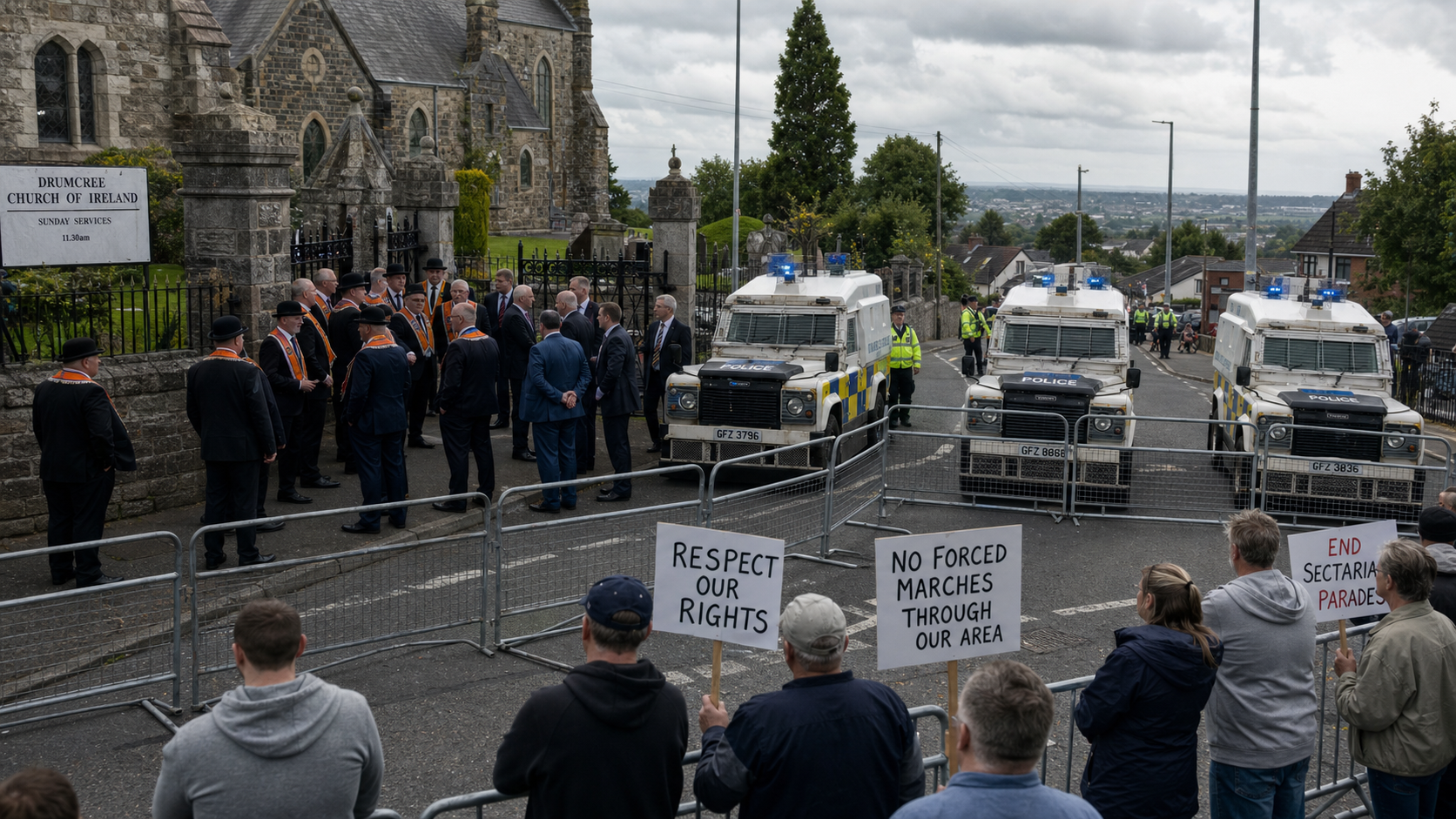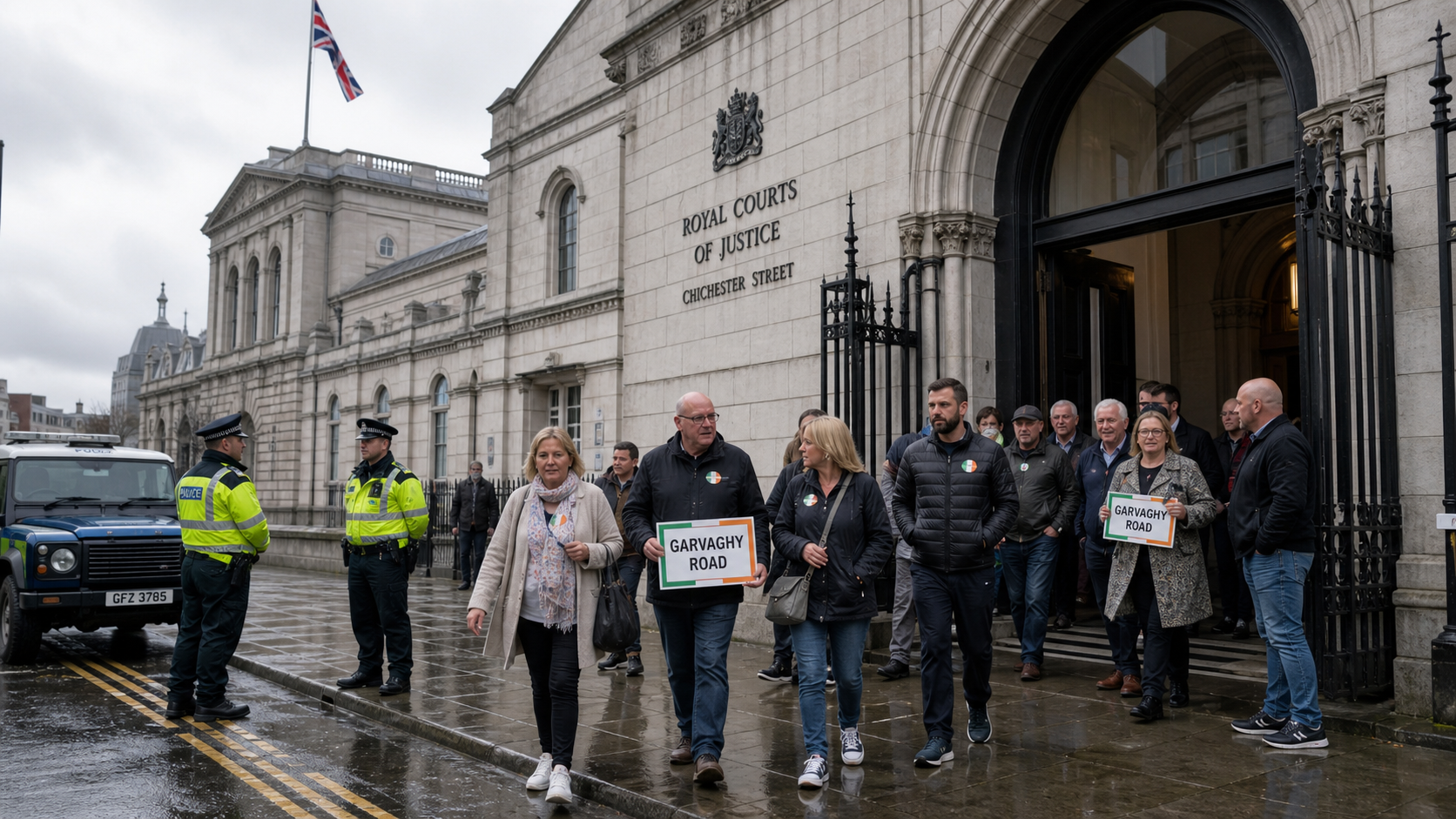
Garvaghy Road Residents Rush to High Court to Block Drumcree Parade as PSNI Deploys 200 Officers
Residents of the Garvaghy Road in Portadown have brought an emergency High Court challenge in Belfast today seeking to overturn the Parades Commission's decision to permit a restricted Orange Order parade along the nationalist route on Sunday morning — the first such march to be authorised since 1997. The PSNI has deployed approximately 200 officers, including mutual aid from Police Scotland, as political leaders across the spectrum respond to a decision that has reignited one of Northern Ireland's most contentious disputes.
Background
The Drumcree dispute is one of the defining conflicts of the Troubles era and its aftermath. For nearly three decades, the Portadown District Orange Order sought to march along the Garvaghy Road — a predominantly nationalist residential area — as part of its annual return from Drumcree Church. The Parades Commission consistently blocked the route from 1998 onwards, following years of violent confrontation that claimed 21 lives between 1996 and 1999 and required the deployment of thousands of soldiers and police officers.
The dispute became a symbol of the broader struggle over contested space, identity, and the right to march in Northern Ireland. The Garvaghy Road Residents' Coalition, led for many years by Breandán Mac Cionnaith, maintained that the route was not a traditional one and that the march was experienced by residents as an act of intimidation rather than cultural expression. The Orange Order, for its part, argued that the route was historically significant and that its exclusion represented an infringement of civil and religious liberties.
The current crisis was triggered by a High Court ruling in August 2026 that quashed a previous Parades Commission determination on procedural grounds, finding that not all commissioners had properly signed off on the decision. The court identified what it described as "sloppy procedures" and ordered the commission to reconsider. The commission's revised determination, published on Friday, authorised a limited march — 35 participants, no bands, no supporters, departing no later than 8am — for Sunday, September 27.
Key Developments
The Garvaghy Road Residents' Coalition moved swiftly to challenge the determination, with a High Court hearing scheduled for today in Belfast. Breandán Mac Cionnaith described the community's reaction as one of "shock and fury," stating that residents had maintained the peace for 28 years and that the commission's decision threatened to undo that achievement. The coalition's legal team is arguing that the determination was made without adequate consideration of the impact on residents and the potential for renewed community tension.
Sinn Féin president Mary-Lou McDonald described the decision as "utterly reckless" and a challenge to the spirit of the Good Friday Agreement. Michelle O'Neill, the First Minister, said she was "baffled" by the commission's reasoning and called on the British government to intervene. DUP leader Gavin Robinson welcomed the determination, describing it as a "significant and long-overdue breakthrough" and arguing that a small, silent march in 2026 should not be a source of major conflict in a shared society.
British Prime Minister Andy Burnham urged all parties to remain calm and work through the weekend's events peacefully, acknowledging the sensitivity of the situation. The Irish government expressed concern, stating it did not wish to see a return to the divisions of the past. The PSNI confirmed it had activated mutual aid arrangements, with approximately 200 officers from Scotland joining local officers in Portadown ahead of Sunday's planned march.
Why It Matters
The Drumcree dispute has always been about more than a single parade route. It is a proxy for the broader question of how Northern Ireland manages competing cultural and political identities in shared space. The commission's decision to authorise the march — even in the heavily restricted form proposed — represents a significant departure from nearly three decades of consistent refusal, and its implications extend well beyond Portadown. Residents' groups in other contested parade areas across Northern Ireland will be watching closely to see whether the Drumcree determination sets a precedent that could be applied elsewhere. The legal challenge today is therefore not merely about Sunday's march but about the principles that will govern parade disputes for years to come. The involvement of 200 police officers — a substantial deployment by any measure — underlines the seriousness with which the PSNI is treating the potential for disorder.
Local Impact
For the residents of the Garvaghy Road, a predominantly nationalist housing estate in Portadown, the prospect of an Orange Order march through their community carries a weight of historical trauma that is difficult to overstate. Many residents lived through the confrontations of the 1990s, when the road was effectively placed under siege during the marching season, with armoured vehicles and razor wire deployed to enforce the commission's rulings. The PSNI has stated it has no current intelligence suggesting Sunday's march will result in violence, but the deployment of mutual aid from Scotland indicates that the risk assessment is being taken seriously. Local community leaders have called on residents to remain calm while pursuing the legal challenge, and a community meeting was held on Friday evening to discuss the situation.
What's Next
The High Court hearing today will determine whether an emergency injunction can be granted to prevent Sunday's march from proceeding. If the court declines to intervene, the march is scheduled to take place at 8am on Sunday, September 27, with 35 participants and no bands or supporters. The Parades Commission has indicated it will monitor compliance with its conditions closely. Regardless of Sunday's outcome, the broader legal challenge — a full judicial review of the commission's determination — is expected to proceed in the coming weeks, with implications for how the commission approaches contested parade decisions in future.