Galway Station Misspelling Exposes Systemic Failures in Irish Language Signage Quality Control
A misspelling on new turnstile signage at the recently renovated Ceannt Station in Galway has become the latest flashpoint in a long-running debate about the quality of Irish language text on public infrastructure, with language advocates arguing that the error reflects a systemic failure to treat Irish with the same rigour applied to English on official signage across the country.
Background
Ceannt Station in Galway city underwent a significant redevelopment in recent years as part of Irish Rail's broader investment in its network infrastructure. The station, named after 1916 Rising leader Éamonn Ceannt, serves as the western terminus of the Dublin-Galway rail line and is a major transport hub for Connacht. Its renovation was welcomed by the city, and the installation of new signage was seen as part of a broader modernisation of the passenger experience.
Galway has a particular sensitivity to Irish language issues given its status as a bilingual city and its proximity to the Connemara Gaeltacht, one of the largest Irish-speaking communities in the country. The city's Irish language community is vocal and well-organised, and errors of this kind tend to be noticed and reported quickly.
The issue of inaccurate Irish language signage on public infrastructure is not new. The office of An Coimisinéir Teanga, the Irish language commissioner, has consistently highlighted the problem in its annual reports. The 2025 report noted that 26.8 per cent of formal complaints received by the office related to non-compliant signage and stationery, up from 23.9 per cent in 2024 — a trend that suggests the problem is worsening rather than improving despite repeated commitments from public bodies to address it.
Key Developments
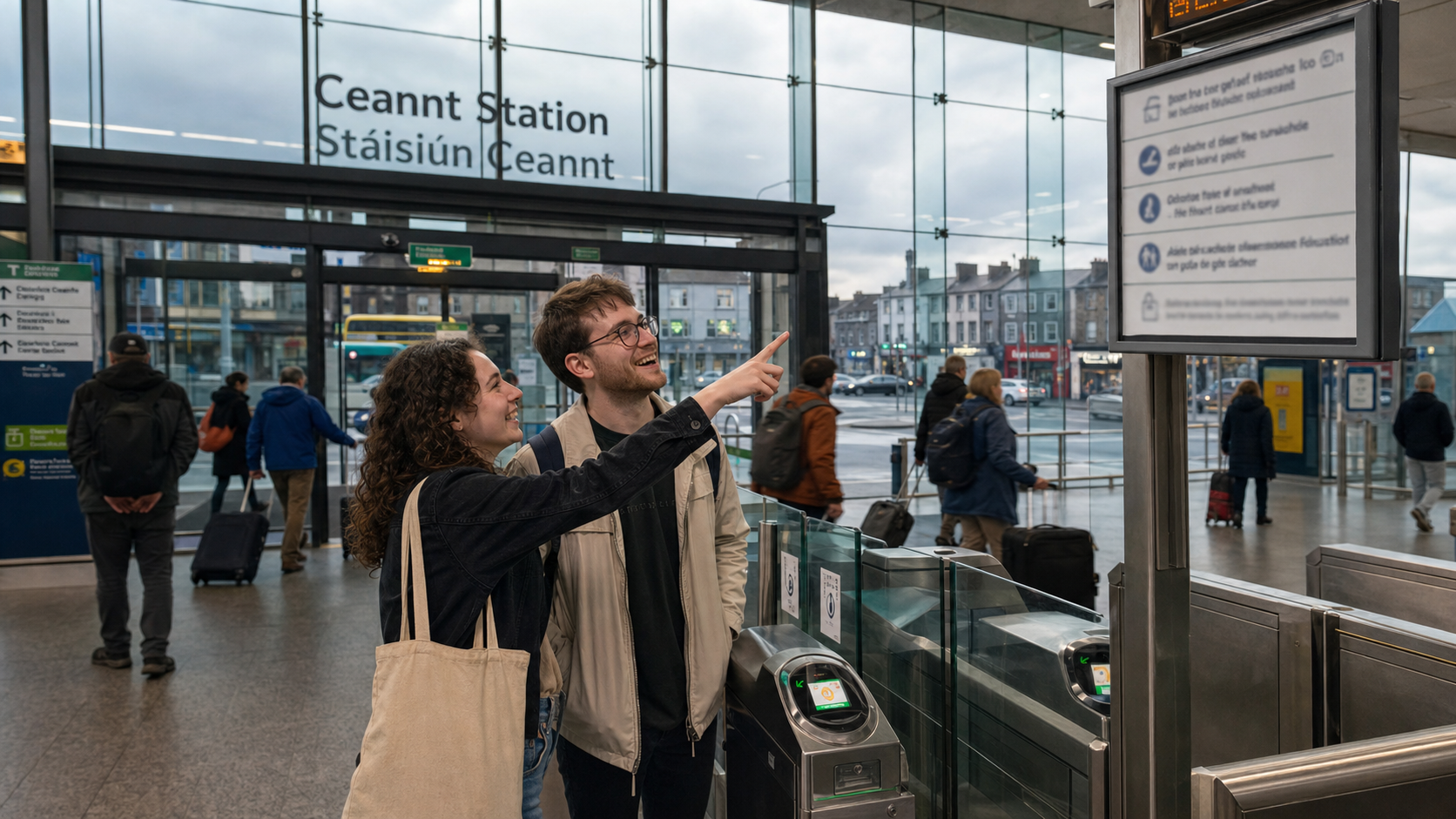
The error at Ceannt Station involved the misspelling of the word "Ceannaigh" — the Irish for "buy" — as "Ceannaig" on the new turnstile signs instructing passengers to purchase tickets. The omission of the final "h" rendered the word grammatically incorrect and meaningless in context. The English versions of the same signs were spelled correctly.
Irish Rail attributed the mistake to an "administrative error" by a supplier, noting that the correct spelling had been provided to the printer. The company committed to correcting the signs as soon as possible. Language advocates, however, argued that the explanation — while plausible — did not address the underlying question of why the Irish text was not subject to the same quality control checks as the English text before the signs were installed.
Journalist Maitiú Ó Coimín and language planning officer Tomás Ó hÓgáin were among those who pointed out that errors of this kind stem from a lack of proper systems for ensuring accuracy, rather than from a shortage of qualified Irish language translators and proofreaders. Under the Official Languages Act 2003, public bodies are legally required to provide accurate signage in Irish, or in both Irish and English.
Why It Matters
The Galway station misspelling is a small error with large symbolic significance. For Irish language speakers, particularly those in Gaeltacht areas and in cities like Galway where Irish is a living community language, errors on official signage send a message about the relative status of the two official languages of the state. When English is consistently correct and Irish is consistently wrong, it reinforces a hierarchy that the Official Languages Act was designed to challenge. The pattern identified in the Coimisinéir Teanga's reports — a rising proportion of complaints related to signage — suggests that the problem is structural rather than incidental, and that the current approach of relying on public bodies to self-regulate their Irish language obligations is not working.
Local Impact
In Galway, the reaction from the Irish language community was one of weary frustration rather than surprise. The city's Irish language organisations, including Gaillimh le Gaeilge, have been campaigning for improved standards in public signage for years, and the Ceannt Station error is seen as confirmation that their concerns have not been adequately addressed. For passengers using the station — including many who travel from the Connemara Gaeltacht — the error is a daily reminder of the gap between the state's stated commitment to the Irish language and the reality of how that commitment is implemented in practice. Irish Rail has committed to correcting the signs, but advocates are calling for a more systematic review of all Irish language text on the company's network.
What's Next
Irish Rail has committed to replacing the incorrect signs at Ceannt Station as soon as possible. An Coimisinéir Teanga is expected to note the incident in its next annual report. Language advocates have called on the Department of Tourism, Culture, Arts, Gaeltacht, Sport and Media to commission an audit of Irish language signage across all state-funded public transport infrastructure. The matter is also expected to be raised in the Dáil, where several TDs from Gaeltacht constituencies have been vocal on the issue of Irish language standards in public life.