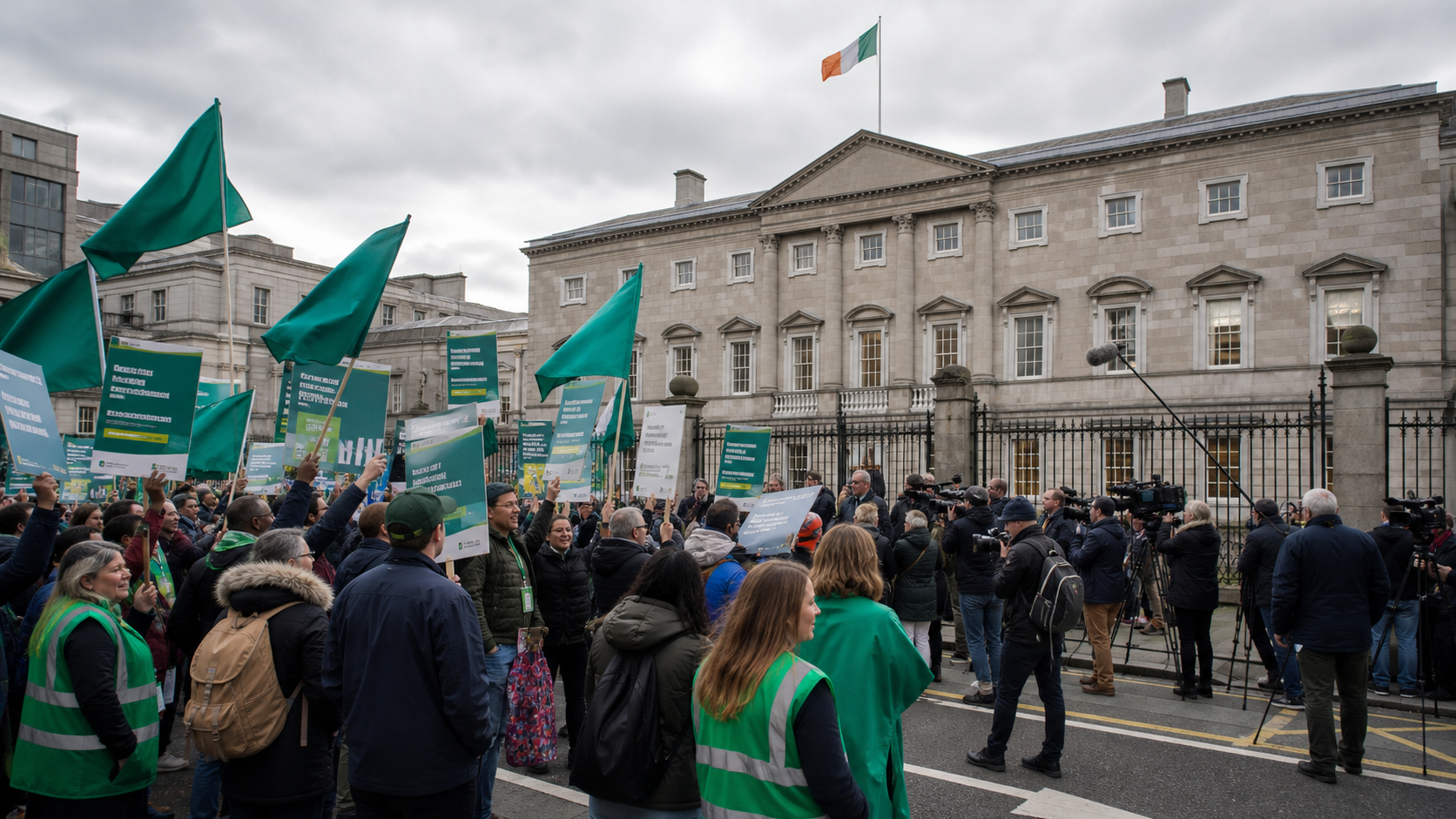
Fórsa Secures 96.6% Strike Mandate in Largest-Ever Irish Trade Union Ballot as Public Sector Pay Dispute Intensifies
Fórsa, Ireland's largest public sector trade union, has secured a 96.6% vote in favour of industrial action from more than 64,000 members — a result described by General Secretary Kevin Callinan as the largest strike ballot in the history of Irish trade unionism — as the dispute over public sector pay threatens to trigger the most widespread industrial disruption the state has seen in a generation.
Background
The Irish public sector pay dispute has been building for months, rooted in a fundamental disagreement between the government and the trade union movement about the value of public service work and the appropriate response to the cost-of-living crisis that has squeezed household incomes across the country. The previous public sector pay agreement — the Building Momentum deal — expired on 30 June 2026, leaving more than 300,000 public servants without a successor agreement and the government without a framework for managing pay expectations in the sector.
Fórsa, which represents workers across a vast range of public services including the civil service, local authorities, health, education, and the community and voluntary sector, has been at the forefront of the campaign for a new deal. The union's position is that public sector wages have fallen at least 5% behind inflation since 2020, and that the government's failure to engage in substantive negotiations for a successor agreement represents a breach of the trust that underpins the social partnership model that has been central to Irish industrial relations for decades.
The ballot, which saw a 72% turnout from Fórsa's membership, produced a result that exceeded even the most optimistic expectations of union leadership. The 96.6% vote in favour of industrial action — representing 62,276 members — was described by Callinan as "a clear and unambiguous signal that our members have reached the end of their patience." The result followed a similar outcome from SIPTU, the country's second-largest public sector union, where 97% of participating members also backed industrial action.
Key Developments
Callinan was unsparing in his assessment of the government's handling of the dispute. "Public sector workers have kept this country running through a pandemic, through a cost-of-living crisis, and through years of chronic underfunding of the services they provide," he said. "They have been patient. They have been professional. And they have been ignored. This ballot result is the consequence of that failure."
The union has indicated that industrial action could begin by the end of September 2026 if the government's position does not shift. The specific form of action — whether work-to-rule, selective strikes, or full strike days — will be determined by Fórsa's national executive in the coming weeks, in coordination with other members of the Irish Congress of Trade Unions public services committee.
Minister for Public Expenditure Jack Chambers characterised the potential for strikes as "completely unnecessary," asserting that the government is open to "substantive engagement" and "constructive and collaborative" talks. He emphasised that any new deal must be affordable and sustainable within the context of medium-term fiscal plans. However, union leaders have dismissed this framing, arguing that the government's definition of "affordable" fails to account for the real-terms pay cuts that public servants have absorbed over the past six years.
Other unions have signalled their support for action. The Prison Officers Association and Unite have both indicated solidarity with Fórsa's position, while teachers' unions and the Irish Nurses and Midwives Organisation have initiated or planned their own ballots. The prospect of coordinated action across multiple unions simultaneously is one that the government will be acutely aware of as it considers its response.
Why It Matters
The scale of the Fórsa ballot result — 96.6% on a 72% turnout — is without precedent in Irish trade union history, and it demands to be taken seriously as a political and economic signal. It is not simply a reflection of frustration with the current pay dispute; it is an expression of a deeper sense among public servants that their contribution to Irish society is undervalued and that the social contract between the state and those who serve it has been eroded.
The timing is also significant. Budget 2027 is due to be presented in October, and the government will be acutely aware that a major public sector strike in the weeks before the budget would be politically damaging and economically disruptive. The pressure on Minister Chambers and Taoiseach Micheál Martin to find a resolution before action begins is considerable.
For comparison, the last major public sector strike in Ireland — the 2009 one-day strike over pension levies — involved a smaller coalition of unions and a less decisive mandate. The current dispute has the potential to be significantly more disruptive, particularly if the coordinated action across multiple unions materialises as threatened.
Local Impact
The potential impact of public sector strikes on communities across Ireland is difficult to overstate. Fórsa's membership spans virtually every public service that citizens depend on: from the civil servants who process social welfare payments and planning applications, to the local authority workers who maintain roads and parks, to the healthcare workers who staff HSE community services, to the education support staff who work in schools across every county. A sustained period of industrial action would affect services in Dublin, Cork, Galway, Limerick, Waterford, and every county in between.
In rural areas, where public services are already stretched and alternatives are limited, the impact of strikes would be felt particularly acutely. Community welfare officers, public health nurses, and local authority housing staff are among the Fórsa members whose absence would be most immediately felt by vulnerable communities.
What's Next
Fórsa's national executive is expected to meet in the coming days to sanction specific plans for industrial action. The union has indicated that it will coordinate its approach with SIPTU and other ICTU members before announcing specific dates or forms of action. The government has been given until the end of September to engage in what Callinan described as "meaningful" negotiations — a deadline that both sides will be watching closely. A failure to reach agreement before that deadline could trigger the most significant industrial dispute in Ireland since the 1990s.