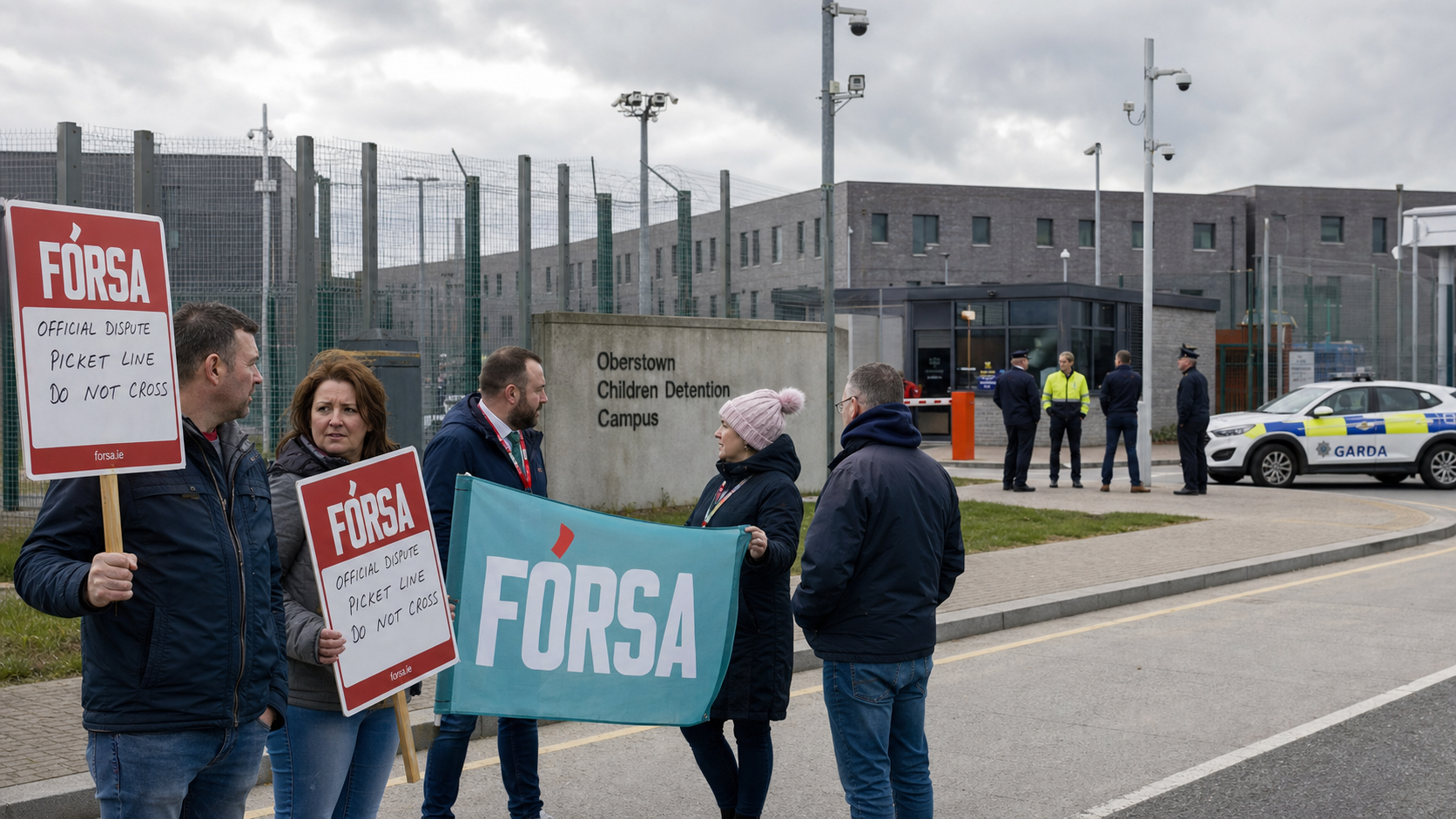
Oberstown Staff Walk Out for Eight Hours as Staffing Dispute Escalates at Children's Detention Campus
Fórsa members at the Oberstown Children Detention Campus in County Kildare staged an eight-hour work stoppage on Tuesday, 11 August 2026, after talks at the Workplace Relations Commission failed to produce a viable resolution to a long-running dispute over safe staffing levels and resourcing at the facility — the latest escalation in a series of planned industrial actions that the union has warned will intensify throughout the month if the underlying issues are not addressed.
Background
Oberstown Children Detention Campus is Ireland's only dedicated detention facility for young people under the age of 18 who have been remanded in custody or sentenced by the courts. Located in Lusk, County Kildare, the campus provides secure residential care for some of the most vulnerable and challenging young people in the Irish justice system, and the work carried out by its staff — who combine elements of custodial care, therapeutic support, and education — is among the most demanding in the public sector.
The dispute between Fórsa and Oberstown management has been building for months. The union, which represents a significant proportion of the campus's frontline staff, has argued that staffing levels at the facility are insufficient to ensure the safety of both staff and residents. The union's concerns centre on the number of staff available on any given shift, the reliance on overtime and agency workers to fill gaps, and what it describes as a failure by management to address the root causes of the staffing shortfall through sustained recruitment and retention measures.
Fórsa members voted in May 2026 to authorise industrial action up to and including a full withdrawal of labour. A work-to-rule began on 25 June 2026, and the union subsequently notified management of a series of escalating work stoppages planned for August. The first, a six-hour stoppage, took place on 4 August. Tuesday's eight-hour action is the second in the series, with further stoppages of increasing duration planned for 18 and 25 August.
Key Developments
Talks at the Workplace Relations Commission, which had been seen as the most likely avenue for a negotiated resolution, broke down in the days before Tuesday's stoppage. Fórsa national secretary Hazel Nolan said the union was "deeply frustrated" by the failure of the WRC process, which she attributed to the exclusion of key recruitment measures from the business case presented to the Department of Children and the absence of Department representatives during certain discussions. "We are not taking this action lightly," she said. "Our members care deeply about the young people in their care, and they would not be doing this if they did not believe that the current situation poses a genuine risk to safety."
The Department of Children, in response, pointed to the allocation of €2.2 million in additional funding in Budget 2026 to increase staffing levels, including 11 full-time equivalent posts, and said that recruitment efforts had been largely successful despite challenging market conditions. The Department expressed disappointment at the escalation of industrial action, arguing that the stoppages negatively impact the care provided to children and deviate from established dispute resolution processes.
Oberstown management has indicated that contingency arrangements are in place to maintain essential services during the work stoppages, but the union has questioned whether those arrangements are adequate to ensure the safety of residents and staff during the periods of reduced cover.
Why It Matters
The dispute at Oberstown raises fundamental questions about the adequacy of resources allocated to Ireland's youth justice system. The young people detained at Oberstown are, by definition, among the most vulnerable in Irish society — many have experienced significant trauma, abuse, and deprivation, and the quality of care they receive during their time at the campus has a direct bearing on their prospects for rehabilitation and reintegration. Understaffing in such an environment is not simply an industrial relations issue; it is a child welfare issue, and the union's argument that current staffing levels pose a genuine safety risk deserves to be taken seriously.
The broader context is one of persistent pressure on Ireland's public sector workforce, particularly in areas that require specialist skills and carry significant personal risk. Recruitment and retention of qualified staff for youth justice settings is a challenge across many jurisdictions, and Ireland is not unique in struggling to maintain adequate staffing levels. However, the failure of the WRC process to produce a resolution suggests that the gap between what the union is seeking and what management is prepared to offer is significant, and that bridging it will require political engagement at a level above the campus management.
Local Impact
The impact of the work stoppages on the young people detained at Oberstown is difficult to quantify precisely, but the disruption to routine — which is a critical element of therapeutic care in secure settings — is a genuine concern. Educational programmes, therapeutic sessions, and recreational activities may be curtailed during periods of reduced staffing, and the uncertainty created by ongoing industrial action can itself be destabilising for young people who have often experienced significant instability in their lives. The campus is located in north County Kildare, and local politicians from the area have called on the Department of Children to engage more directly with the union's concerns to bring the dispute to a swift resolution.
What's Next
Further work stoppages are planned for 18 August (12 noon to 10 pm) and 25 August (12 noon to midnight) unless a resolution is reached. Fórsa has indicated that it remains open to further engagement at the WRC, but only if the Department of Children is represented at the talks and if the union's core demands regarding recruitment and staffing levels are genuinely on the table. The Department has said it is willing to continue discussions, and there is some hope that a return to the WRC could produce a resolution before the end of August. If the dispute is not resolved, the union has indicated that it will consider further escalation, potentially including a full withdrawal of labour.