Enniskillen Food Workers Escalate to All-Out Strike as Fridge Raiders Plant Dispute Deepens
Approximately 130 workers at the Pilgrim's Europe food production plant in Enniskillen, County Fermanagh — which manufactures Fridge Raiders, Richmond sausages, Denny sausages, and Rollover sausages — have escalated their industrial dispute to an all-out indefinite strike, following three weeks of prior action that failed to produce a satisfactory offer from management. The Unite union says workers have "no choice" but to remain on the picket line until the company returns with a meaningful improvement on pay and break arrangements.
Background
The Pilgrim's Europe plant in Enniskillen is one of the largest food manufacturing facilities in County Fermanagh, employing several hundred workers across multiple shifts. The company, which is a subsidiary of the US agri-food giant Pilgrim's Pride, reported after-tax profits of £128.4 million for the 2024 financial year — a figure that Unite has repeatedly cited as evidence that the company has the financial capacity to meet its workers' demands without difficulty.
The dispute has two distinct elements. The first is a pay claim: the lowest-paid workers at the Enniskillen site earn £12.82 per hour, which Unite points out is just 11 pence above the current national minimum wage. The union is seeking a pay increase that would provide meaningful relief from the cost-of-living pressures that have squeezed workers' real incomes over the past several years. The second element concerns break arrangements: morning shift workers are the only staff at the plant who do not receive fully paid breaks, while evening and night shift workers receive 30 minutes of paid break time. Workers on the morning shift regard this disparity as fundamentally unfair and have made its resolution a condition of any settlement.
Pilgrim's Europe has maintained that it has offered "above-inflation" pay increases weighted toward the lowest-paid employees, and has stated that it put forward proposals to address the break payment disparity for day-shift staff. The company has also said that there are no current product shortages and has expressed gratitude to the wider workforce for their support in maintaining operations during the dispute. Unite has rejected the company's characterisation of its offer, describing it as inadequate and arguing that the proposals on break payments do not go far enough.
Key Developments
The escalation to an all-out indefinite strike, which began on September 2, 2026, represents a significant intensification of the dispute. The previous three weeks of action had involved rolling strikes and work-to-rule arrangements, which disrupted production but allowed the plant to continue operating at reduced capacity. An all-out strike means that the 130 Unite members involved are withdrawing their labour entirely, and Unite has indicated that the skilled nature of the workers involved will significantly slow down production processes in a way that the company cannot easily mitigate.
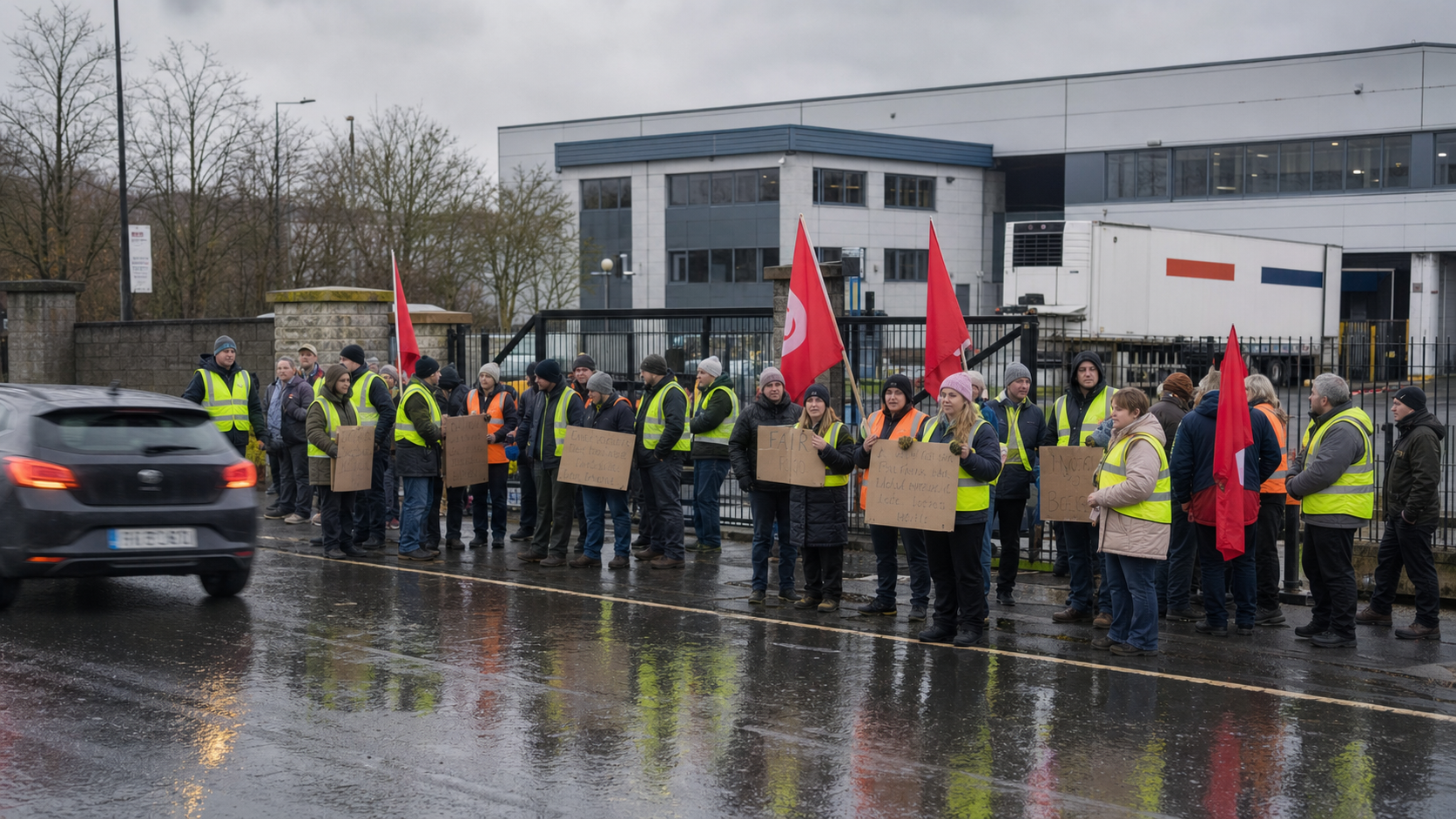
Workers on the picket line outside the Enniskillen plant have described the decision to escalate as a difficult but necessary one. Many of the workers involved have families and mortgages, and the financial impact of an indefinite strike is significant. But Unite representatives have argued that the alternative — accepting a settlement that fails to address the fundamental pay and equality issues — would leave workers worse off in real terms and would set a damaging precedent for future negotiations.
The dispute has attracted attention from across the trade union movement in Northern Ireland, with expressions of solidarity from other Unite branches and from the Irish Congress of Trade Unions. The ICTU has called on Pilgrim's Europe to return to the negotiating table with a substantially improved offer, and has described the company's current position as "unacceptable" given its profitability.
Why It Matters
The Enniskillen dispute is part of a broader pattern of industrial action in the food manufacturing sector in Northern Ireland and the Republic, driven by the combination of rising living costs, stagnant wages, and the perception that profitable companies are not sharing the benefits of their success with their workforce. The food manufacturing sector in Northern Ireland employs tens of thousands of people, many of them in rural areas where alternative employment opportunities are limited. The outcome of the Pilgrim's Europe dispute will be watched closely by workers and employers across the sector.
The pay disparity highlighted by Unite — £12.82 per hour, just 11 pence above the minimum wage — illustrates a broader problem in the food manufacturing sector, where many workers are employed at or near the minimum wage despite the essential nature of their work and the significant profits generated by their employers. The break payment inequality adds an additional dimension of unfairness that has clearly galvanised the workforce. For context, the living wage in Northern Ireland, as calculated by the Living Wage Foundation, is currently £12.60 per hour — meaning that the lowest-paid workers at the Enniskillen plant are earning above the living wage, but only marginally so, and without the full break entitlements that their colleagues on other shifts receive.
Pilgrim's Europe's £128.4 million after-tax profit for 2024 is a figure that Unite has deployed effectively in the public debate around the dispute. It is difficult for a company to argue that it cannot afford to pay its workers more when it is generating profits of that magnitude, and the union's communications strategy has focused on making that contrast as visible as possible.
Local Impact
In Enniskillen, the dispute has divided opinion. The town, which is the county town of Fermanagh and one of the largest urban centres in the west of Northern Ireland, has a significant food manufacturing sector, and the Pilgrim's Europe plant is one of its largest employers. Many residents have expressed sympathy for the striking workers, while others have expressed concern about the impact of a prolonged dispute on the local economy. The picket line at the plant has become a focal point for the local trade union movement, with regular solidarity visits from other unions and from local politicians. Sinn Féin and the SDLP have both expressed support for the workers' demands, while the DUP has called on both sides to return to negotiations. The Unite regional office in Belfast has indicated that it is prepared to support the workers for as long as the dispute continues.
What's Next
Unite has indicated that it is open to returning to negotiations if Pilgrim's Europe comes forward with a substantially improved offer. The union has set no specific deadline for a resolution, but has made clear that the all-out strike will continue until the workers' core demands on pay and break equality are met. The Labour Relations Agency in Northern Ireland has offered its mediation services, and both sides have been urged to engage with that process. A further round of talks is expected in the coming days, though the gap between the two sides remains significant. The dispute is expected to be raised in the Northern Ireland Assembly when it sits later this month.