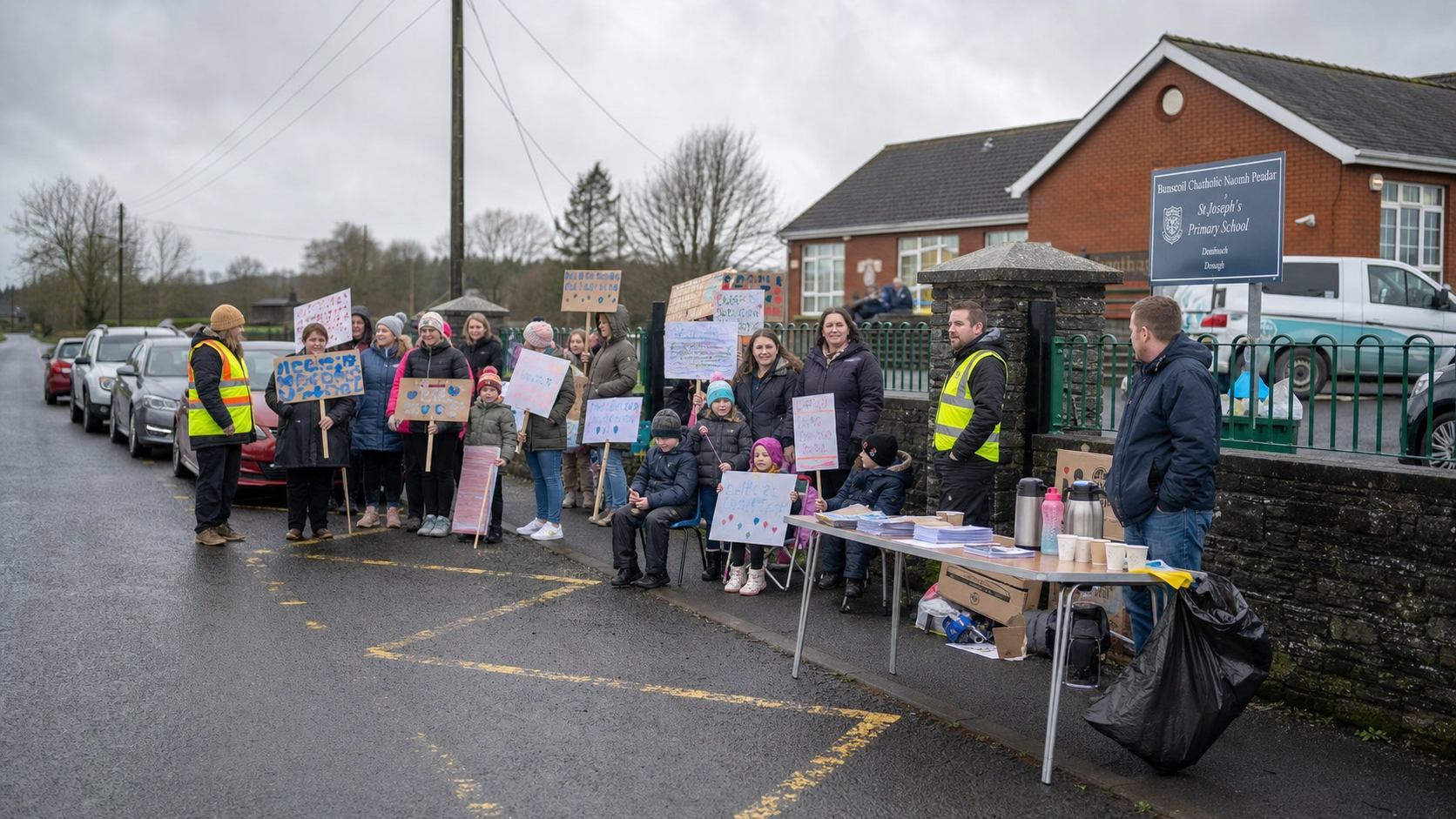
Fermanagh Parents Stage Four-Day Protest Over Education Authority's School Kitchen Closure in Donagh
Parents and community members at St Joseph's Primary School in Donagh, County Fermanagh, have staged a four-day protest outside the school gates in response to the Education Authority's decision to permanently close the school's on-site kitchen and transport meals from Maguiresbridge Primary School, a move the EA says will save approximately £36,000 per year. The protest, which ran from Tuesday to Friday of this week, has drawn support from local politicians and community organisations who accuse the EA of making a significant decision affecting a rural school without meaningful consultation.
Background
St Joseph's Primary School in Donagh is a small rural school in south Fermanagh, serving a community that has seen its population decline over recent decades. Like many small schools in rural Northern Ireland, it operates with limited resources and a close-knit relationship between the school, parents, and the wider community. The school's kitchen has been a source of pride for the community, providing freshly cooked meals for pupils and employing a local catering assistant who is known to the families of every child in the school.
The Education Authority informed the Board of Governors and the acting school principal on 18 August 2026 — just two weeks before the start of the new school term — that the kitchen would close with effect from 1 September. The EA cited unprecedented budgetary pressures and described the consolidation of school meal production as a well-established practice that would yield savings of approximately £36,000 per year, based on the daily production of around 47 meals. The catering assistant would remain in post to serve the transported meals, the EA said, but the cooking would be done at Maguiresbridge Primary School and delivered by taxi.
The announcement provoked immediate and intense opposition from parents, who organised a public meeting at the Millennium Hall in Donagh and subsequently staged a peaceful protest outside the school gates from Tuesday, 1 September, to Friday, 4 September, between 11.30am and 1pm. Many parents opted to provide their children with packed lunches rather than accept the transported meals, stating explicitly that they would be willing to pay for school dinners again if the on-site kitchen were reinstated.
Key Developments
The central grievances of the protesting parents are threefold. First, they argue that the EA failed to engage in meaningful consultation before making the decision, presenting the closure as a fait accompli with minimal notice before the start of term. Sinn Féin MLA Áine Murphy, who has been supporting the community, described the lack of consultation as unacceptable and called on the EA to pause the decision and enter into genuine dialogue with the school community.
Second, parents have raised concerns about the quality and nutritional value of meals prepared off-site and transported by taxi. While the EA has maintained that the meals will meet the same nutritional standards as those previously cooked on-site, parents are sceptical that food prepared at a different school and transported over several kilometres will arrive at the same temperature and quality as freshly cooked meals.
Third, and perhaps most significantly, the community fears that the kitchen closure is the first step in a broader strategy to consolidate school services that could ultimately threaten the school's viability. The Board of Governors reportedly presented an alternative proposal to the EA — under which the Donagh kitchen would serve three local schools, potentially generating savings while preserving on-site cooking — but this was not adopted. The rejection of that alternative has deepened suspicions that the EA's decision is driven by a predetermined agenda rather than a genuine assessment of the options.
Why It Matters
The Donagh school kitchen dispute is a microcosm of a much larger challenge facing rural education in Northern Ireland. The Education Authority is operating under severe budgetary pressure, with the Department of Education facing a funding gap that has forced difficult decisions across the school system. The EA's approach — making savings through service consolidation with minimal consultation — reflects the constraints it is operating under, but it also reflects a failure to understand the significance of small decisions for small communities.
For a rural school like St Joseph's, the kitchen is not merely a facility for producing meals. It is a source of employment for a local person, a connection between the school and the community, and a signal that the school is a functioning, valued institution. When the EA closes the kitchen, it sends a message — whether intentionally or not — that the school is being managed for decline rather than for sustainability. That message, once received, is very difficult to unsend.
Local Impact
Donagh is a small community in the Clogher Valley area of south Fermanagh, close to the border with County Monaghan. The school serves families from a wide rural catchment, and for many of those families, St Joseph's is the anchor of community life. The Donagh Development Association has backed the protest, and local councillors from Sinn Féin and the SDLP have both called on the EA to reverse its decision. The Fermanagh and Omagh District Council is expected to raise the matter at its next meeting.
For the catering assistant who remains in post, the situation is also difficult: she is now serving meals that she did not cook, in a kitchen that has been stripped of its function, while the community around her expresses its dissatisfaction with the arrangement. The human dimension of the decision — its impact on a local worker and on the daily experience of children at the school — has been largely absent from the EA's public communications.
What's Next
The Education Authority has indicated that it is willing to meet with the Board of Governors and parent representatives to discuss the decision, but has not committed to reversing it. MLA Áine Murphy has called for the matter to be raised at the Stormont Education Committee, and Education Minister Paul Givan is expected to be asked about the case at the Assembly when it returns from recess. The community has indicated that it will continue to protest and to explore legal options if the EA does not engage meaningfully with its concerns.