Dáil Debate on Aughinish Alumina Intensifies as Ireland's EU Presidency Raises Stakes
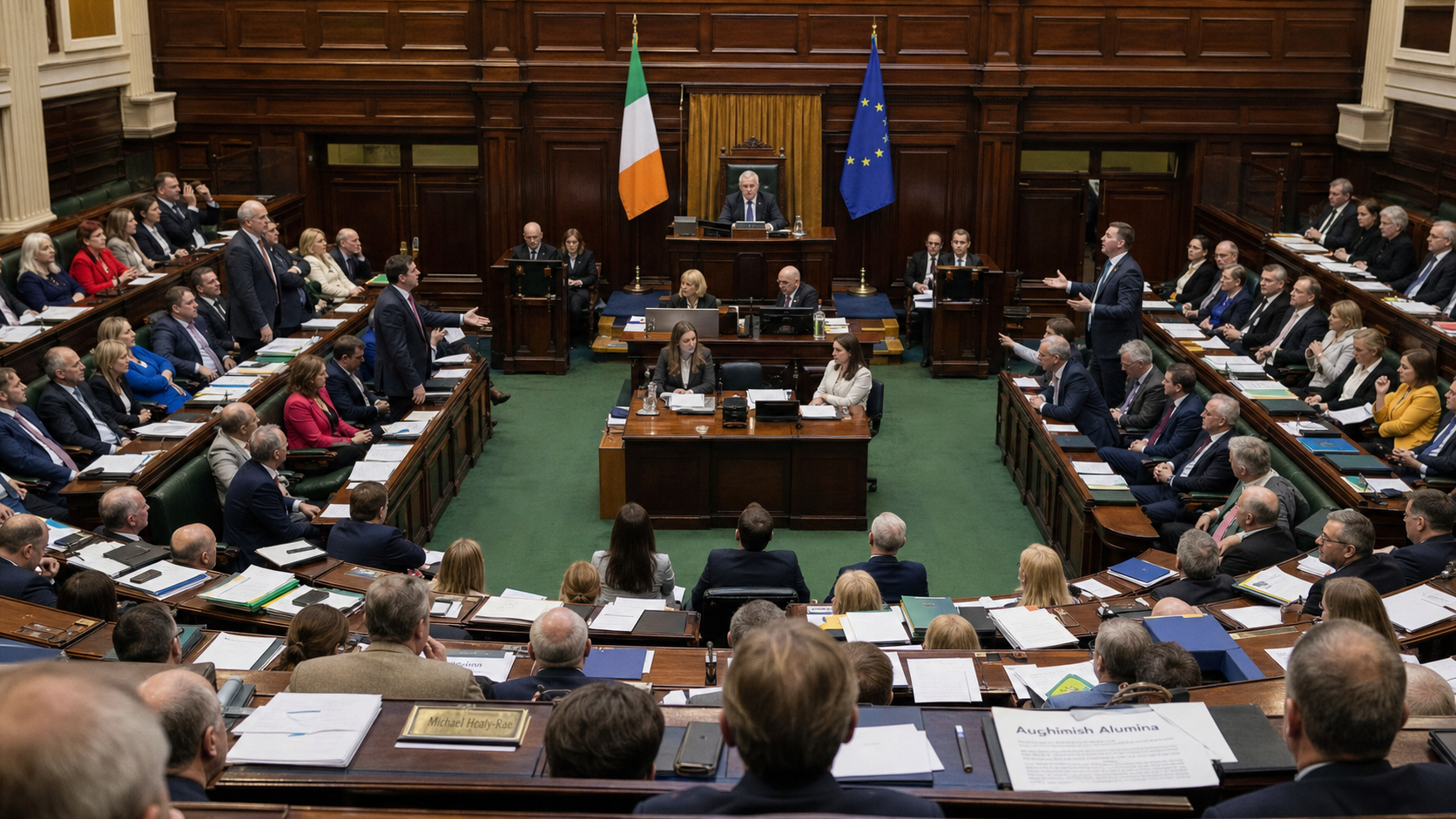
Political pressure on the Irish Government over Aughinish Alumina has intensified in the Dáil, with opposition parties arguing that Ireland's rotating EU Council Presidency — which began in July 2026 — makes decisive action on the Rusal-owned refinery in Co Limerick a matter of national credibility. The government faces a difficult balance between its stated commitment to supporting Ukraine and the significant employment implications of any action that could threaten the plant's operations.
Background
The Aughinish Alumina controversy has been building for over four years, since Russia's full-scale invasion of Ukraine in February 2022 brought renewed scrutiny to the operations of Russian-owned industrial assets within the European Union. Aughinish, which is owned by Rusal — the Russian aluminium giant linked to sanctioned oligarch Oleg Deripaska — is the largest alumina refinery in the EU and a significant employer in the mid-west region of Ireland.
The political sensitivity of the issue in Ireland reflects the tension between two legitimate concerns: the moral and strategic imperative to support Ukraine and to ensure that EU-based industrial activity is not contributing to Russia's war effort, and the economic imperative to protect the livelihoods of the 450 direct employees and approximately 1,450 people in indirect employment who depend on the plant. This tension has made the issue a difficult one for successive governments to navigate, and the investigation launched by the Department of Enterprise has been criticised by some as a mechanism for delay rather than action.
Ireland's assumption of the rotating EU Council Presidency in July 2026 has added a new dimension to the debate. As the country chairing EU Council meetings and setting the agenda for European legislative business, Ireland's handling of Ukraine-related issues is under particular scrutiny from partner governments and from the European Parliament. A perception that Ireland is protecting a Russian-owned industrial asset for economic reasons would be damaging to the country's credibility as a committed EU partner and supporter of Ukraine.
Key Developments
The Dáil debate has been sharpened by the revelation that Russia receives over 50% of Aughinish's production — a figure that has given opposition parties a concrete basis for their argument that the plant is making a material contribution to the Russian economy at a time of war. Sinn Féin, the Social Democrats, and People Before Profit have all called for the government to support EU-level sanctions on alumina exports, arguing that the employment argument, while legitimate, cannot be allowed to override Ireland's obligations under EU sanctions policy.
The government's position — that it will not object if the European Commission decides to include alumina on the sanctions list, but will not unilaterally advocate for such a move — has been characterised by critics as a form of diplomatic evasion. Taoiseach Micheál Martin has defended the approach, arguing that the appropriate forum for decisions about EU sanctions is the European Commission and the Council, not individual member states acting unilaterally.
The Attorney General's advice that the legal threshold for nationalisation of the plant has not been met has effectively ruled out that option, at least for now. This leaves the government with a limited range of options: support EU-level sanctions, impose national-level restrictions on the plant's operations, or continue to monitor the situation while the investigation's findings are processed.
Why It Matters
The Aughinish debate is a microcosm of a broader challenge facing EU member states: how to implement a coherent and effective sanctions policy against Russia while managing the domestic economic consequences of that policy. Ireland is not unique in facing this challenge — Germany's dependence on Russian gas, Hungary's resistance to sanctions, and Italy's concerns about the impact on its industrial sector have all created tensions within the EU's sanctions framework. But Ireland's position as a small, open economy with a strong commitment to EU solidarity makes the Aughinish case particularly visible.
The EU Presidency adds a specific dimension. Ireland's presidency programme includes a strong focus on Ukraine support and on the implementation of EU sanctions policy. If the government is seen to be equivocating on Aughinish while chairing meetings at which other member states are being pressed to maintain sanctions discipline, the contradiction will be difficult to sustain politically.
Local Impact
In Limerick and the Shannon region, the Aughinish debate is being followed with intense anxiety by workers, their families, and the businesses that depend on the plant's economic activity. The plant's payroll is a significant contributor to the local economy, and its closure — whether through sanctions, commercial decisions, or government action — would have consequences that would be felt across the region for years. Local politicians of all parties have been careful to acknowledge both the geopolitical concerns and the employment implications, and there is broad cross-party support for any action to be accompanied by a comprehensive plan for affected workers and communities.
What's Next
The government's investigation report is expected within the next two to three weeks. Following its publication, the Dáil's Joint Committee on Enterprise, Trade and Employment will hold hearings at which Minister Burke and other officials will be questioned on the findings. The European Commission is expected to consider the question of alumina sanctions in the context of its next sanctions package review, which is scheduled for the autumn. Swedish authorities conducting parallel investigations into Rusal's operations may provide additional evidence that informs the EU-level decision.