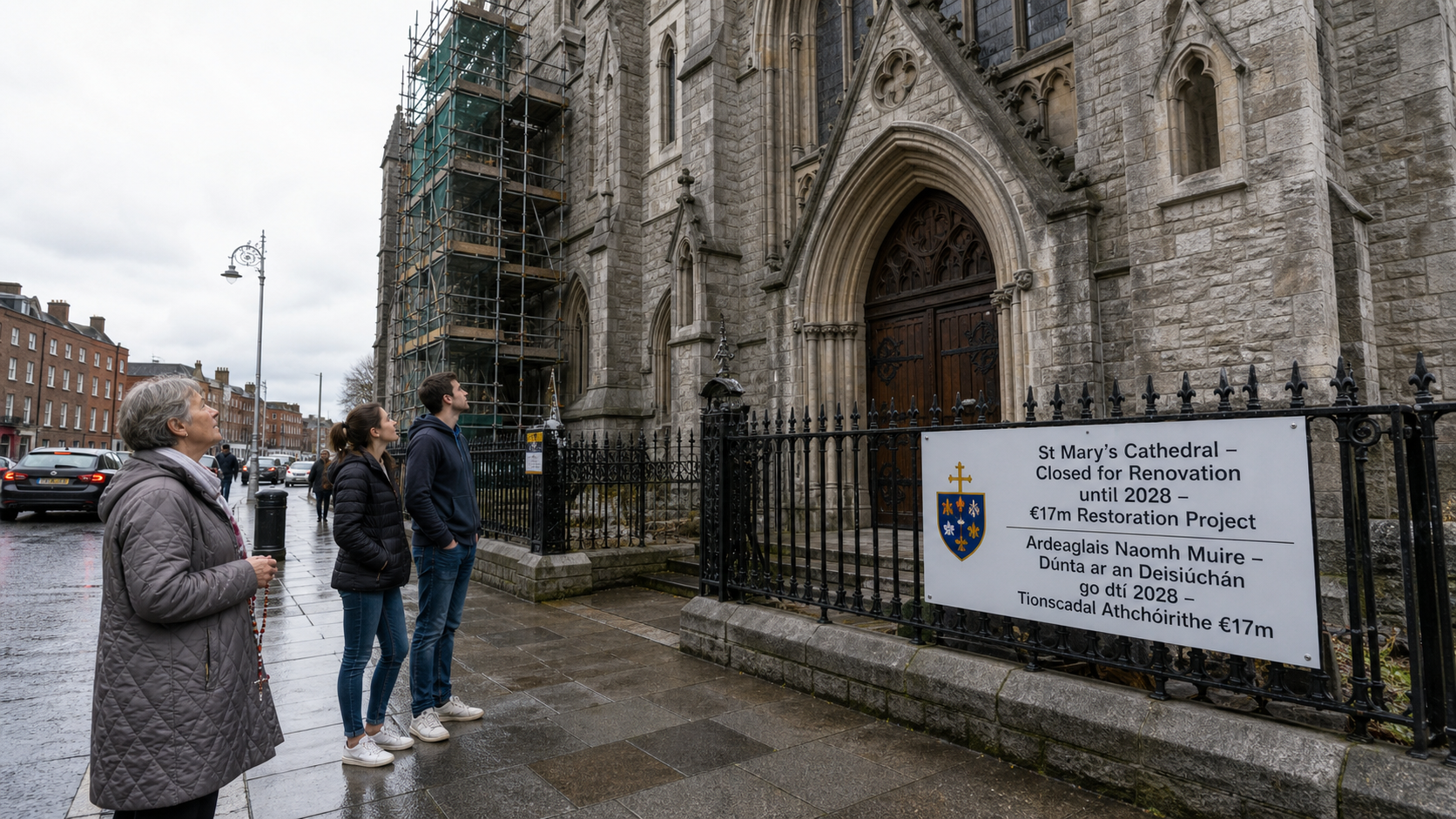
Dublin's New Catholic Cathedral Closes Today for €17 Million Two-Year Renovation
St Mary's Cathedral on Marlborough Street in Dublin — the building long known as the Pro-Cathedral and formally designated as the Catholic cathedral for the Archdiocese of Dublin by Pope Leo XIV in 2025 — has closed its doors today, 17 August, for a €17 million renovation project that is expected to take approximately two years to complete and will transform the building's infrastructure while preserving its historic character.
Background
St Mary's Cathedral has occupied a central place in the religious and cultural life of Dublin since its construction in the early nineteenth century. Built in the Greek Revival style and consecrated in 1825, the building has served as the principal Catholic church in the city for two centuries, hosting state funerals, papal visits, and the daily liturgical life of the Dublin Catholic community. Its designation as a full cathedral by Pope Leo XIV in 2025 — ending its long status as a pro-cathedral, a designation that reflected the historical anomaly of Christ Church Cathedral remaining in Church of Ireland hands — was a significant moment in the history of the Archdiocese.
The decision to undertake a major renovation was driven by the accumulated maintenance needs of a building that is now more than two hundred years old. The roof, in particular, has been identified as requiring urgent attention, with structural surveys indicating that significant work is needed to ensure the building's long-term integrity. The renovation also provides an opportunity to address accessibility issues that have made parts of the building difficult to use for people with mobility impairments, and to upgrade the mechanical and electrical systems that support the building's day-to-day operation.
The project has been developed under the "Twin Pillar" strategy adopted by Archbishop Dermot Farrell, which focuses on the complementary roles of St Mary's Cathedral and St Andrew's Church on Westland Row in serving the city centre Catholic community. The strategy reflects a recognition that the Archdiocese's resources are finite and that investment in the two principal city centre churches must be carefully planned and coordinated.
Key Developments
The €17 million renovation project encompasses a wide range of works. The structural and external programme focuses primarily on the roof, which will be comprehensively repaired and, where necessary, replaced. External accessibility upgrades will include improved ramp access and the installation of automatic doors at key entrances. Interior works will include the replacement of the mechanical and electrical systems, the installation of a new amplification system to improve the acoustic experience for worshippers, and the creation of a new baptismal area.
Significant investment is also being made in the facilities for the Palestrina Choir, one of Ireland's most distinguished choral ensembles, which has been associated with the cathedral since 1903. New rehearsal spaces, improved choral facilities, and a choral manuscript library will be created as part of the renovation. The Cathedral Girls' Choir will also benefit from upgraded facilities.
Three-quarters of the project's funding has been secured through private donors, with the remainder to be raised through ongoing fundraising. During the two-year closure, major diocesan liturgies will be held at St Andrew's Church on Westland Row, while the Palestrina Choir will be based at the College Chapel on the All Hallows Campus of Dublin City University.
Why It Matters
The renovation of St Mary's Cathedral is significant not just as a building project but as a statement about the Archdiocese of Dublin's commitment to its principal place of worship at a time when the Catholic Church in Ireland is navigating a period of profound change. Church attendance has declined significantly over the past three decades, and the institutional Church has faced enormous reputational damage as a result of the clerical abuse scandals. Against that backdrop, the decision to invest €17 million in the renovation of the cathedral is a signal that the Archdiocese intends to maintain a significant physical and cultural presence in the city.
The building itself is a piece of Dublin's architectural heritage that transcends its religious function. Its Greek Revival facade on Marlborough Street is one of the most distinctive streetscapes in the city centre, and its interior — with its coffered dome and classical columns — is among the finest examples of early nineteenth-century ecclesiastical architecture in Ireland. The renovation will ensure that this heritage is preserved for future generations, regardless of their relationship with the Catholic faith.
Local Impact
The closure of the cathedral will have a significant impact on the daily life of the Marlborough Street area and the broader city centre. The building attracts a substantial number of visitors — both worshippers and tourists — and its closure will redirect footfall to St Andrew's Church on Westland Row and to other city centre churches. Parish and sacramental activities will continue at St Joseph's Church on Berkeley Road during the renovation period. The Palestrina Choir's relocation to the DCU All Hallows Campus in Drumcondra will require adjustments for choir members and their families, but the choir's director has expressed confidence that the temporary arrangement will work well. Local businesses in the Marlborough Street area have been briefed on the closure and the expected timeline for reopening.
What's Next
The renovation is expected to be completed by late 2028, with a formal reopening ceremony planned to mark the occasion. The Archdiocese has indicated that it will provide regular updates on the progress of the works through its communications channels. A fundraising campaign to close the remaining gap in the project's financing is expected to be launched in the autumn, with a particular focus on engaging the Irish diaspora and corporate donors with connections to the city. Archbishop Farrell has indicated that the reopened cathedral will be a building fit for the twenty-first century — accessible, technologically equipped, and worthy of its status as the principal Catholic church in the capital.