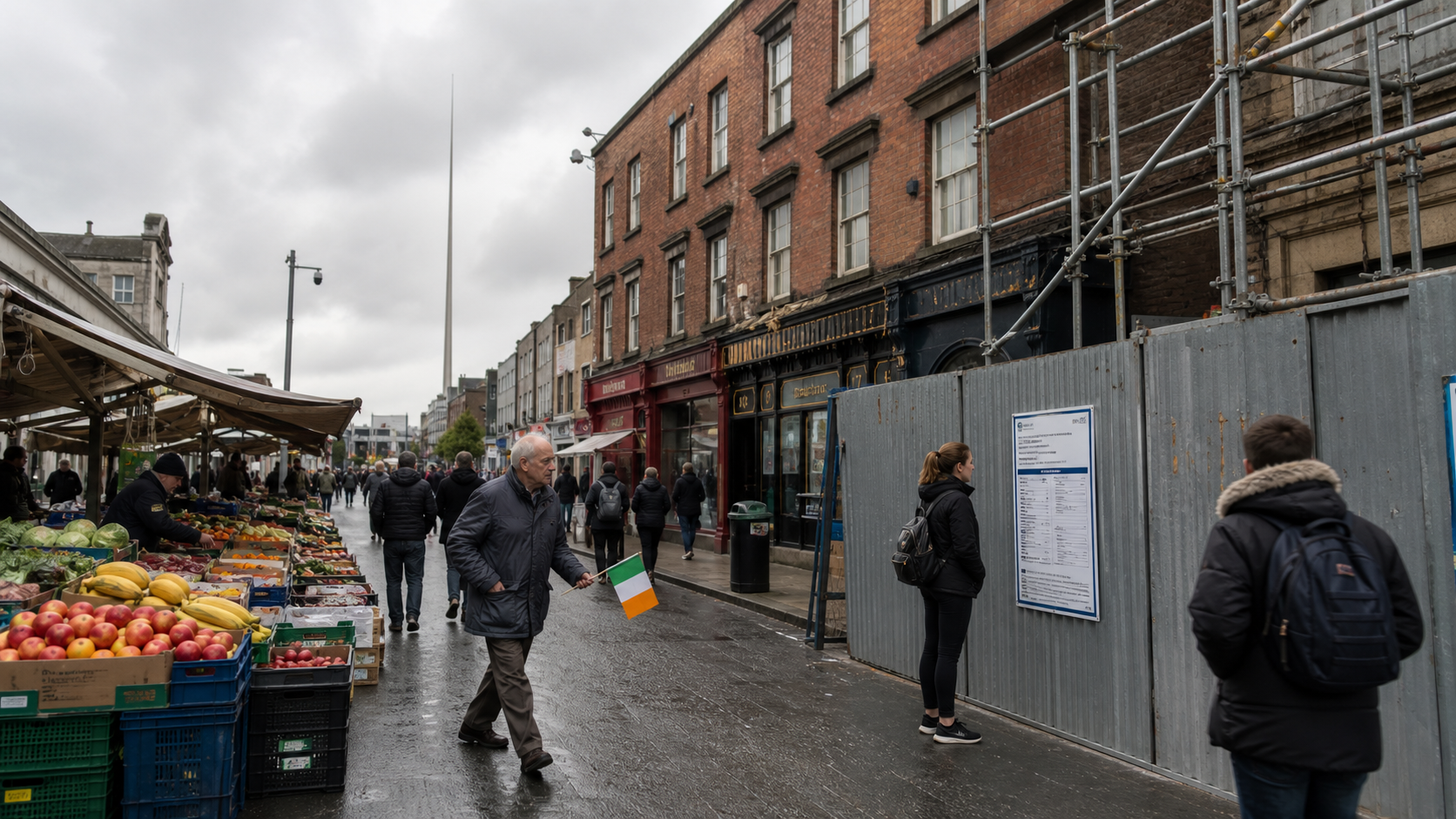
Dublin's Long-Delayed 1916 Rising Centre Finally Advances as Moore Street Planning Clears After a Decade of Controversy
Plans for a major cultural centre commemorating the 1916 Rising on Moore Street in Dublin are finally advancing, more than a decade after the project was first proposed in the aftermath of the centenary commemorations, with the government confirming that planning permission has been granted for the development and that construction is expected to begin in 2027 — bringing to a close a prolonged and often bitter planning dispute that has become a cause célèbre for heritage advocates and republican commemorative groups alike.
Background
Moore Street in Dublin's north inner city is one of the most historically significant sites in the story of Irish independence. It was to the buildings on Moore Street that the leaders of the 1916 Rising retreated after the GPO became untenable, spending their final hours before Patrick Pearse's surrender in the houses and laneways of what was then one of Dublin's most vibrant market streets. The buildings where the leaders sheltered — numbers 14 to 17 Moore Street — are among the most important physical remnants of the Rising, and their preservation and interpretation has been a matter of intense public interest since the centenary commemorations of 2016.
The centenary itself generated significant momentum for a major commemorative centre on the site, with the government committing to develop a cultural and heritage facility that would tell the story of the Rising and its aftermath in a way that was worthy of the event's significance. However, the project became entangled in a complex web of planning disputes, heritage controversies, and political disagreements about the appropriate scale and nature of the development. The surrounding Moore Street area, which had been the subject of a major commercial development proposal, added further complexity to the planning process.
The decade-long delay has been a source of considerable frustration for heritage advocates, republican commemorative groups, and the families of the 1916 leaders, who have argued that the failure to develop the site is a failure of the state's commitment to its own history. The buildings themselves have deteriorated during the period of uncertainty, adding urgency to the need for a resolution.
Key Developments
The government has confirmed that planning permission has been granted for the 1916 Rising Centenary Centre on Moore Street, following a lengthy planning process that involved multiple appeals and revisions to the original proposal. The approved development will incorporate the historic buildings at numbers 14 to 17 Moore Street, which will be restored and interpreted as part of a broader cultural facility that will include exhibition space, an education centre, and public amenities.
The Minister for Culture has described the planning approval as "a significant milestone" in the development of the site, noting that the project has been a priority for the government since the centenary commemorations. The Office of Public Works, which will manage the development, has indicated that a detailed design process will begin immediately, with construction expected to start in 2027 and the centre expected to open in 2029 — the 113th anniversary of the Rising.
Heritage advocates have broadly welcomed the planning approval, though some have expressed concern about specific aspects of the approved design and about the timeline for construction. The 1916 Relatives Association, which represents the families of the Rising's leaders, has called for the centre to be developed in close consultation with the families and with the broader republican commemorative community, to ensure that the interpretation of the events of Easter 1916 is accurate, respectful, and inclusive.
Why It Matters
The 1916 Rising Centenary Centre matters because Moore Street is one of the few physical sites in Dublin where the events of Easter 1916 can be directly experienced — where visitors can stand in the buildings where the leaders of the Rising spent their final hours and connect with the human reality of those events in a way that no museum exhibit or documentary can replicate. The preservation and interpretation of those buildings is not just a heritage matter — it is a question of how Ireland understands and communicates its own history to future generations and to the world.
The decade-long delay has also been a cautionary tale about the difficulty of delivering major heritage projects in Ireland, where the intersection of planning law, heritage protection, commercial interests, and political controversy can create a perfect storm of delay and inaction. The resolution of the Moore Street planning dispute is a positive development, but it should prompt reflection on how Ireland can do better in the future at protecting and developing its most significant heritage sites.
Local Impact
In the Moore Street area, the planning approval has been welcomed by local traders and community groups who have been living with the uncertainty of the site's future for more than a decade. The street, which retains its traditional market character despite the pressures of urban development, has suffered from the blight of the unresolved planning situation, with several properties in the area remaining vacant or underused. The development of the centenary centre is expected to bring significant footfall to the area and to support the regeneration of Moore Street as a cultural and commercial destination in Dublin's north inner city. The Dublin City Council has indicated that it will work with the OPW to ensure that the development is integrated with broader plans for the regeneration of the surrounding area.
What's Next
The Office of Public Works will begin the detailed design process for the 1916 Rising Centenary Centre in the coming weeks, with a design team expected to be appointed by the end of 2026. A public consultation on the design will be held in early 2027, before construction begins. The centre is expected to open in 2029, with a programme of events and exhibitions that will mark the 113th anniversary of the Rising. The government has indicated that the centre will be free to enter, in keeping with the principle that access to Ireland's national heritage should not be restricted by ability to pay.