Drumcree Parade Proceeds Down Garvaghy Road for First Time in 29 Years After Unprecedented Overnight Court Drama
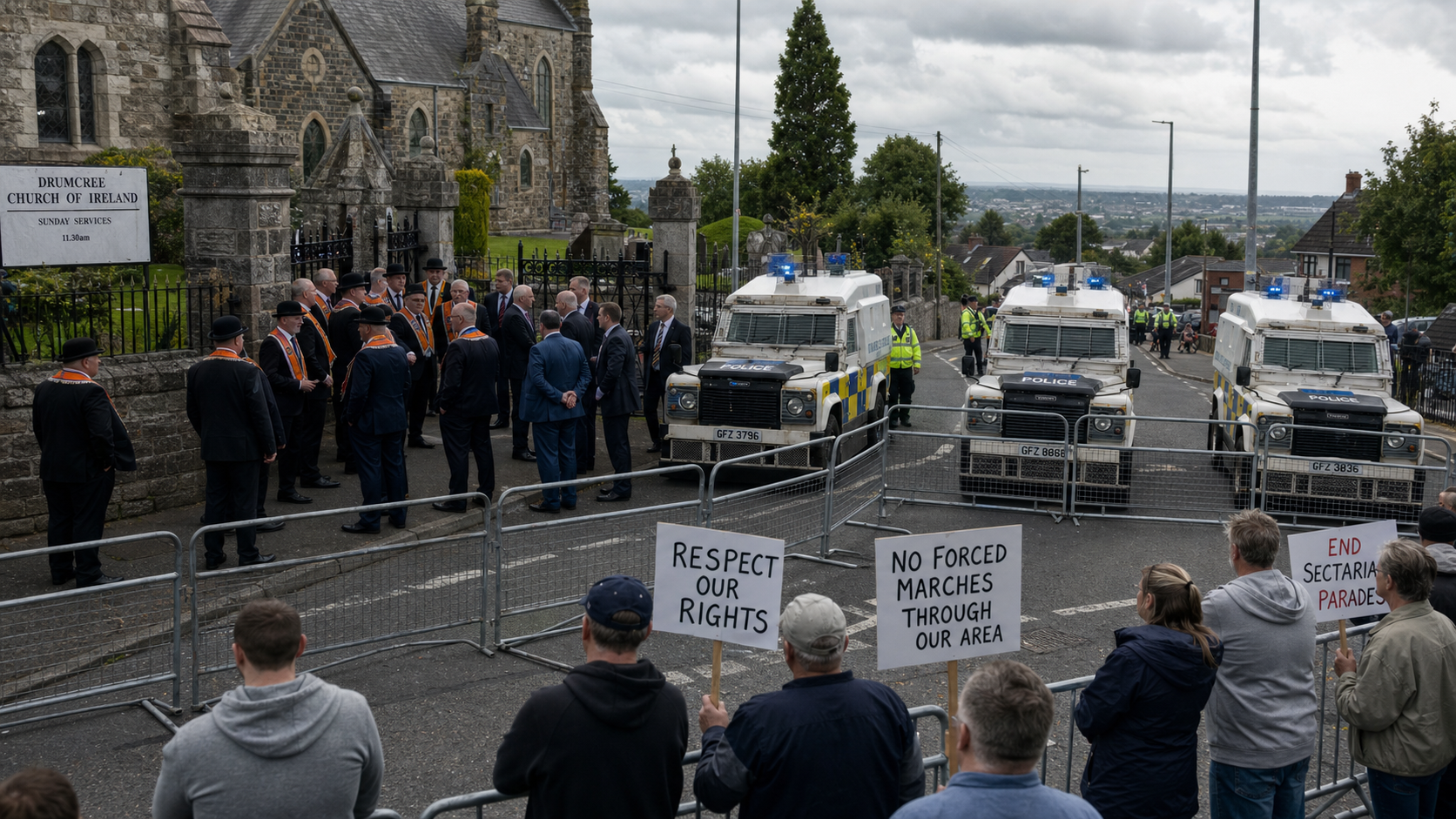
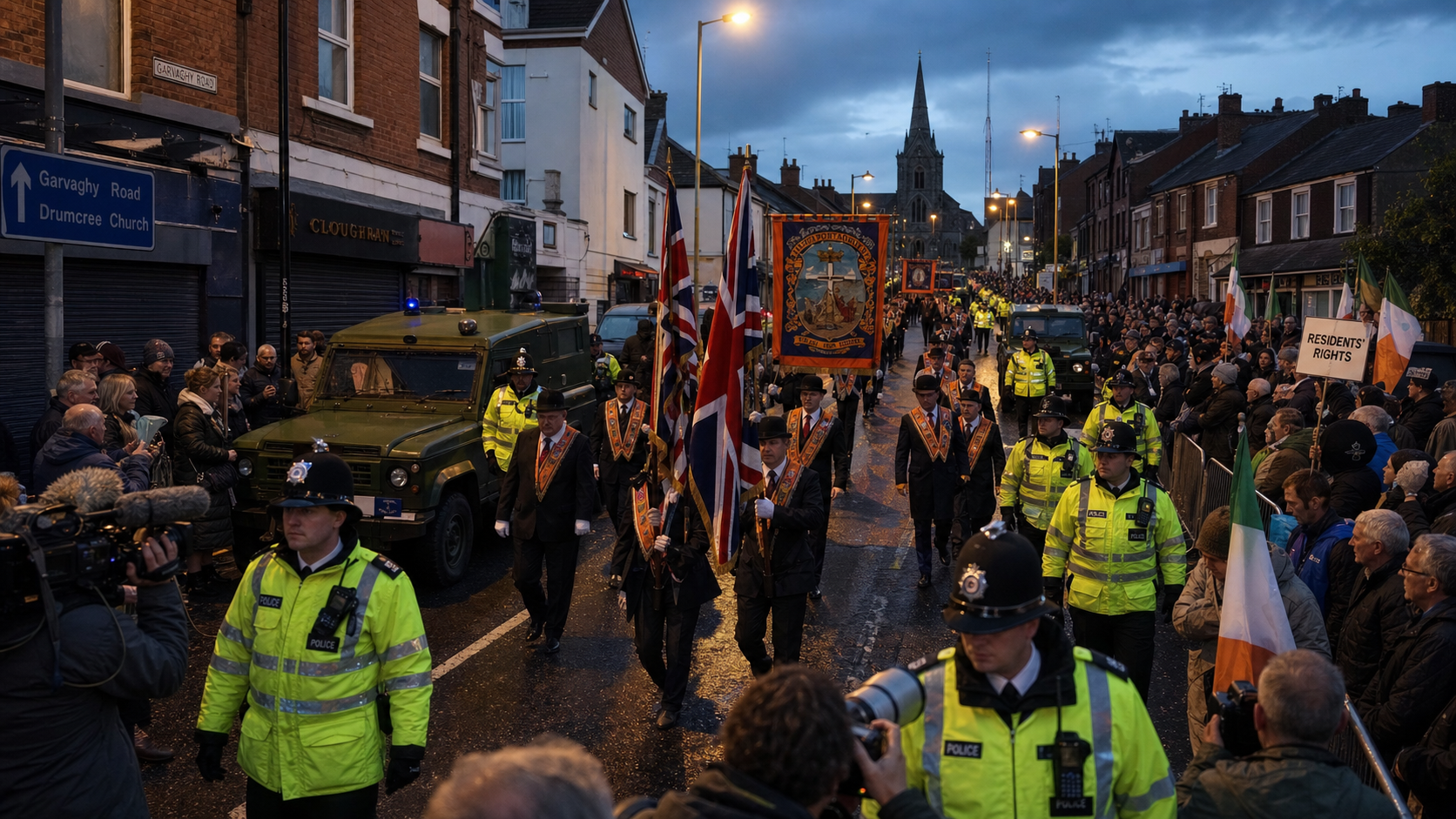
A restricted Orange Order parade has proceeded down the Garvaghy Road in Portadown for the first time in nearly 30 years, following an extraordinary sequence of overnight legal proceedings that saw the Court of Appeal overturn a High Court injunction in the early hours of Sunday morning, clearing the way for 35 Orangemen to march under strict Parades Commission conditions at 8:00am — a development that has reignited one of the most bitterly contested disputes in Northern Ireland's recent history.
Background
The Drumcree dispute has its roots in the annual tradition of the Portadown District Orange Order marching from Drumcree Church of Ireland along the Garvaghy Road — a route that passes through a predominantly nationalist residential area. The marches proceeded without significant controversy for decades, but as the demographics of the Garvaghy Road area shifted in the 1980s and 1990s, residents began to object to what they characterised as an unwanted and intimidating presence in their community.
The dispute came to a head in the mid-1990s, when the Parades Commission — established in 1998 under the Public Processions Act — began restricting the route. The summers of 1995, 1996, and 1997 saw serious disorder in Portadown and across Northern Ireland as the standoff between the Orange Order and the Garvaghy Road Residents' Coalition played out against the backdrop of the peace process. The 1998 marching season was particularly violent, culminating in the deaths of three young brothers — Richard, Mark, and Jason Quinn — in an arson attack on their home in Ballymoney that was widely attributed to the sectarian atmosphere generated by the Drumcree standoff. Since 1998, the Parades Commission has consistently restricted the parade from proceeding down the Garvaghy Road.
The 2026 controversy began in August, when the High Court quashed a previous Parades Commission determination on the grounds that not all commission members had signed off on the decision — a procedural error that required the commission to reconsider the matter from scratch. The reconsidered determination, issued in September, granted permission for a scaled-back march of 35 participants, with no bands, no supporters, and an 8:00am start time designed to minimise the potential for confrontation.
Key Developments
The Garvaghy Road Residents' Coalition immediately challenged the new determination in the High Court. On Saturday, September 26, Justice Patricia Smyth granted a temporary injunction blocking the parade, citing concerns about the PSNI's risk assessment and the potential for the dispute to escalate across Northern Ireland. The Orange Order appealed the injunction, triggering what Lady Chief Justice Dame Siobhan Keegan described as an "unprecedented" late-night sitting of the Court of Appeal.
In the early hours of Sunday morning, the Court of Appeal ruled that Justice Smyth had erred in law in granting the injunction, and remitted the matter to the High Court for a final hearing before Justice Michael Humphreys. Justice Humphreys, sitting in the early hours of Sunday, dismissed the residents' challenge, ruling that the Parades Commission's determination was reasonable and that the threshold for judicial interference with a public body's decision had not been met. The legal path was cleared for the parade to proceed.
Approximately 1,000 protesters gathered on the Garvaghy Road in anticipation of the march, with Sinn Féin leader Mary Lou McDonald and First Minister Michelle O'Neill among those who travelled to Portadown to address the crowd. O'Neill urged protesters to remain strong and united, describing the decision to allow the parade as deeply wrong. The PSNI deployed approximately 200 officers, including mutual aid from Scotland, to manage the situation. The 35 Orangemen marched in silence, as required by the Parades Commission conditions, completing the route without the disorder that many had feared.
Why It Matters
The Drumcree parade is not merely a local dispute about a stretch of road in Portadown. It is a barometer of community relations in Northern Ireland and a test of the institutions established under the Good Friday Agreement. The fact that the parade has proceeded for the first time in 29 years — not through negotiation or community consent, but through a sequence of legal manoeuvres — will be deeply troubling to those who believe that sustainable solutions to contested parades must be built on dialogue rather than litigation. The Parades Commission was established precisely to provide a structured, independent mechanism for resolving such disputes, and its authority has been upheld by the courts. But the residents of the Garvaghy Road, who were not party to any negotiated agreement, will experience the outcome as an imposition rather than a resolution. This is the third time in five years that a contested parade determination has ended up before the courts, suggesting that the commission's processes are increasingly being used as a starting point for litigation rather than a final word.
Local Impact
For the residents of the Garvaghy Road — a nationalist community in the heart of Portadown — Sunday's events will have been experienced as a profound shock. Many residents had believed that the 1998 restrictions represented a permanent settlement of the dispute, and the sight of Orange Order members marching through their area for the first time in nearly three decades will have reopened wounds that many had hoped were healing. The PSNI's deployment of 200 officers, including officers from Scotland, reflects the scale of the security operation required to manage the situation and the genuine risk of disorder that existed throughout the night. Community relations organisations working in the Portadown area have warned that the aftermath of Sunday's events will require careful and sustained engagement to prevent a deterioration in relations between the two communities.
What's Next
The Garvaghy Road Residents' Coalition has indicated that it will pursue further legal action, including a potential challenge to the Parades Commission's decision-making process. Political parties across the spectrum have called for an urgent review of the commission's procedures and the legal framework governing contested parades. The Northern Ireland Executive is expected to discuss the matter at its next meeting, with First Minister O'Neill and Deputy First Minister Emma Little-Pengelly likely to face questions about the government's response. The Orange Order, for its part, has indicated that it will seek to build on Sunday's march and apply for a full parade in 2027 — a prospect that will be viewed with alarm by the Garvaghy Road community and by those who fear a return to the disorder of the 1990s.