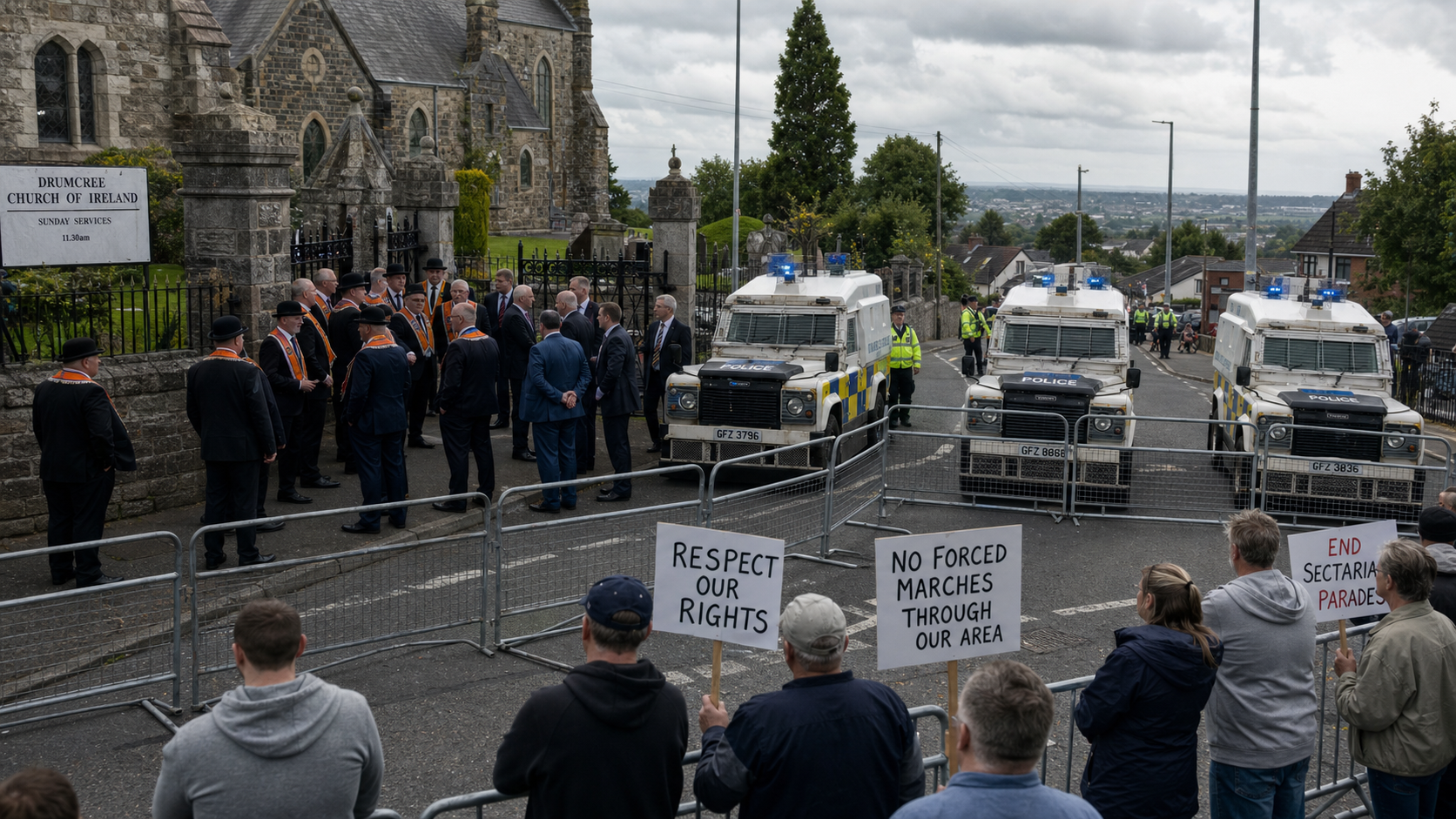
Drumcree Dispute Returns to Centre Stage as Sinn Féin Calls on Taoiseach to Visit Garvaghy Road Residents
The Drumcree dispute — one of the most bitterly contested flashpoints of the Troubles era — has returned to political prominence after a Belfast High Court ruling quashed a Parades Commission determination restricting an Orange Order parade, with Sinn Féin calling on Taoiseach Micheál Martin to visit the Garvaghy Road community in Portadown and First Minister Michelle O'Neill declaring the issue "closed" and the Orange Order's new application a "direct provocation".
Background
The Drumcree dispute centres on the Orange Order's desire to march along the Garvaghy Road in Portadown, County Armagh, a predominantly nationalist area that the Order's traditional parade route passes through. The dispute reached its most intense phase in the 1990s, when annual standoffs between Orange marchers and nationalist residents — backed by the Royal Ulster Constabulary — resulted in widespread violence, the deaths of three children in a petrol bomb attack in Ballymoney in 1998, and 21 sectarian murders directly linked to the tensions surrounding the parade.
The Parades Commission, established under the Public Processions (Northern Ireland) Act 1998, has consistently imposed restrictions on the Drumcree parade since 1998, preventing the Order from marching along the Garvaghy Road. For 28 years, those restrictions held, and the dispute — while never fully resolved — had receded from the front pages. The Garvaghy Road Residents Coalition maintained that the issue was settled, and successive Irish and British governments treated it as such.
The situation changed in September 2026 when the Belfast High Court quashed a Parades Commission determination on procedural grounds, finding that the commission's determination had not been considered in its "final form" by all members. The court was explicit that its ruling was not an endorsement of the parade itself, but the Orange Order moved quickly to submit a new application for a "limited" parade on 27 September 2026.
Key Developments
Sinn Féin's response to the new application has been unequivocal. Party leader Mary Lou McDonald highlighted the history of the dispute, noting that it had been settled for 28 years and that the potential for renewed conflict threatens "hard-won progress" in the peace process. MLA John O'Dowd urged Taoiseach Micheál Martin to travel to the Garvaghy Road to meet residents directly, arguing that the Irish government has a responsibility to stand with the community.
First Minister Michelle O'Neill declared the issue "closed," labelling the Orange Order's application a "direct provocation" intended to stir up fear and hatred. O'Neill's language was notably stronger than that of the Taoiseach, who addressed the matter in the Dáil and confirmed that the Irish government is keeping the situation under "constant review" while monitoring the Parades Commission's process regarding the new application.
The Garvaghy Road Residents Coalition has rejected the commission's appointed mediator, citing concerns about the mediator's neutrality and its previous work for the Orange Order. The Orange Order, for its part, has expressed readiness to enter mediation without preconditions, a position that its critics regard as a tactical manoeuvre rather than a genuine commitment to dialogue.
UK Secretary of State for Northern Ireland Chris Bryant has initiated a judge-led review into the Parades Commission's decision-making processes following criticism from unionist politicians who have called for the resignation of the commission's members. That review adds another layer of complexity to an already fraught situation.
Why It Matters
The return of the Drumcree dispute is a reminder that the peace process, while durable, is not irreversible. The Good Friday Agreement created the conditions for a more peaceful Northern Ireland, but it did not resolve the underlying tensions around identity, territory, and cultural expression that have defined the conflict for generations. Drumcree is one of the most potent symbols of those tensions, and its re-emergence as a live political issue is a source of genuine concern for those who have worked to build a stable, shared society in Northern Ireland.
The procedural nature of the High Court ruling — which quashed the Parades Commission determination on technical grounds rather than on the merits of the parade application — has created a legal vacuum that the Orange Order has moved to exploit. The commission must now consider the new application afresh, and its determination will be subject to intense scrutiny from all sides.
Local Impact
For the residents of the Garvaghy Road and the wider Portadown area, the return of the dispute is a source of profound anxiety. Many residents have vivid memories of the violence and intimidation that accompanied the standoffs of the 1990s, and the prospect of a renewed confrontation — even a "limited" one — is deeply unsettling. Community organisations in the area have been in contact with the Parades Commission and with political representatives from both governments to express their concerns.
The PSNI has been monitoring the situation closely and has indicated that it is prepared to manage whatever outcome the Parades Commission determines. However, policing a contested parade in Portadown would require significant resources and would carry substantial risks for community relations in the town and beyond.
What's Next
The Parades Commission is expected to issue a determination on the Orange Order's application for a 27 September parade in the coming days. Whatever it decides, the determination is likely to be challenged by one side or the other. The Taoiseach's office has indicated that Martin will consider the request to visit the Garvaghy Road community, but no date has been confirmed. The UK Secretary of State's review of the Parades Commission is expected to report its initial findings before the end of the year.