Daniel Kinahan Fails in Final Bid to Block Extradition from Dubai as Return to Ireland Nears
Suspected crime boss Daniel Kinahan has exhausted his legal options to prevent extradition from the United Arab Emirates to Ireland, where he faces charges of directing an organised crime group before the Special Criminal Court. While several diplomatic formalities remain to be completed before the transfer can take place, Irish authorities are understood to be preparing a major security operation for his return, which is expected to occur in the coming months.
Background
Daniel Kinahan, who is believed to be in his mid-40s, is the suspected leader of the Kinahan organised crime cartel, a transnational criminal organisation that has been linked to drug trafficking, money laundering, and a series of murders across Ireland and Europe. The cartel became the subject of intense international scrutiny following a violent feud with the Hutch crime gang that began in 2015 and resulted in 18 deaths, including the murder of David Byrne at the Regency Hotel in Dublin in February 2016.
Kinahan had been living in Dubai for a number of years, operating what he presented publicly as a boxing promotion business while allegedly continuing to direct the activities of the cartel. In 2022, the United States Treasury Department imposed sanctions on Kinahan and several associates, designating them as significant transnational criminal organisations and offering a $5 million reward for information leading to his arrest. The sanctions effectively cut Kinahan off from the international financial system and significantly complicated his business activities.
His arrest in Dubai in April 2026, executed on the basis of an extradition warrant issued by the Irish courts under a bilateral extradition agreement between Ireland and the UAE, was a significant moment in what had been a long and complex international law enforcement effort. The agreement between Ireland and the UAE, which was negotiated over several years, was specifically designed to address the gap in Ireland's extradition arrangements that had allowed individuals to shelter in Gulf states beyond the reach of Irish justice.
Key Developments
Kinahan's legal team mounted a series of challenges to the extradition process in the UAE courts, arguing on grounds that included procedural irregularities and concerns about the conditions he would face in Irish custody. Each of those challenges was rejected, and his final appeal was dismissed in late July 2026, clearing the legal path for his transfer to Ireland.
The extradition follows the successful prosecution of Sean McGovern, described by the Garda National Drugs and Organised Crime Bureau as a "senior lieutenant" in the Kinahan cartel, who was sentenced to 24 years in prison in July 2026 for directing the activities of a criminal organisation. McGovern's conviction, which was based on extensive surveillance and intelligence gathered over several years, demonstrated the capacity of the Irish justice system to prosecute complex organised crime cases.
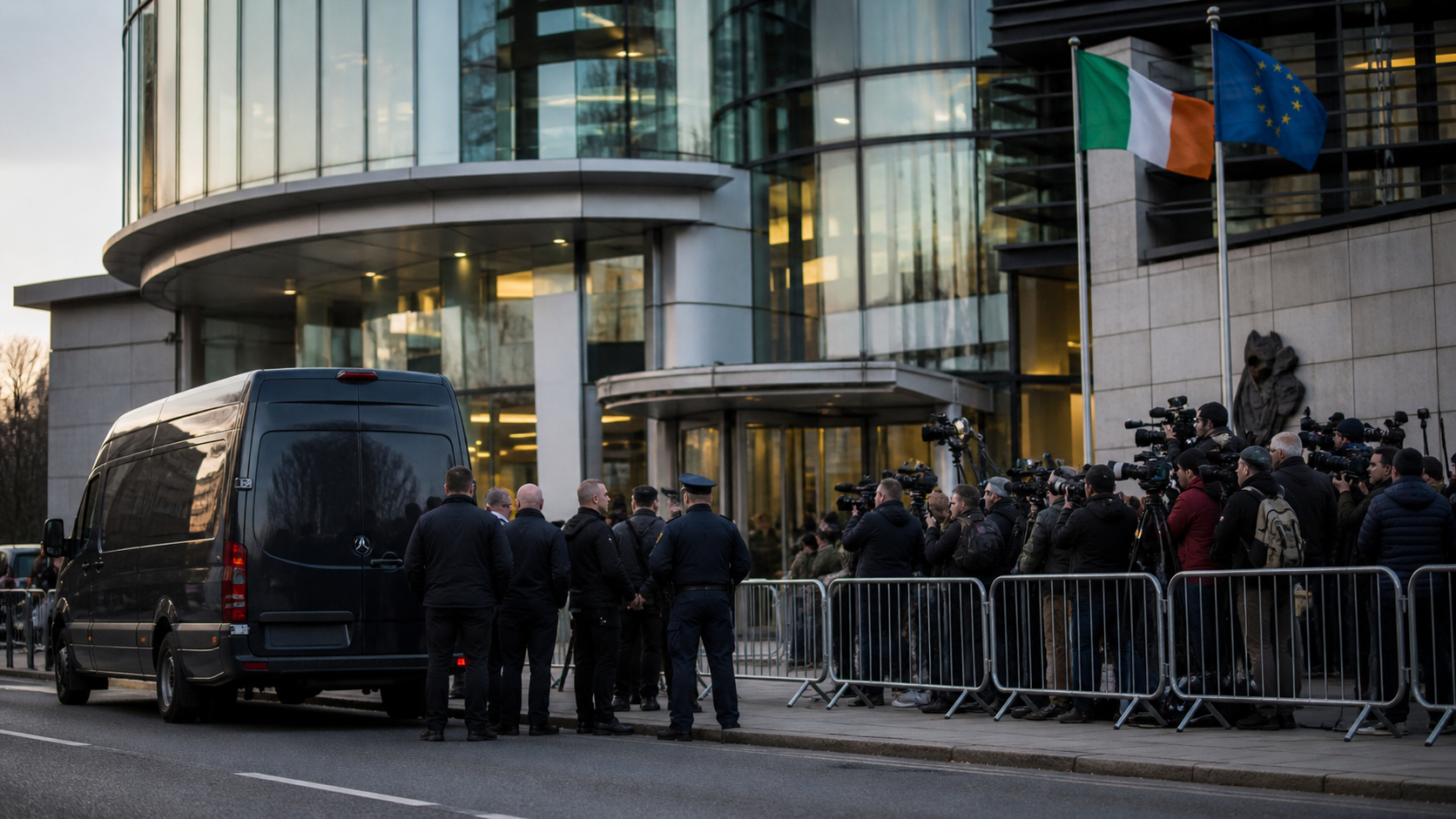
Irish authorities are planning a significant security operation for Kinahan's return. It is understood that he will be transported via an Irish Air Corps C295 aircraft, landing at Casement Aerodrome in Baldonnel, County Dublin. The Irish Prison Service has acquired new armoured prisoner transport vehicles equipped with ballistic protection in preparation for his arrival, and he is expected to be held at the maximum-security facility in Portlaoise.
Why It Matters
Kinahan's extradition, when it occurs, will represent one of the most significant moments in the history of Irish organised crime enforcement. The Kinahan cartel has been responsible for enormous harm — not just the deaths directly attributable to the feud with the Hutch gang, but the broader damage caused by the drug trafficking operations that fund the organisation's activities. Bringing the alleged leader of that organisation before an Irish court is a statement about the reach and determination of Irish law enforcement.
The case also has implications for Ireland's international law enforcement relationships. The extradition agreement with the UAE was a diplomatic achievement that required sustained effort over several years, and its successful application in the Kinahan case will strengthen the argument for similar agreements with other jurisdictions where Irish criminals have sought refuge. The cooperation of the UAE authorities in this case has been noted with appreciation by the Irish government.
The Special Criminal Court, before which Kinahan is expected to appear, is a non-jury court established to try serious organised crime and terrorism cases. Its use in this case reflects the assessment of the Director of Public Prosecutions that the ordinary courts system is not appropriate for a case of this sensitivity and complexity.
Local Impact
For the families of those killed during the Kinahan-Hutch feud, the prospect of Kinahan facing justice in an Irish court is a moment they have waited years for. The feud claimed 18 lives between 2015 and 2018, leaving a trail of grief across communities in Dublin's north inner city and beyond. Victim support organisations have welcomed the news of the failed extradition appeal, while cautioning that the legal process ahead will be lengthy and that the outcome is not guaranteed.
What's Next
The remaining diplomatic formalities between Ireland and the UAE are expected to be completed within the coming weeks, after which a date for Kinahan's transfer can be finalised. Upon his arrival in Ireland, he will be brought before the Special Criminal Court, where the charges against him will be formally put. The trial itself is likely to be one of the most complex and high-profile criminal proceedings in the history of the Irish state, and is expected to take several years to complete.