Criminal Defence Solicitors Extend Boycott of Dublin Courts as Legal Aid Flat Fee Dispute Leaves Defendants Without Representation
Criminal defence solicitors across Ireland have extended their withdrawal of services from district courts, deepening a dispute over a new flat-fee legal aid payment structure that they say is unworkable and forces them to provide complex legal representation for free — a standoff that has left defendants without lawyers, caused court backlogs stretching to December, and triggered High Court rulings that some detentions are unlawful.
Background
The criminal legal aid system in Ireland is one of the cornerstones of the constitutional right to a fair trial. Under the system, defendants who cannot afford legal representation are entitled to have a solicitor appointed at the state's expense. The system has, for decades, operated on a per-appearance basis: solicitors were paid approximately €239 for the first court appearance and roughly €60 for each subsequent hearing. This model, while imperfect, provided a degree of financial predictability for solicitors taking on legal aid cases and ensured that defendants received continuous representation throughout the often lengthy process of criminal proceedings.
On 1 July 2026, Minister for Justice Jim O'Callaghan introduced a new payment model that replaced the per-appearance system with a flat fee of €520 per client, regardless of the number of court appearances or the complexity of the case. The minister argued that the old system incentivised unnecessary adjournments — a practice that contributed to the chronic delays that have long plagued the Irish criminal justice system — and that the flat fee would provide better value for the state while still adequately compensating solicitors for their work.
The solicitors' response was immediate and unequivocal. Criminal defence practitioners across Dublin and Munster argued that the flat fee was unsustainable, particularly for complex cases involving multiple appearances, vulnerable clients, or fitness-to-plead issues. They warned that the new system would effectively force them to work for free on the most demanding cases and that many solicitors would simply stop taking legal aid work — with devastating consequences for defendants who cannot afford private representation.
Key Developments
The withdrawal of services, which began in the weeks following the introduction of the new fee structure, has now extended to the point where its impact on the criminal justice system is severe. Court backlogs have grown significantly, with some hearings being deferred until December 2026. Defendants have appeared in court without legal representation, and in several cases, individuals have been denied bail due to the absence of a solicitor — a situation that has prompted High Court interventions ruling such detentions unlawful and a violation of fundamental rights.
The state is now facing mounting legal bills as a result of these High Court challenges, adding a financial dimension to a dispute that was already politically sensitive. The solicitors have proposed two specific modifications to the minister's plan: that legal aid certificates be issued per case on separate dates, with a cap of five certificates per defendant per court per day; and that a further legal aid certificate be issued for cases that exceed ten court appearances, to account for complex matters.
Minister O'Callaghan has introduced some concessions — including allowing for staged payments and increasing certain fees — but these have been rejected by the solicitors as insufficient. A judicial review initiated by solicitor John Quinn is currently challenging the statutory instrument behind the new scheme, with the High Court expected to deliver its judgment on 13 October 2026.
The Law Society of Ireland has called for urgent talks between the minister and the solicitors' representative bodies, warning that the ongoing dispute is causing "serious and irreparable harm" to the criminal justice system. Chief Justice Donal O'Donnell has also expressed concern about the impact of the boycott on the courts' ability to function effectively.
Why It Matters
The legal aid dispute matters because it goes to the heart of the constitutional guarantee of a fair trial. The right to legal representation is not a luxury; it is a fundamental protection against the power of the state. When defendants appear in court without a solicitor — whether because they cannot afford one or because the legal aid system has broken down — the integrity of the criminal justice process is compromised.
The dispute also raises important questions about the government's approach to public spending on justice. The flat-fee model was introduced as a cost-saving measure, but the High Court challenges and the resulting legal bills suggest that the savings may be illusory. A system that generates unlawful detentions and constitutional challenges is not an efficient system, whatever its headline cost.
For comparison, similar disputes over legal aid fees in England and Wales in 2022 and 2023 resulted in significant disruption to the criminal justice system before a negotiated settlement was reached. The Irish government would do well to study those precedents before the current dispute causes further damage.
Local Impact
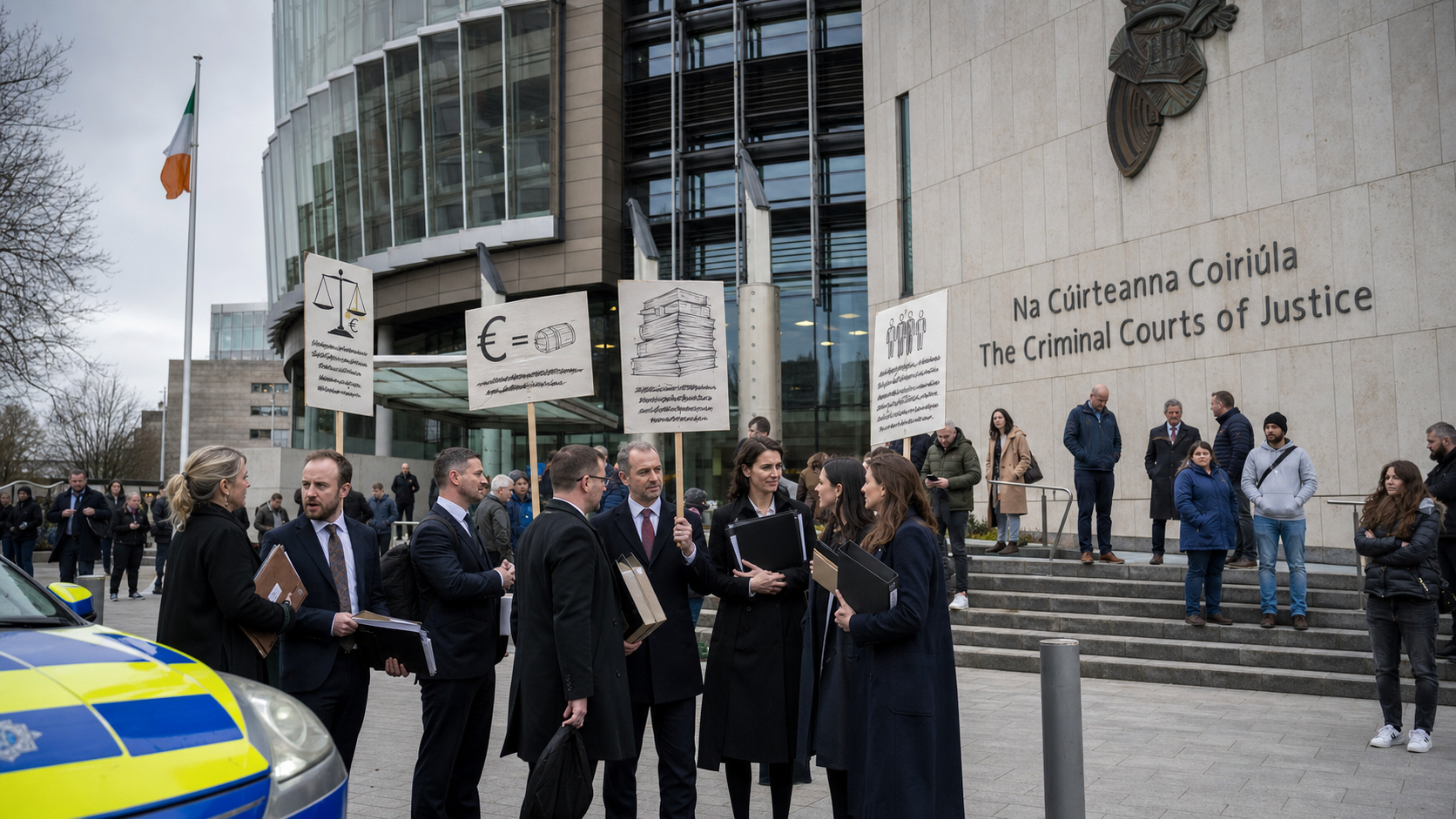
In Dublin's district courts — at the Criminal Courts of Justice on Parkgate Street, at the Bridewell, and at courts across the city — the impact of the boycott is visible and immediate. Courtrooms that would normally be busy with legal aid cases are operating at reduced capacity, with judges forced to adjourn matters that cannot proceed without legal representation. Defendants who are in custody are particularly affected, as delays in their cases mean longer periods on remand.
In Munster, where solicitors have also withdrawn their services, the impact is felt in Cork, Limerick, and Waterford district courts. Community legal aid centres, which provide advice and representation to some of the most vulnerable members of society, have reported increased demand as defendants seek alternative sources of help.
What's Next
The High Court is expected to deliver its judgment on the judicial review of the flat-fee scheme on 13 October 2026. In the meantime, the Law Society has called for an emergency meeting between the minister and solicitors' representatives, and there are indications that the minister may be willing to engage in further talks if the solicitors agree to suspend their withdrawal of services. The outcome of the judicial review will be a significant factor in determining whether a negotiated settlement is possible, or whether the dispute escalates further.