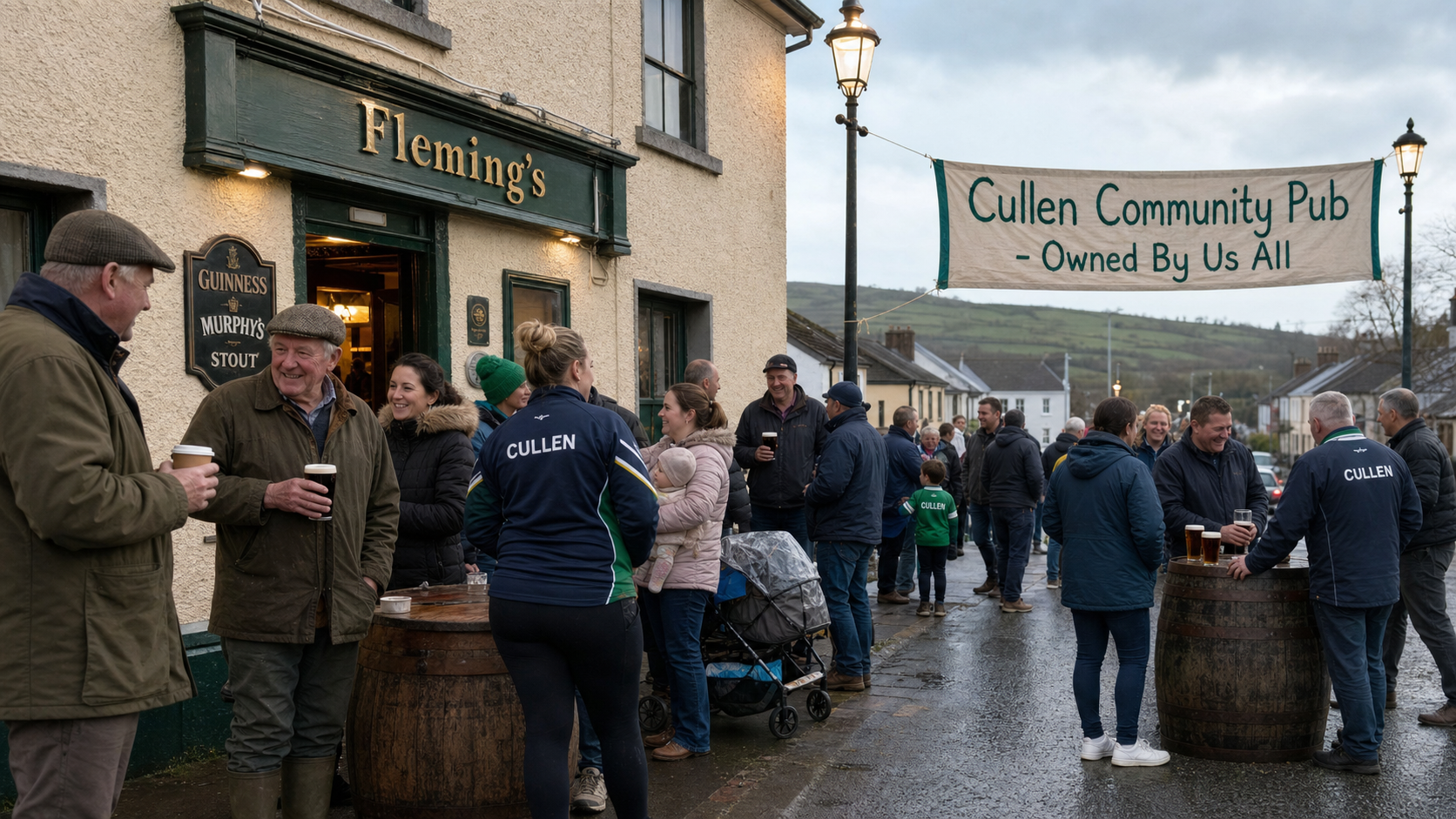
Cork Village Rallies to Buy Its Last Pub and Keep Community Spirit Alive
The residents of Cullen, a small village in North Cork, have completed the purchase of Fleming's Tavern — the last pub in their community — after a grassroots fundraising campaign that captured the imagination of people far beyond the parish boundaries. The effort, which began in late 2025 after the pub closed its doors in September of that year, has been described by organisers as a triumph of collective will over the forces of rural decline.
Background
Fleming's Tavern, also known locally as Art O'Connor's, had been a fixture of Cullen village life for generations. When it closed in September 2025, it left the community without a single licensed premises — a situation that has become increasingly common in rural Ireland as the economics of small-scale hospitality grow ever more challenging. The closure prompted immediate concern among residents, particularly about the impact on older members of the community who relied on the pub as a social anchor.
The broader context is a troubling one for rural Ireland. Hundreds of rural pubs have closed across the country over the past two decades, with the trend accelerating in the years following the pandemic. In many villages, the pub is not merely a place to drink but the last remaining communal space — the venue for wakes, fundraisers, birthday celebrations, and the informal conversations that bind a community together. When it goes, something irreplaceable goes with it.
The property, which includes an adjoining four-bedroom house, was listed for sale at €300,000. For a small rural community, that represented a formidable financial target. But local resident Damian Hickey and a group of neighbours refused to accept that the pub was simply gone. They formed a fundraising committee, began reaching out to the wider diaspora, and launched a campaign that quickly gained traction on social media and in local media.
Key Developments
The response to the campaign exceeded all expectations. Donations arrived not just from Cullen and the surrounding parishes but from Irish people across the country and abroad who recognised in the story something universal about the threat to rural community life. The committee described the level of support as "phenomenal," with contributions ranging from small individual donations to more substantial pledges from businesses and community organisations.
By August 2026, the purchase had been completed. The committee confirmed that the transaction had gone through and that planning was now under way for the reopening of the premises. While the precise timeline for reopening has not yet been confirmed, organisers have indicated that they intend to run the pub as a community-owned enterprise, with a governance structure that ensures it remains in local hands for the long term.
The model being considered draws on examples from elsewhere in Ireland and Britain, where community-owned pubs have demonstrated that the model can be both financially sustainable and socially transformative. In several cases, community pubs have expanded their offering beyond alcohol to include food, events, and local services, becoming genuine hubs of rural life rather than simply licensed premises.
Why It Matters
The Cullen story matters because it represents a genuine alternative to the narrative of inevitable rural decline. For too long, the closure of rural pubs, post offices, and schools has been treated as an economic inevitability — the market speaking, and communities simply having to accept the verdict. What the people of Cullen have demonstrated is that communities can, when sufficiently motivated and organised, push back against that verdict and reclaim the infrastructure of their own social lives.
There is also a public health dimension to this story that deserves acknowledgement. Social isolation is one of the most significant health challenges facing rural Ireland, particularly among older men. The research is unambiguous: loneliness is associated with significantly elevated risks of depression, cognitive decline, and premature death. The pub, for all its imperfections, has historically served as a counterweight to that isolation — a place where people show up, talk to each other, and feel part of something larger than themselves. Losing that space has real consequences that do not show up in any economic model.
The success of the Cullen campaign will also be watched closely by other communities facing similar situations. There are dozens of villages across Munster, Connacht, and Ulster where the last pub is either closed or at risk of closure. If the Cullen model can be replicated — and there is no reason in principle why it cannot — it could offer a template for community-led responses to rural decline that goes well beyond the pub trade.
Local Impact
For Cullen itself, the immediate impact is straightforward: the village will once again have a pub. But the significance runs deeper than that. The campaign has already strengthened community bonds, brought people together around a shared project, and demonstrated to younger residents that their village is worth fighting for. The fundraising process itself — the meetings, the social media posts, the conversations with donors — has been a form of community building in its own right.
The adjoining four-bedroom house that forms part of the property may also offer possibilities for the future, whether as accommodation for a manager, a community space, or some other purpose that serves local needs. The committee has indicated that decisions about the full use of the property will be made collectively, in keeping with the spirit of the campaign that made the purchase possible.
What's Next
The immediate priority for the committee is to finalise the governance structure for the community-owned enterprise and to begin the process of preparing the premises for reopening. Planning permission may be required for any significant alterations to the building, and the committee will need to navigate the licensing process for the new ownership structure. A target date for reopening has not yet been publicly confirmed, but organisers have expressed confidence that the pub will be serving pints before the end of 2026. The story of Cullen's last pub is, it seems, far from over.