Cork University Hospital Warns HSE of 'Unsafe' Conditions as Staffing Deficit Exceeds 1,000 Posts
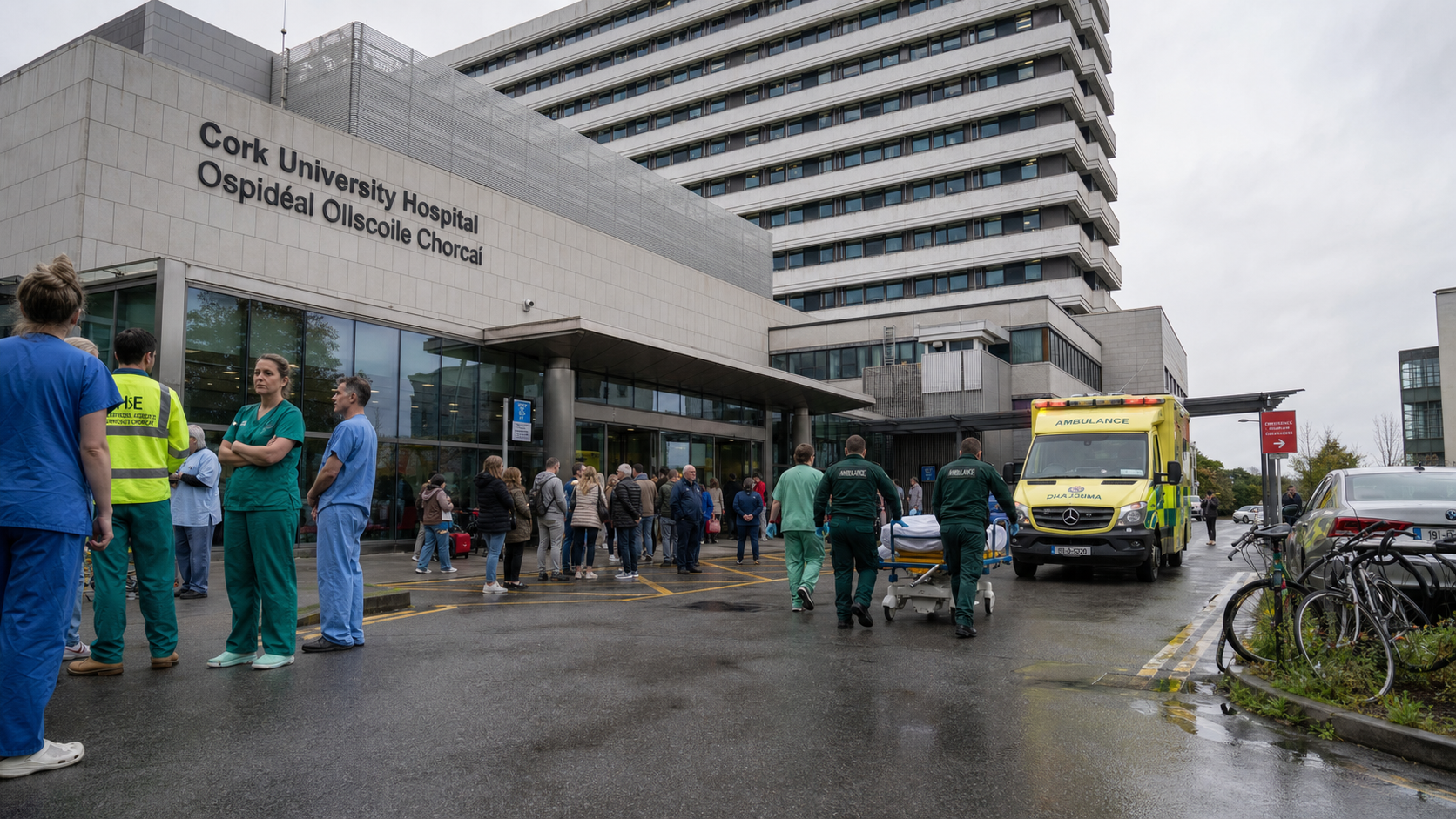
Cork University Hospital chief executive Jennifer Kearney has formally warned the Health Service Executive that the hospital is operating in conditions that are neither sustainable nor safe for patients, with a staffing deficit of more than 1,000 whole-time equivalent posts that has forced the restriction of CT scanning, the outsourcing of lung capacity testing, and the cancellation of complex paediatric neurology appointments.
Background
Cork University Hospital is the largest acute hospital in Munster and one of the busiest in the country, serving a catchment area that encompasses Cork city and county, parts of Kerry, Limerick, and Tipperary. It is a tertiary referral centre for a range of specialist services, including cardiac surgery, neurology, oncology, and paediatrics, and it operates one of the busiest emergency departments in the State. The hospital is also a major teaching hospital, affiliated with University College Cork, and it plays a central role in the training of doctors, nurses, and allied health professionals across the south of Ireland.
The staffing crisis at CUH is not new. The hospital has been operating with significant vacancies for several years, driven by a combination of recruitment difficulties, employment restrictions imposed by the HSE, and the broader challenges of attracting and retaining healthcare workers in a competitive labour market. But the scale of the current deficit — more than 1,000 whole-time equivalent posts — is unprecedented, and the formal warning from the chief executive to the HSE represents an escalation of the hospital's concerns to a level that demands a response.
The letter from Jennifer Kearney to HSE management, which has been seen by several media outlets, describes a hospital that is managing a 12 per cent increase in patient demand while operating with a workforce that is significantly below the level required to deliver safe care. Admissions for patients aged over 75 are running at twice the national average, reflecting the demographic profile of the hospital's catchment area and the particular pressures associated with caring for an ageing population.
Key Developments
The specific impacts of the staffing deficit are stark. The hospital has been forced to restrict CT scanning capacity due to a shortage of radiographers — a constraint that affects the speed and accuracy of diagnosis for a wide range of conditions, including cancer, stroke, and trauma. Lung capacity testing has been outsourced to private providers because the hospital lacks the staff to deliver it in-house. Complex appointments in paediatric neurology — a service that is critical for children with conditions such as epilepsy, cerebral palsy, and rare neurological disorders — have been cancelled.
The letter also highlights a specific and particularly frustrating aspect of the crisis: 24 funded consultant posts, including roles in cardiology, anaesthesiology, and various surgical and paediatric specialties, remain unfilled because of an HSE embargo on new appointments. Some of the consultants who would fill these posts have already accepted offers and are ready to start work; they cannot do so because the formal contracts have not been issued. Kearney has called for an immediate derogation from the employment restrictions to allow these appointments to proceed.
The HSE South West has acknowledged the staffing pressures at CUH but has maintained that the hospital is operating approximately 260 whole-time equivalent staff above its approved limit — a claim that hospital management disputes, arguing that the approved limit does not reflect the clinical necessity of the posts required to maintain patient safety.
Why It Matters
The CUH situation is a microcosm of a broader crisis in the Irish health system. The HSE's employment control framework — designed to manage the overall cost of the public health service — has created a situation in which hospitals are unable to fill funded posts even when the clinical need is clear and the candidates are available. The result is a paradox: a health service that is simultaneously overspending on agency and locum staff to cover gaps created by the inability to hire permanent employees.
The winter period, which typically sees a significant increase in demand for acute hospital services, is now only weeks away. CUH's busiest July on record — cited in Kearney's letter — is a warning sign that the hospital is already operating at or near capacity before the seasonal surge begins. If the staffing situation is not addressed before winter, the consequences for patients could be severe.
The broader context is one of a health system that has been under sustained pressure for years. The Sláintecare reform programme, which aims to move Ireland toward a universal single-tier health service, has made progress in some areas but has struggled to address the fundamental workforce and infrastructure challenges that underpin the current crisis. CUH's situation is a reminder that the gap between the ambition of health policy and the reality of health service delivery remains very wide.
Local Impact
For patients in Cork city and county, the staffing crisis at CUH has immediate and tangible consequences. Longer waits for CT scans mean delayed diagnoses. Cancelled paediatric neurology appointments mean children with serious neurological conditions going without specialist review. Restricted emergency surgical capacity means that patients who need urgent intervention may face longer waits or transfers to other hospitals.
The hospital's emergency department, which serves the south side of Cork city and the wider county, is already under significant pressure. The restriction of diagnostic services compounds that pressure by slowing the throughput of patients through the department and increasing the time spent on trolleys waiting for beds.
What's Next
Kearney has demanded an immediate escalation of the workforce situation to the HSE executive team and a derogation from current employment restrictions to reflect the specific patient safety risks at CUH. The HSE is expected to respond formally within the next week. The Department of Health has been briefed on the situation, and Minister for Health Stephen Donnelly is understood to be monitoring developments closely. A formal review of the hospital's staffing situation is expected to be completed before the end of September, with a view to implementing emergency measures before the winter surge begins.