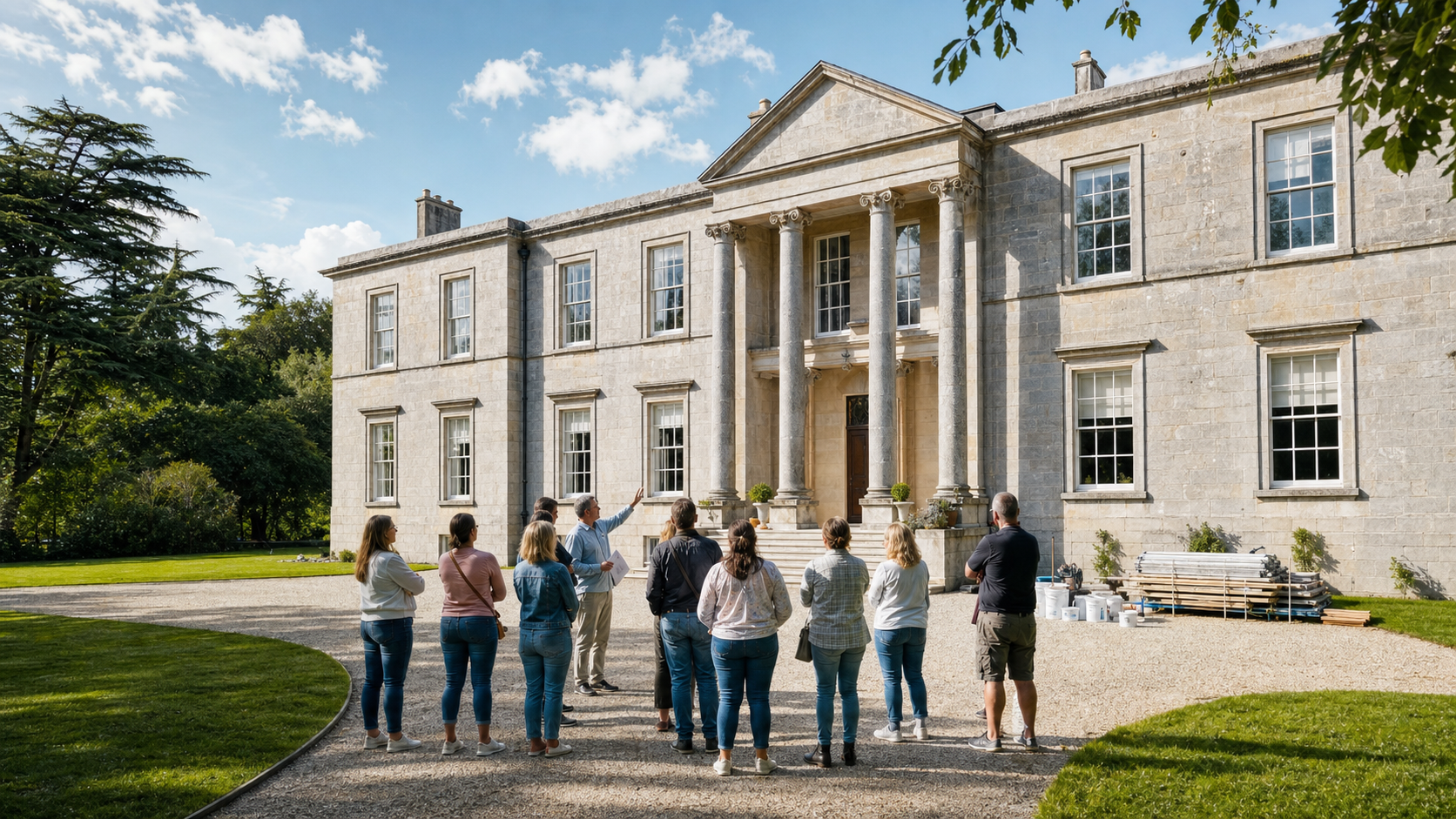
Coollattin House: The Wicklow Mansion Rescued from Ruin by Seven People Opens Its Doors for Heritage Week
Coollattin House, a 65,000 square foot Palladian mansion near Shillelagh in County Wicklow that was on the verge of irreversible collapse when a partnership of seven individuals purchased it in 2021, has opened its doors to the public for National Heritage Week 2026, offering guided tours that tell one of the most extraordinary conservation stories in modern Irish history — and a powerful argument for what determined private citizens can achieve when the State cannot or will not act.
Background
Coollattin House has a history that stretches back three centuries and is deeply intertwined with some of the most significant events in Irish social history. The estate was owned for generations by the Fitzwilliam family, one of the great Anglo-Irish landowning dynasties, and it was from Coollattin that thousands of families were assisted — or, depending on one's perspective, compelled — to emigrate during the Great Famine of the 1840s. The Fitzwilliams funded the passage of approximately 6,000 tenants to Canada and the United States between 1847 and 1856, a chapter of the estate's history that continues to generate both scholarly interest and strong emotion among the descendants of those who left.
By the time the Coollattin House Partnership acquired the property from the local golf club in 2021 for €975,000, the building was in a state of severe and accelerating deterioration. Water ingress had caused extensive structural rot, entire sections of roof had failed, and the interior — once one of the grandest in Leinster — had been reduced to a landscape of collapsed ceilings, buckled floors, and encroaching vegetation. Conservationists who inspected the building at the time warned that without immediate intervention, the house would pass the point of no return within a decade.
The seven members of the partnership, which includes conservationist Ian Lumley, brought a combination of professional skills, personal commitment, and sheer determination to the project. Rather than attempting a full restoration — a task that would require tens of millions of euros and decades of work — they focused on stabilisation: stopping the deterioration, securing the structure, and buying time for a longer-term plan to emerge.
Key Developments
Five years on, the results are striking. The roofs have been repaired, the gutters cleared, the windows secured, and the most vulnerable sections of the structure stabilised. The Irish Georgian Society has provided technical support, and the building received State grant funding in 2024 to assist with the most critical stabilisation work. The house is not yet restored — that remains a long-term aspiration — but it is no longer dying, and that in itself is a remarkable achievement.
For Heritage Week 2026, whose theme is "Heritage at Risk," Coollattin House is hosting guided tours and a public talk titled "Three Centuries of Building and Rebuilding" that traces the mansion's history from its construction in the early eighteenth century through its various phases of expansion, decline, and now tentative recovery. The tours have been fully booked since they were announced, reflecting the enormous public interest in the project.
"I felt sorry for the house," Ian Lumley told the Irish Times this week. "It had survived so much — famine, land reform, two world wars, the decline of the ascendancy — and it seemed wrong that it should be lost to simple neglect. We couldn't let that happen."
Why It Matters
Coollattin House is far from unique in its predicament. Ireland has hundreds of historic buildings in various states of decay, many of them on the Buildings at Risk register maintained by the Irish Georgian Society and the Heritage Council. The State's capacity to intervene directly is limited, and the planning and grant systems, while helpful, are not designed to address the scale of the problem. What Coollattin demonstrates is that private initiative, properly organised and supported, can fill some of that gap — not as a substitute for public policy, but as a complement to it.
The project has also generated significant interest from heritage organisations in Britain and Europe, where the challenge of maintaining large historic houses in private ownership is a perennial concern. The Coollattin model — a partnership structure that distributes both the costs and the decision-making — is being studied as a potential template for similar projects elsewhere.
Local Impact
For the Shillelagh area of south Wicklow, Coollattin House has become a source of local pride and a growing tourism draw. The estate sits within a landscape of exceptional beauty, and the combination of architectural history, famine heritage, and ongoing conservation work makes it a compelling destination for visitors interested in Irish history. Local accommodation providers in Shillelagh, Tinahely, and Carnew have reported increased bookings during Heritage Week, and the Wicklow County Council has included Coollattin in its heritage tourism strategy for the coming years.
What's Next
The partnership is currently developing a long-term masterplan for the estate that will set out a phased approach to restoration over the next twenty years. Funding applications are being prepared for European heritage conservation programmes, and discussions are ongoing with the Office of Public Works about the possibility of State involvement in the project. Heritage Week tours will continue through Sunday 23 August, and the partnership hopes to open the house for a further series of public events in October.