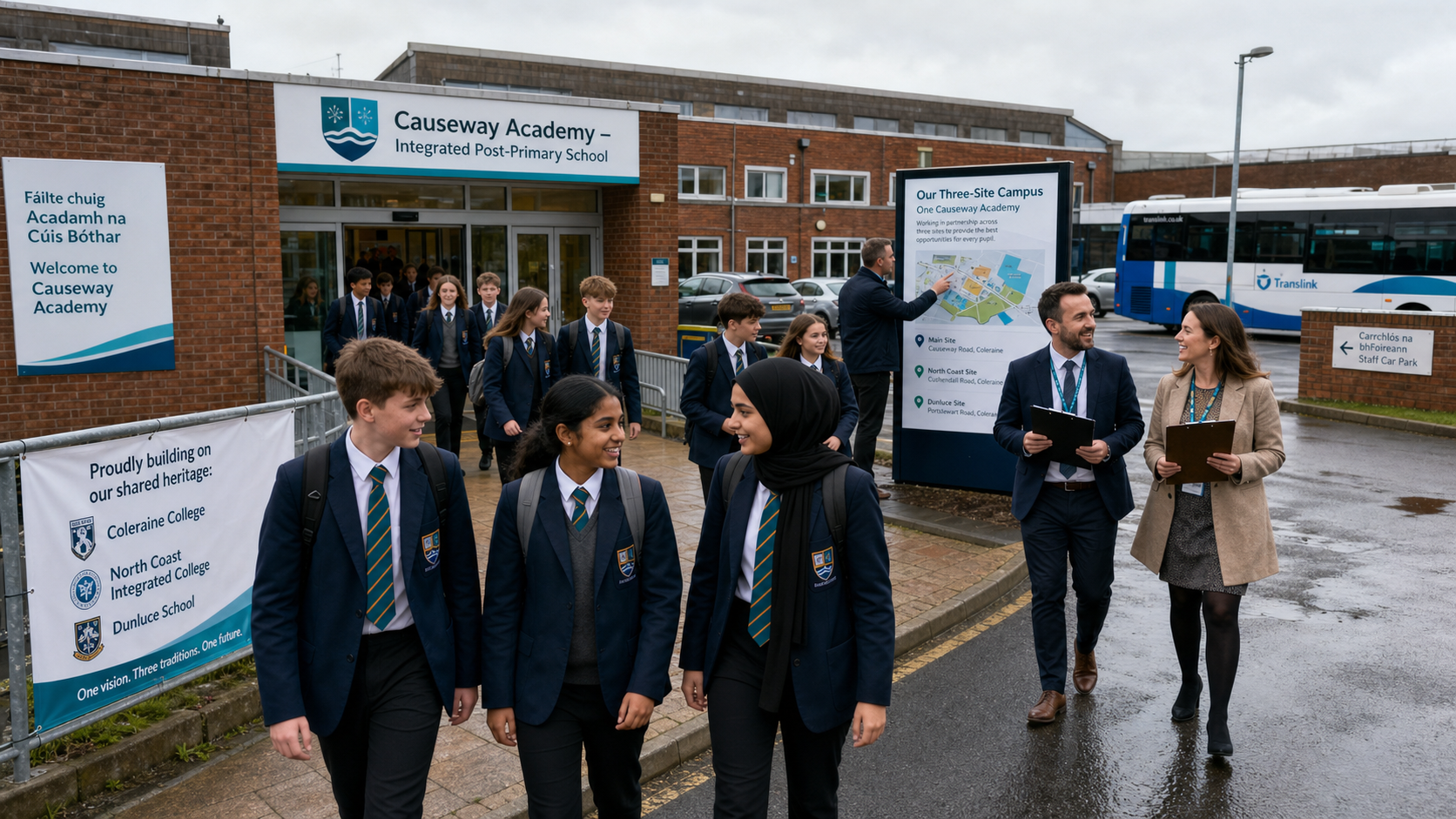
Causeway Academy Opens Across Three Sites as North Coast's New Integrated School Begins Historic First Term
Causeway Academy, the new non-selective integrated post-primary school formed through the amalgamation of Coleraine College, North Coast Integrated College, and Dunluce School, is set to begin its first term in September 2026, operating across the three existing campus locations of its predecessor schools in what Education Minister Paul Givan has described as a 'student-centred' approach necessitated by the absence of more than £20 million in capital funding required for a single new building.
Background
The creation of Causeway Academy represents one of the most significant developments in Northern Ireland's post-primary education landscape in recent years. The amalgamation of three schools — Coleraine College, North Coast Integrated College, and Dunluce School — into a single integrated institution has been years in the making, driven by demographic pressures, the desire to expand integrated education provision on the north coast, and a vision of a school that could offer a broader curriculum and stronger pastoral care than any of the three predecessor institutions could provide individually.
The project is notable for being the first school in Northern Ireland to be established in formal partnership with a university. Ulster University, whose Coleraine campus is located close to the proposed school sites, will support the development of educational programmes and student placements, though it will not hold a management role in the school's governance. The partnership was intended to create a distinctive educational offer that would prepare students for higher education and employment in ways that reflected the specific economic and social context of the north coast.
The process has not been without controversy. A 2022 consultation revealed that a majority of respondents were opposed to the merger, with concerns raised about the reduction of parental choice, increased travel times for students, and the potential impact on pastoral care during the transition period. In November 2025, five governors from Dunluce School resigned from the interim board, citing what they described as a fundamental misunderstanding of school governance by those leading the project. Local political representatives expressed concern that pupils had been left in a state of uncertainty for too long.
Key Developments
Despite the governance difficulties, the Education Authority has proceeded with the amalgamation, and Causeway Academy will open in September 2026 under the leadership of Principal Designate Ruth Harkness, who was appointed in 2024. The school's name was selected following consultations with student councils from the three merging institutions — a process that gave young people a meaningful stake in the new school's identity.
The three-site operating model — with campuses at the former Coleraine College site at Carthall, the Dunluce School site, and the North Coast Integrated College site — will remain in place for the foreseeable future. Education Minister Paul Givan confirmed that the absence of capital budget for a new single-site facility, estimated to cost in excess of £20 million, means that the multi-site approach is likely to continue until funding becomes available. The Education Authority has described the arrangement as designed to minimise disruption for students, allowing them to complete their studies on their current campuses.
The school will cater to approximately 1,200 students aged 11 to 18, making it one of the larger post-primary schools in the Causeway Coast and Glens area. The integrated ethos of the school — bringing together students from Catholic, Protestant, and other backgrounds — reflects the broader ambition of the integrated education movement in Northern Ireland, which has seen growing demand from parents across the community divide.
Why It Matters
Integrated education in Northern Ireland has been one of the most consistent success stories of the post-Good Friday Agreement era. Research consistently shows that students who attend integrated schools develop stronger cross-community relationships and are better prepared for life in a diverse society. The demand for integrated school places has outstripped supply for years, with many integrated schools operating at or above capacity while the overall school population in some areas is declining.
The creation of Causeway Academy adds significant capacity to the integrated sector on the north coast, an area that has historically had limited integrated provision. For families in Coleraine, Portrush, Portstewart, Ballymoney, and the surrounding rural areas, the new school offers an option that was not previously available within reasonable travelling distance.
The three-site model, while not ideal, is not without precedent in Northern Ireland's education system. Several schools have operated across multiple sites during transition periods, and the Education Authority has experience of managing the logistical challenges involved. The key question for Causeway Academy will be whether the three-site arrangement can deliver the coherent school community that the integrated ethos requires, or whether the physical separation of campuses will undermine the sense of shared identity that is central to the integrated model.
Local Impact
In Coleraine and the surrounding area, the opening of Causeway Academy has generated a mixture of anticipation and anxiety. Parents who chose the new school for their children are broadly positive about the integrated ethos and the partnership with Ulster University, while those who had concerns about the merger process remain watchful. The school's first year will be closely observed by the Education Authority, by local politicians, and by the integrated education sector as a whole.
For the staff of the three predecessor schools, the transition to a single institution has required significant professional adjustment. Teachers who have spent their careers in schools with distinct cultures and traditions are now working together to build a new shared identity, a process that requires both goodwill and strong leadership. Principal Designate Ruth Harkness has spoken of her commitment to creating a school where every student feels valued and where the integrated ethos is lived rather than merely stated.
What's Next
The first term of Causeway Academy will begin in early September 2026, with Year 8 students — the first cohort to join the new school — arriving at their respective campuses for induction days in the final week of August. The school's board of governors will meet in September to review the opening arrangements and to begin planning for the medium-term development of the institution. The question of capital funding for a single-site campus will remain on the political agenda, with local MLAs expected to raise the issue at Stormont in the autumn term.