Catalpa Rescue Memorial Fundraiser Draws Irish-American Community to Manhattan as 150th Anniversary Approaches
The Irish-American community in New York has gathered at Ernie O'Malley's in Manhattan for a talk and fundraiser supporting the creation of a memorial to the 1876 Catalpa rescue — one of the most audacious episodes in Irish republican history — as organisers seek to ensure that the story of the rescue is properly commemorated ahead of its 150th anniversary in 2026.
Background
The Catalpa rescue of 1876 is one of the most remarkable stories in the history of the Irish diaspora and the Irish republican movement. In April of that year, the American whaling ship Catalpa, secretly chartered by the Fenian Brotherhood, sailed to the coast of Western Australia and rescued six Irish political prisoners — Fenian soldiers who had been transported to the Fremantle Prison following their conviction for involvement in the 1867 Fenian Rising in Ireland. The rescue, which was planned and executed with extraordinary precision and daring, succeeded in bringing the six men to freedom in the United States despite the efforts of the British authorities to intercept the ship.
The operation was masterminded by John Devoy, the Irish-American Fenian leader who coordinated the rescue from New York, and executed by Captain Anthony Harvey of the Catalpa and John Breslin, an Irish-American agent who had previously helped James Stephens escape from Richmond Prison in Dublin. The rescue was celebrated as a triumph by the Irish-American community and became one of the defining stories of the Fenian movement — a demonstration that the Irish republican cause had friends and resources on both sides of the Atlantic.
The six men rescued — Thomas Darragh, Martin Hogan, Michael Harrington, Thomas Hassett, Robert Cranston, and James Wilson — were all members of the British Army who had been recruited to the Fenian cause and convicted of treason-felony. Their rescue and subsequent lives in the United States became part of the mythology of the Irish-American community, and the story of the Catalpa has been told and retold in books, plays, and films over the intervening 150 years.
Key Developments
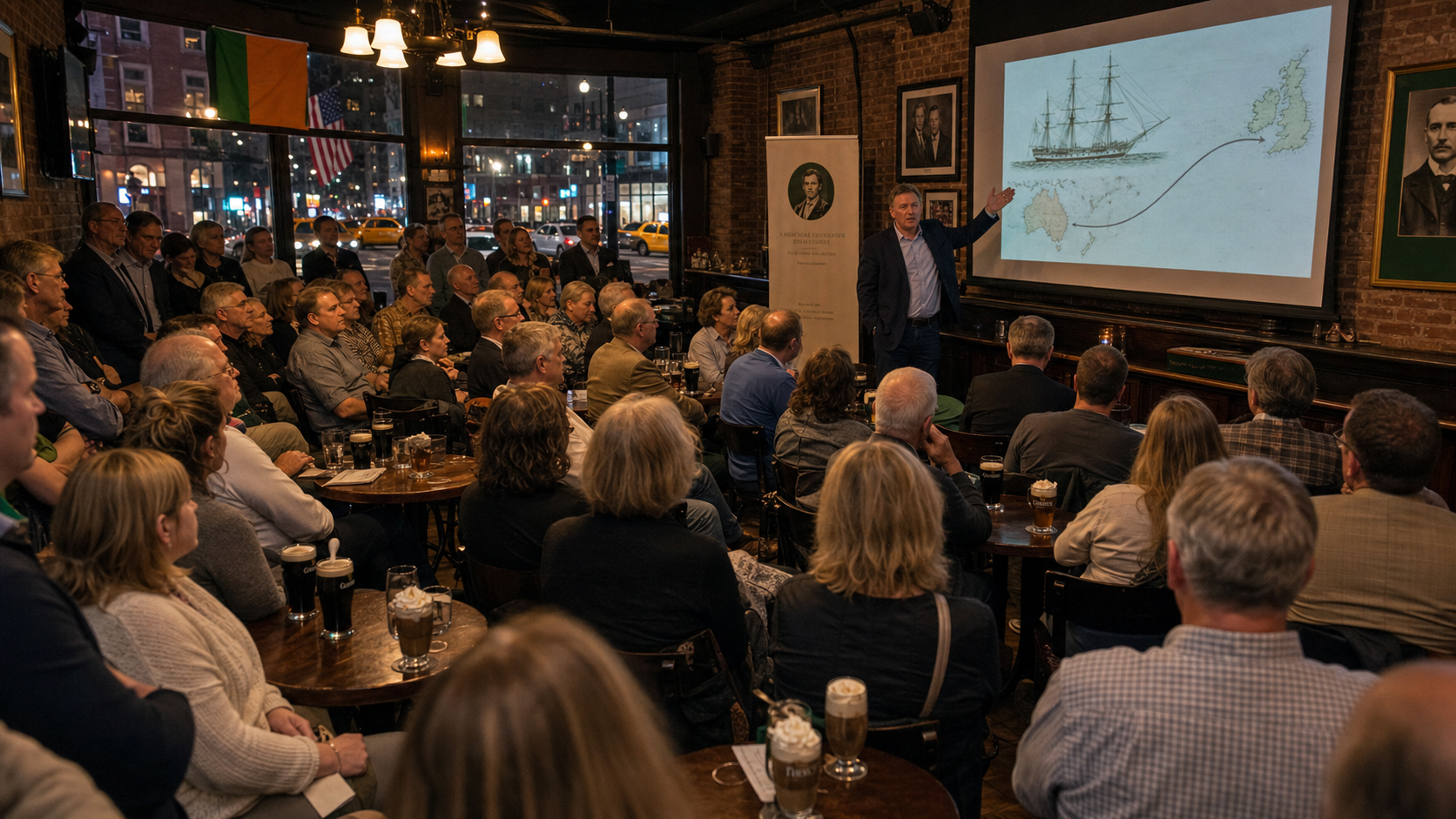
The fundraiser at Ernie O'Malley's in Manhattan, held on Saturday evening, brought together members of the Irish-American community in New York to hear a talk on the history of the Catalpa rescue and to contribute to the creation of a permanent memorial to the event. The organisers — a group of Irish-American historians and community activists — have been working for several years to establish a memorial that would honour the memory of the rescue and ensure that the story is not forgotten as the 150th anniversary approaches.
The talk, delivered by a historian specialising in the Fenian period, covered the planning and execution of the rescue in detail, drawing on primary sources including the correspondence of John Devoy and the accounts of the participants. The audience — which included members of several Irish-American organisations, as well as recently arrived Irish emigrants — responded with considerable enthusiasm, with the fundraising appeal generating significant contributions toward the memorial project.
The organisers have indicated that they are in discussions with several potential sites for the memorial, including locations in New York and in Western Australia, where the rescue took place. They are also exploring the possibility of a commemorative event in Ireland, where the story of the Catalpa rescue is less well-known than in the United States and Australia.
Why It Matters
The Catalpa rescue matters as a story of Irish-American solidarity and ingenuity — a demonstration that the Irish diaspora in the United States was not simply a passive community of emigrants, but an active force in the struggle for Irish independence. The rescue was made possible by the organisational capacity and financial resources of the Irish-American community, and its success was celebrated as a victory not just for the six rescued men, but for the entire Irish republican movement.
The story also matters because it illustrates the deep and enduring connections between Ireland and its diaspora — connections that have shaped the history of both Ireland and the United States in ways that are still being felt today. The Irish-American community's support for Irish independence — through fundraising, political lobbying, and direct action — was a crucial factor in the eventual achievement of Irish self-government, and the Catalpa rescue is one of the most dramatic expressions of that support.
Local Impact
For the Irish-American community in New York, the Catalpa fundraiser is part of a broader effort to maintain connections with Irish history and culture in a community that is increasingly diverse and geographically dispersed. The event at Ernie O'Malley's — a bar in Manhattan that has long been a gathering place for the Irish-American community — drew a cross-generational audience, with older members of the community who have a deep knowledge of Irish history sitting alongside younger Irish emigrants who may be encountering the story of the Catalpa for the first time. This intergenerational transmission of historical knowledge and cultural identity is one of the most important functions of events like this fundraiser, and its success suggests that there is a genuine appetite within the Irish-American community for engagement with the deeper history of the Irish diaspora.
What's Next
The organisers of the Catalpa memorial project will continue their fundraising efforts in the coming months, with events planned in New York, Boston, and Chicago — the three cities with the largest Irish-American populations. They are also in contact with the Irish government's diaspora office about potential support for the memorial project, and with cultural organisations in Western Australia about the possibility of a joint commemoration. The 150th anniversary of the rescue falls in April 2026, and the organisers are hoping to have the memorial in place — or at least formally announced — by that date. Further information about the project and how to contribute is available through the Irish Echo newspaper and the New York Irish Center.