Casement Park Redevelopment Remains at Standstill as £100 Million Funding Gap Persists and Opposition Demands Decision
The proposed redevelopment of Casement Park in West Belfast has ground to a complete halt, with a funding shortfall of approximately £100 million remaining unresolved despite a £50 million commitment from the UK government, Ulster GAA's refusal to downsize the planned stadium, and a Stormont Executive Programme for Government update in May that offered no concrete progress — prompting opposition parties to demand that Communities Minister Gordon Lyons make a definitive decision on whether the project will proceed.
Background
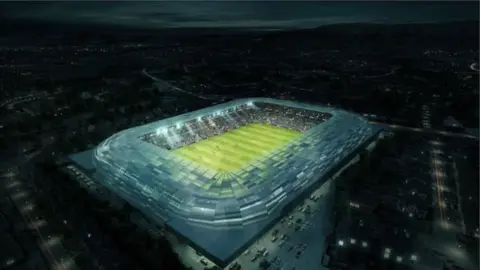
Casement Park, the home ground of Antrim GAA in West Belfast, has been closed since 2013 when structural concerns were identified with the existing stadium. The proposal to redevelop the site into a modern, 34,500-capacity venue has been in various stages of planning, controversy, and delay ever since. The project has become one of the most politically charged infrastructure decisions in Northern Ireland, touching on questions of community identity, planning law, public funding, and the relationship between the GAA and the broader Northern Irish state.
The planning process alone took years, with a public inquiry, legal challenges, and multiple revisions to the design. Planning permission was finally granted in 2023, raising hopes that construction could begin in earnest. Those hopes were quickly tempered by the emergence of a significant funding gap. The UK government pledged £50 million towards the project, but the total estimated cost — which has risen substantially due to construction inflation — now stands at approximately £150 million, leaving a shortfall of around £100 million that has proved impossible to bridge.
The project was also intended to serve as a key venue for a potential UK and Ireland bid to host Euro 2028, adding an international dimension to what was already a complex domestic story. That bid has since been awarded to the UK and Ireland, but the status of Casement Park as a venue remains uncertain — a situation that has embarrassed the Irish Football Association and the Football Association of Ireland, both of which had included the stadium in their planning assumptions.
Key Developments
The Stormont Executive's Programme for Government update, published in May 2026, was the most recent official statement on the project's status. It was notable primarily for what it did not say. Rather than announcing a funding solution, a revised timeline, or a decision to proceed or abandon the project, the update stated only that the Executive would "continue to work with the UK government and other funders" — language so vague as to be functionally meaningless.
Ulster GAA has maintained its position that it will not accept a reduction in the planned stadium capacity. The organisation argues that a smaller venue would not meet the needs of Gaelic games in Ulster, would not justify the disruption to the local community that construction would entail, and would represent a diminution of the ambition that has sustained the project through years of delay. This position has effectively created a deadlock: the funding is not available for the full project, but the GAA will not accept a scaled-back version.
Opposition parties at Stormont — led by the SDLP's Matthew O'Toole — have intensified their pressure on Communities Minister Gordon Lyons to make a clear decision. O'Toole and others have argued that the current situation, in which the project is neither proceeding nor formally cancelled, is the worst of all possible outcomes: it prevents the site from being used for any other purpose, maintains uncertainty for the local community, and allows the Executive to avoid accountability for a decision it is clearly reluctant to make.
Minister Lyons has not indicated when or whether he intends to make a definitive announcement. His department has pointed to the ongoing discussions with the UK Treasury and other potential funders as justification for the continued delay, but critics argue that those discussions have been ongoing for years without producing results.
Why It Matters
Casement Park has become a symbol of the Stormont Executive's broader difficulties with major infrastructure delivery. It is not the only large project that has stalled — the A5 dual carriageway, the York Street interchange in Belfast, and several major hospital developments have all experienced significant delays and cost overruns. But Casement Park is the most visible and politically charged of these failures, and its continued stagnation reflects poorly on an Executive that came back into office in 2024 promising to deliver tangible improvements for citizens.
The cultural dimension of the project adds to its significance. Casement Park is not simply a sports stadium — it is a community asset in West Belfast that carries deep historical and cultural meaning for the GAA community in Antrim and beyond. The closure of the ground since 2013 has meant that Antrim GAA has been without a home venue for more than a decade, a situation that has had real consequences for the development of Gaelic games in the county.
This is the third consecutive year in which the project has been described as being in active negotiation without any concrete progress. For comparison, the Aviva Stadium in Dublin was built in approximately three years from groundbreaking to opening. The contrast between the Republic's ability to deliver major sports infrastructure and Northern Ireland's inability to do so is not lost on observers.
Local Impact
In West Belfast, the continued uncertainty around Casement Park is a source of frustration that extends well beyond the GAA community. The site sits in the Andersonstown area, and its redevelopment was expected to bring significant economic activity to a part of the city that has historically been underserved by major investment. Construction jobs, hospitality spending on match days, and the broader regeneration effect of a major new venue were all factored into the community's expectations when the project was first announced.
Those expectations have been repeatedly deferred. Local businesses that had anticipated increased footfall from a new stadium have had to adjust their plans. Community organisations that had hoped to use the new facilities for non-GAA activities — a feature of the original design — have had to find alternative venues. And Antrim GAA continues to play its home fixtures at grounds across the province, a logistical challenge that has complicated the county's ability to develop its player base and its supporter culture.
The PSNI and Belfast City Council have also noted that the continued closure of the Casement Park site creates a security and maintenance challenge — a large, fenced-off area in a residential neighbourhood that requires ongoing monitoring and upkeep without generating any community benefit.
What's Next
The immediate pressure on Minister Lyons is to provide a clear timeline for a decision — not necessarily a decision itself, but a commitment to when one will be made. Opposition parties have indicated they will use Stormont committee hearings in the autumn to press for that commitment, and the issue is likely to feature prominently in the Assembly's scrutiny of the Executive's Programme for Government delivery.
Ulster GAA has indicated it will not change its position on stadium capacity, meaning that any resolution to the funding gap must come from the government side. The most likely scenarios are either a significant increase in public funding — which would require agreement between the UK Treasury, the Stormont Executive, and potentially the Irish government — or a formal decision to abandon the project in its current form, which would trigger a new planning process for a smaller venue.
Neither outcome is politically straightforward, which may explain why the Executive has been so reluctant to force the issue. But the cost of continued inaction — in community frustration, in reputational damage, and in the ongoing waste of a valuable urban site — is mounting with every passing month.