Annals of Inisfallen Returns to Ireland for First Time in Decades as UCC Exhibition Opens to Public
One of the most significant medieval manuscripts in the Irish historical record has returned to the island for the first time in over four decades, with the Annals of Inisfallen — a 1,000-year-old chronicle of Irish history written on 57 vellum leaves by approximately thirty scribes over three centuries — now on public display at the Glucksman Gallery at University College Cork in an exhibition that has already attracted significant attention and reignited a long-running debate about the permanent repatriation of Irish cultural artefacts held in British institutions.
Background
The Annals of Inisfallen is one of the great treasures of Irish medieval scholarship. Written in both Latin and Irish, it provides a year-by-year chronicle of Irish history from before the arrival of St Patrick through to the fifteenth century, with a particular focus on Munster. Its entries range from the momentous — Viking raids, the arrival of the Normans, the deaths of kings and bishops — to the unexpectedly intimate: the "great snow" of 1047, the gifting of a camel in 1105, the appearance of comets that terrified the population. It is, in the words of UCC's Professor Máire Ní Mhaonaigh, "a window into a world that is both utterly foreign and surprisingly familiar."
The manuscript is believed to have been initially compiled at the monastery of Lismore in County Waterford, drawing on materials from the monasteries of Clonmacnoise and Emly, before being moved to the island monastery of Inisfallen in Killarney, County Kerry, in the twelfth century. It has been held at the Bodleian Library at the University of Oxford for more than 250 years, having passed through the collections of the seventeenth-century historian Sir James Ware and subsequently the Richard Rawlinson bequest. Its return to Ireland for the current exhibition is the result of a collaborative arrangement between UCC and the Bodleian Libraries, and represents the first time the manuscript has been publicly displayed in Ireland in over forty years.
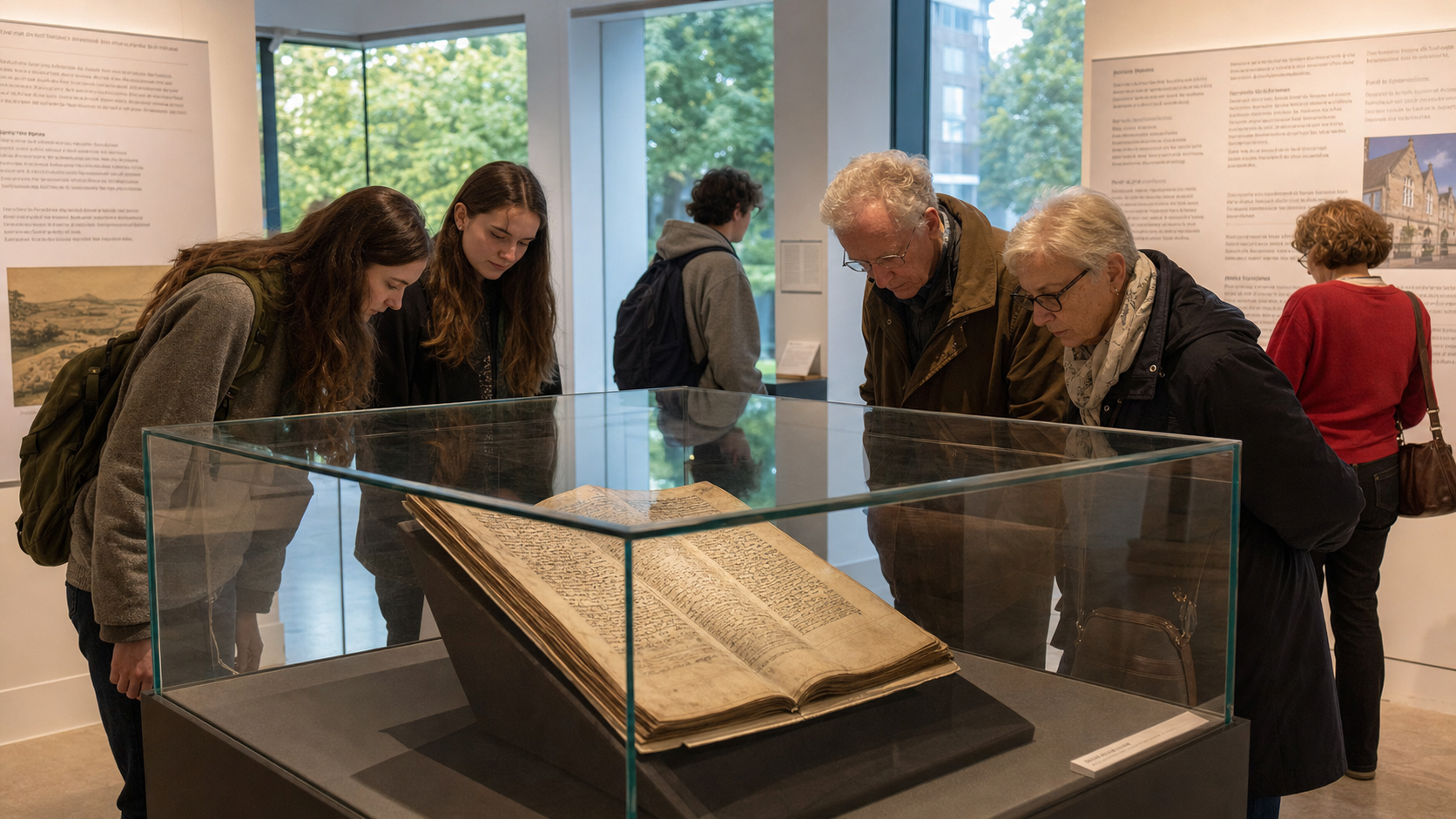
The exhibition, titled "Recording the Past: The Annals of Inisfallen and the Making of Irish History," opened at the Glucksman Gallery on September 2 and runs until November 1. It presents the original manuscript in a glass case alongside a digital version that allows visitors to explore the text in detail, and is supported by contextual material explaining the manuscript's historical significance and the process by which it was created.
Key Developments
The exhibition has been warmly received by scholars, heritage professionals, and the general public, with the Glucksman reporting strong attendance in its first week. UCC President Professor John O'Halloran described the exhibition as "a major moment for Irish cultural heritage" and expressed hope that it would inspire further collaboration between Irish institutions and the Bodleian Libraries. Bodley's Librarian Richard Ovenden, who attended the opening, said the loan was "a demonstration of what can be achieved when institutions work together in the spirit of shared stewardship."
The exhibition has also reignited calls for the permanent repatriation of the manuscript to Ireland. Donnchadh Ó Laoghaire, a Sinn Féin TD for Cork South Central, has publicly advocated for the Annals of Inisfallen to remain in Ireland permanently, arguing that many such items were removed from Ireland under conditions of "colonial plunder" and should be returned to Irish ownership, with the Irish state acting as the ultimate custodian. The Irish government established an advisory body on the restitution and repatriation of cultural objects in 2023, but no formal plan for the return of the Annals has been announced.
Why It Matters
The debate about the repatriation of Irish cultural artefacts is one that has gained momentum in recent years, driven by the broader global conversation about the provenance of objects held in major Western museums and libraries. Ireland's position in this debate is complicated by its colonial history: many of the most significant Irish manuscripts, artworks, and artefacts were removed from the country during the centuries of British rule, often under circumstances that would not be considered acceptable today. The Annals of Inisfallen is a particularly resonant case because of its direct connection to the island of Inisfallen in Killarney — a place that remains a living part of the Irish landscape — and because of the depth of its significance to Irish historical scholarship. Unlike the Book of Kells, which is held at Trinity College Dublin and is accessible to Irish scholars and the public, the Annals has been effectively inaccessible to most Irish people for generations.
Local Impact
In Cork, the exhibition has generated considerable excitement, with the Glucksman reporting that it has attracted visitors from across Munster and beyond. The university has arranged a programme of public lectures and educational events to accompany the exhibition, including a series of talks by leading scholars of medieval Irish history and a workshop for secondary school students on the art of manuscript illumination. The exhibition is expected to be one of the most significant cultural events in Cork this autumn, and the Glucksman has indicated that it is already planning a follow-up exhibition on related themes for 2027.
What's Next
The exhibition runs until November 1, after which the manuscript will return to the Bodleian Library in Oxford. The Irish government's advisory body on restitution and repatriation is expected to publish a report on its work before the end of 2026, which may include recommendations on the Annals of Inisfallen. UCC has indicated that it will continue to press for further loans of the manuscript and for a longer-term arrangement that would allow it to be displayed in Ireland on a more regular basis. The question of permanent repatriation is likely to remain a live political and cultural issue for years to come.