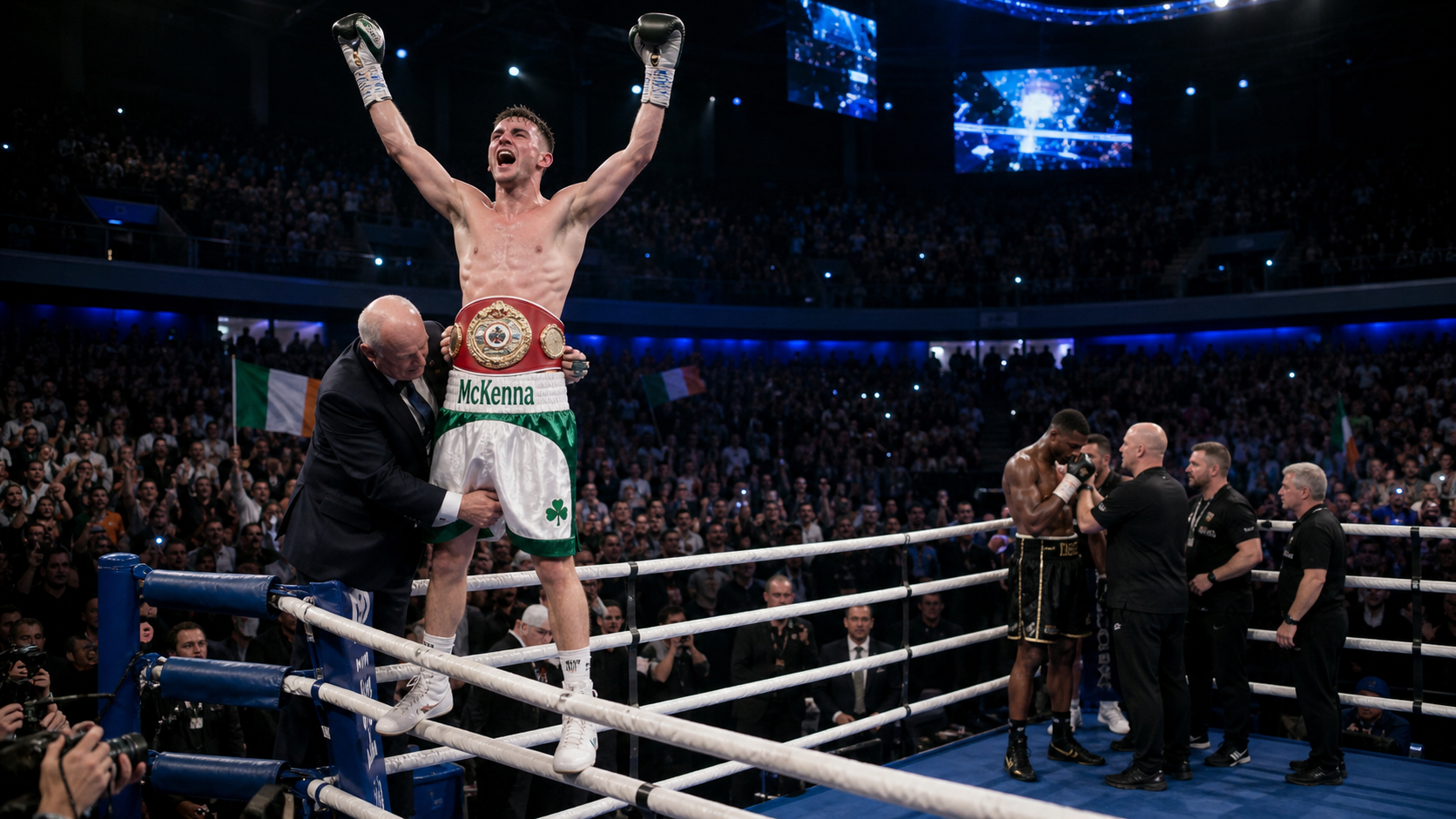
Aaron McKenna: Monaghan's World Champion and the Night Irish Boxing Stood Still
The scenes inside the 3Arena in Dublin on the night of 8 August 2026 will live long in the memory of Irish boxing. Aaron McKenna, a 27-year-old from Monaghan, defeated the previously unbeaten Italian contender Etinosa Oliha by unanimous decision to claim the vacant IBF middleweight world title — becoming only the third active boxing world champion from the island of Ireland, alongside Katie Taylor and Anthony Cacace. The victory, scored 118-110, 117-111, and 116-112 by the three judges, was the culmination of a nine-year professional journey that had taken McKenna from the gyms of Monaghan to the summit of world boxing.
Background
Aaron McKenna's path to a world title was never straightforward, but it was always purposeful. Born into a boxing family in Monaghan — his brother Stevie is also a professional fighter — McKenna turned professional at 18 and spent the early years of his career building his record in the United States, where he was based for much of his development. The decision to fight abroad, while it kept him from Irish audiences for extended periods, gave him access to the competitive environment and promotional infrastructure that a world title challenge requires.
By the time he entered the 3Arena on 8 August, McKenna carried a professional record of 20-0 with ten knockouts. His opponent, Etinosa Oliha, was similarly unbeaten at 22-0 and had been widely regarded as one of the most dangerous middleweights outside the top tier of the division. The fight, promoted by Zuffa Boxing as the headline event of their tenth Irish card, attracted significant attention both domestically and internationally, with UFC president Dana White among those in attendance.
The significance of the homecoming dimension cannot be overstated. McKenna had not fought professionally on Irish soil in nine years, and the pent-up desire among Irish boxing fans to see him perform at home added an emotional charge to the occasion that went beyond the sporting stakes. For Monaghan in particular, a county with a proud GAA tradition but a less prominent profile in boxing, the prospect of a world champion emerging from their community carried a special resonance.
Key Developments
The fight itself was a masterclass in controlled aggression. McKenna used his jab effectively throughout, disrupting Oliha's rhythm and preventing the Italian from establishing the sustained pressure that had undone previous opponents. Despite a clash of heads in the eleventh round that left McKenna bleeding from a cut above his eye, he maintained his composure and saw out the final rounds with the authority of a champion.
The undercard provided additional cause for celebration. Callum Walsh defeated Tyler Denny by a wide decision in the co-main event to improve his record to 17-0, while Joe Ward secured a unanimous decision over Artjom Kasparian. Stevie McKenna, Aaron's brother, added a family dimension to the night with a first-round knockout of Owen O'Neill. The clean sweep of victories for Irish fighters made it one of the most successful nights for domestic boxing in recent memory.
Following the victory, McKenna spoke of his ambition to unify the middleweight division, naming the WBC, WBA, and WBO champions as future targets. "I didn't come this far to stop here," he said in his post-fight interview. "I want all the belts. That's what I've been working towards my whole career."
Why It Matters
McKenna's title win arrives at a moment of genuine depth in Irish professional boxing. With Katie Taylor's farewell fight against Flora Pili confirmed for Croke Park on 5 September, and Anthony Cacace holding a world title at super-featherweight, Ireland now has three active world champions simultaneously — a remarkable achievement for a country of five million people. The last time Ireland could claim comparable depth at world level was during the era of Barry McGuigan and Steve Collins in the 1980s and 1990s.
The broader significance for Irish boxing lies in the pipeline. McKenna's success, combined with the amateur achievements of the Irish team at the European U19 Championships — where Kristian Jubani, John Donoghue, and Louise Joyce all reached finals — suggests that the sport is in a period of genuine health. Michael Conlan's public emphasis on the importance of the correct appointment for the new national head coach reflects an awareness that maintaining this momentum requires structural investment as well as individual talent.
Local Impact
In Monaghan, the reaction to McKenna's title win has been one of unrestrained pride. The county's GAA clubs have long provided the backbone of community sporting life, but McKenna's achievement has opened a new chapter. Local boxing clubs in Monaghan town, Castleblayney, and Clones have all reported increased interest from young people in the weeks since the fight, with coaches noting that the visibility of a world champion from the county has a galvanising effect that is difficult to manufacture through any other means.
Across the border in Tyrone and Armagh, where McKenna also has family connections, the response has been similarly warm. The fight was broadcast live on DAZN, and viewing parties were held in pubs and community centres across Ulster, creating a shared moment of celebration that transcended county and community boundaries.
What's Next
McKenna's management team is expected to begin negotiations for his first title defence in the coming weeks. The IBF's mandatory challenger will need to be accommodated within a defined timeframe, though there is also significant commercial interest in a unification bout with one of the other major sanctioning bodies' champions. A fight in Ireland — potentially at Croke Park or the Aviva Stadium — remains the ambition, with promoters at Zuffa Boxing indicating that the appetite for a major outdoor event is strong. A formal announcement on McKenna's next opponent is expected before the end of September 2026.