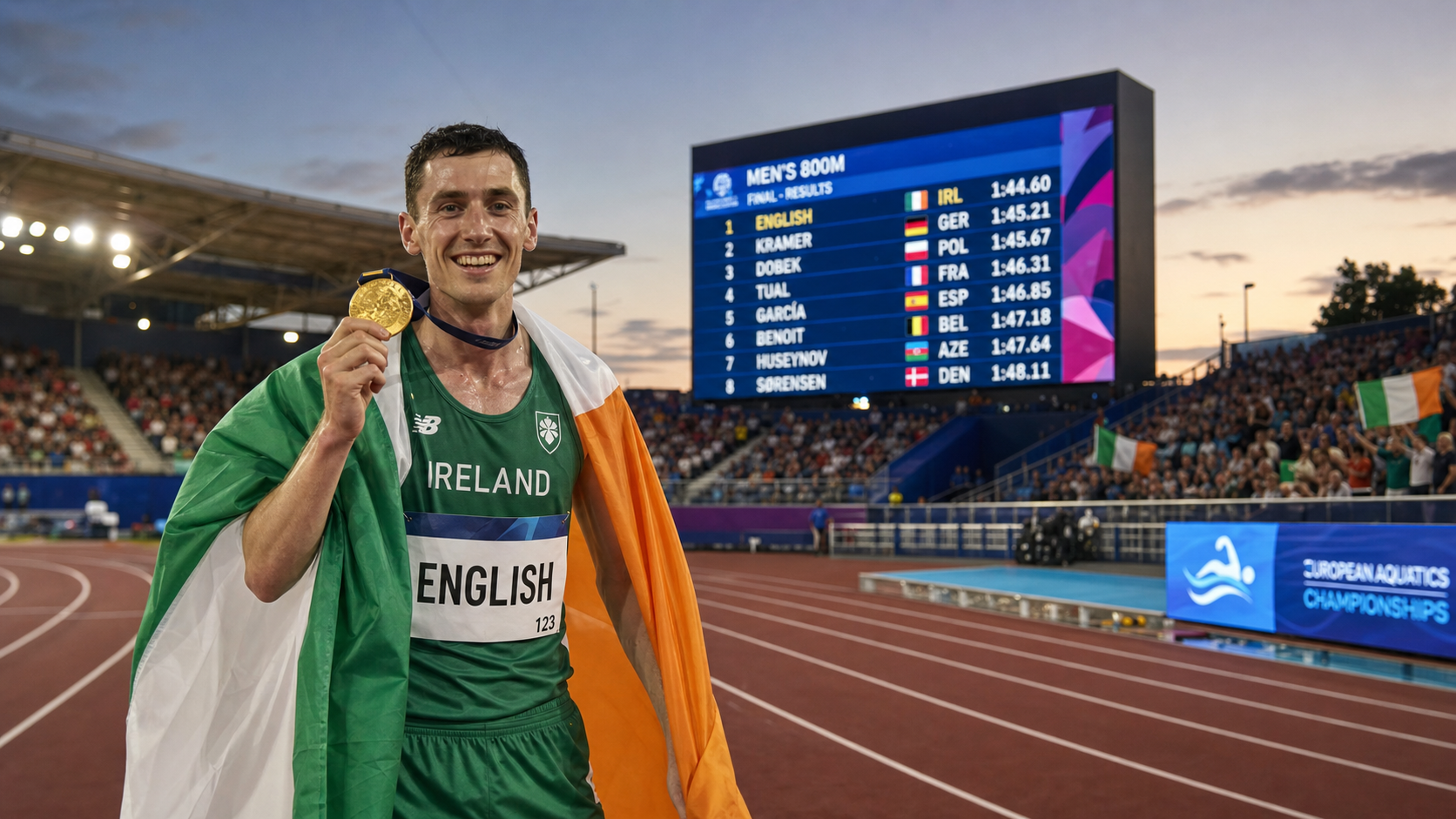
A Week Like No Other: Ireland's Athletes Deliver Five European Championship Medals in Paris and Birmingham
In a week that will be spoken about for years to come, Ireland's athletes produced one of the most extraordinary collective performances in the country's sporting history, claiming five medals across two major European championships simultaneously — with gold, silver, and bronze spread across athletics and swimming in Birmingham and Paris.
Background
Irish sport has known golden periods before — the Sydney Olympics, the 2016 Rio Games, the 2023 World Athletics Championships — but the week of 11 to 17 August 2026 stands apart for the sheer breadth of its achievement. Across two cities and two disciplines, Irish men and women competed at the very highest level of European sport and came away with medals that reflect years of investment, coaching excellence, and individual determination.
The European Athletics Championships in Birmingham and the European Aquatics Championships in Paris overlapped almost entirely, meaning that Irish supporters were toggling between two sets of results simultaneously, each bringing fresh cause for celebration. It was the kind of week that reminds a nation of what its athletes are capable of when everything comes together.
The backdrop to these performances is significant. Irish athletics has been on an upward trajectory for several years, driven by a generation of middle-distance runners who have benefited from improved coaching structures and greater access to high-altitude training camps. Irish swimming has undergone a similar transformation, with Swim Ireland's investment in elite performance beginning to yield consistent results at the highest level.
Key Developments
The headline achievement of the week came from Mark English of Letterkenny, who claimed gold in the men's 800m at Alexander Stadium in Birmingham with a time of 1:45.26 — becoming the first Irish male athlete ever to win gold at the European Athletics Championships. The 33-year-old doctor, who has been chasing a major title for his entire career, executed a perfectly judged race, sitting patiently before unleashing a devastating surge in the final 50 metres to overtake Croatia's Marino Bloudek. English, who had previously won bronze at the 2014 and 2022 editions of the championships, was visibly overcome with emotion at the finish line.
Kate O'Connor from Dundalk had already claimed gold in the women's heptathlon earlier in the week, scoring 6,751 points across two days of competition to become the fourth Irish athlete ever to win a European outdoor title. Andrew Coscoran added bronze in the men's 1500m final, finishing in 3:36.24 after a tactically astute race in which he found a gap on the inside of the home straight to claim the podium position. Rhasidat Adeleke, the Irish-American sprinter, took silver in the women's 200m with a national record of 22.28 seconds.
In Paris, Mona McSharry completed a remarkable individual championships by claiming bronze in the women's 50m breaststroke final with a national record time of 29.95 seconds — her third individual medal of the championships, following silver in the 100m and bronze in the 200m breaststroke. Ellen Walshe had already claimed double gold in the 400m and 200m individual medley, the latter in a stunning comeback from fifth place at the 150-metre mark.
Why It Matters
Five medals across two major European championships in a single week is a performance that demands to be placed in its proper historical context. Ireland is a small nation of five million people competing against countries with populations ten, twenty, and thirty times larger. The fact that Irish athletes can consistently challenge for medals at the highest level of European competition is a testament to the quality of the talent pipeline that has been developed over the past decade and to the willingness of individual athletes to make the sacrifices that elite sport demands.
Mark English's gold is particularly significant. He is 33 years old, a qualified doctor, and has been competing at the top level of European athletics for more than a decade. His victory is a reminder that sporting greatness does not always arrive on schedule, and that persistence and self-belief can ultimately overcome the frustrations of near-misses and injury. His win will inspire a generation of young Irish middle-distance runners who now know that the top step of a European podium is within reach.
Local Impact
The celebrations have been nationwide. In Letterkenny, Mark English's home town in County Donegal, the reaction to his gold medal was described as euphoric, with the town's pubs and community centres filling spontaneously as the news broke. In Dundalk, Kate O'Connor's heptathlon gold prompted similar scenes. In Carrick-on-Shannon, Mona McSharry's home club Aidan McLoughlin Swimming Club organised a viewing party for her 50m final that drew hundreds of supporters. The week has provided a unifying moment of national pride at a time when the country has been dealing with the trauma of the M9 motorway crash and the ongoing pressures of the housing and cost-of-living crises. Sport, at its best, does exactly this — it reminds people of what they share and what they are capable of.
What's Next
The focus for Ireland's athletes now shifts to the 2028 Los Angeles Olympics, with the European Championships performances providing crucial qualification points and confidence. Mark English has indicated he intends to compete at the Olympics, which would be his fourth Games. Mona McSharry and Ellen Walshe are both firmly in the frame for multiple events in Los Angeles. Andrew Coscoran will target a medal at the World Athletics Championships in Tokyo in 2027. The week in Birmingham and Paris has set a new benchmark for Irish athletics and swimming — and the athletes themselves have made clear they intend to build on it.