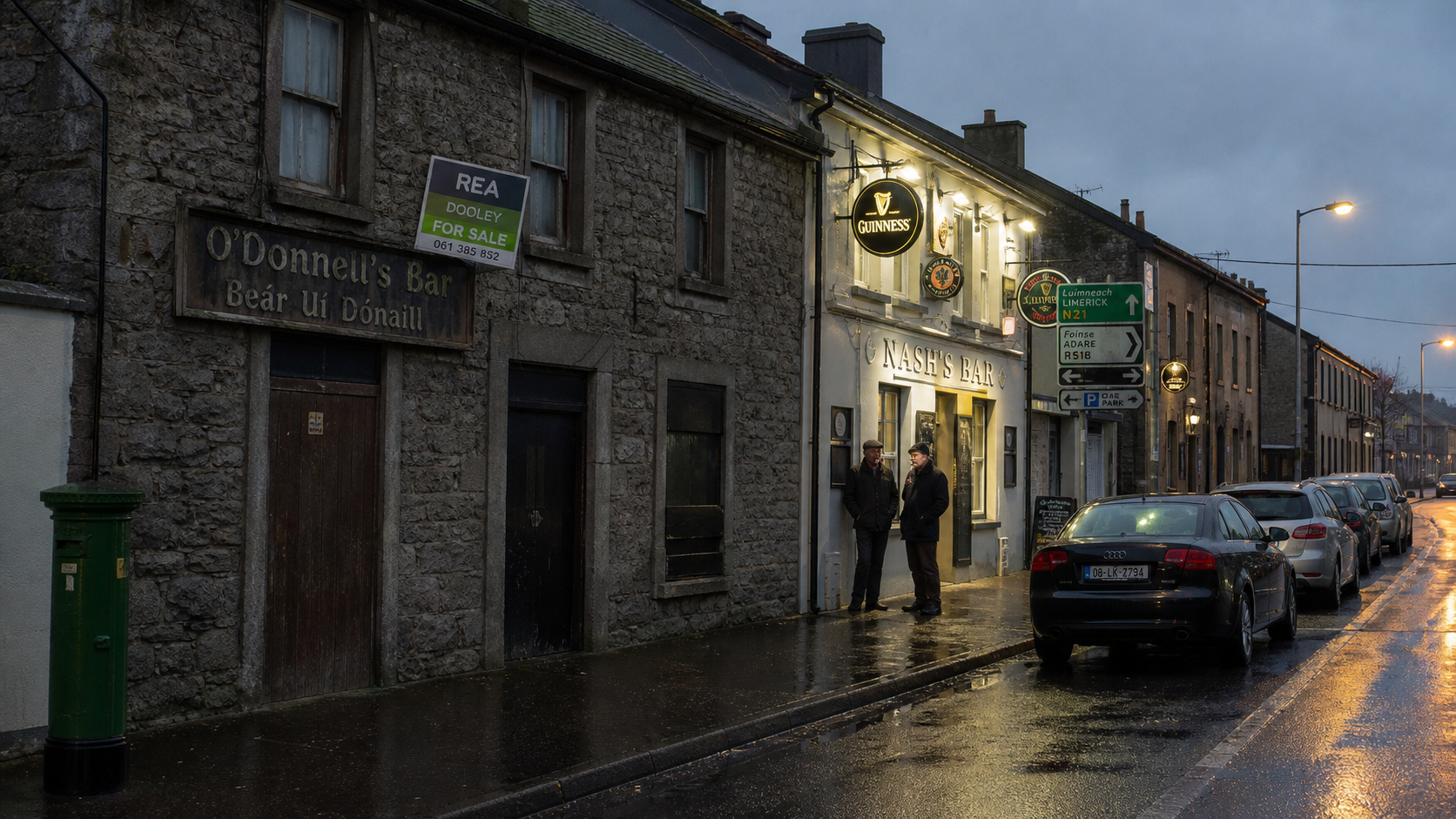
A Quarter of Ireland's Pubs Have Closed Since 2005 as Study Warns 1,000 More Could Shut Without Budget Relief
A new study commissioned by the Drinks Industry Group of Ireland has found that 2,205 pubs — one in four of all licensed premises — have closed across Ireland since 2005, with Limerick recording the highest county-level decline at 37% and Dublin the lowest at just 1%. The report, authored by economist Anthony Foley and published on Tuesday, warns that without a 10% reduction in excise duty in Budget 2027, between 600 and 1,000 additional pubs could close over the next decade.
Background
The Irish pub is one of the most recognisable cultural institutions in the world, and its decline has been a subject of concern for communities across the country for many years. The Drinks Industry Group of Ireland has been tracking pub numbers since the early 2000s, and the data published on Tuesday represents the most comprehensive assessment of the sector's trajectory over the past two decades. The findings confirm what many in rural Ireland have long known from direct experience: the local pub, once the social hub of every town and village, is disappearing at a rate that is transforming the character of communities across the country.
The causes of pub closures are multiple and interrelated. High excise taxation — Ireland has the second-highest excise rates on alcohol in the European Union — has been a persistent complaint from the industry, which argues that the tax burden makes it impossible for many rural pubs to operate viably. Rising operational costs, including energy, insurance, and labour, have compounded the pressure. Changing consumer habits, including the shift to home consumption and the decline of traditional social drinking patterns among younger generations, have reduced footfall. And the absence of younger family members willing to take over businesses from retiring publicans has accelerated the closure of many long-established premises.
The geographic pattern of closures is striking. Every county in Ireland has seen a decline in pub numbers, but the impact has been most severe in rural counties where the pub often serves as the primary social infrastructure for dispersed communities. Limerick's 37% decline, followed by Offaly at 34% and Cork at 33%, reflects the particular vulnerability of rural and market-town pubs to the combination of factors driving closures. Dublin's 1% decline, by contrast, reflects the resilience of urban pub culture and the continued demand for licensed premises in a growing city.
Key Developments
The DIGI report, published on Tuesday, found that 86 pubs closed in 2025, an increase from 65 in 2024 but a decrease from the 117 closures recorded in 2023. The average annual closure rate over the 20-year period studied is 110 pubs per year — a figure that, compounded over time, has produced the dramatic reduction in total pub numbers documented in the report. Economist Anthony Foley noted that the closures have occurred despite economic growth and population increases over the same period, a finding that underlines the structural nature of the challenges facing the sector.
The DIGI is calling on the government to implement a 10% reduction in excise duty in Budget 2027, arguing that Ireland's excise rates are "unjust and actively harmful" to the social and cultural life of rural Ireland. The organisation has also called for a review of the planning and licensing framework to make it easier for pubs to diversify their offerings — including food, live music, and community events — in ways that might help them remain viable in a changing market.
The report's projections for the next decade are sobering. Under an optimistic scenario, 600 additional pubs will close over the next ten years. Under a more pessimistic outlook, the figure could reach 1,000. Either scenario would represent a further significant reduction in the social infrastructure of rural Ireland, with consequences that extend well beyond the licensed trade itself.
Why It Matters
The closure of a pub in a rural Irish community is rarely just a commercial event. In many towns and villages, the local pub is the last remaining social space — the place where people gather for funerals and celebrations, where community news is exchanged, and where the social bonds that hold communities together are maintained. The loss of that space has consequences for social cohesion, mental health, and community resilience that are difficult to quantify but are deeply felt by those who experience them.
For context, Ireland's excise duty on a pint of beer is among the highest in Europe. A pint that costs €6.50 in a Dublin pub carries an excise burden of approximately €1.20, a figure that the DIGI argues is unsustainable for rural pubs operating on thin margins. The comparison with the UK, where excise rates are lower and the pub sector — while also under pressure — has not experienced the same rate of closures, is frequently cited by industry representatives as evidence that taxation policy is a significant driver of the Irish decline.
The government's response to the DIGI report will be closely watched ahead of Budget 2027. Minister for Finance Paschal Donohoe has previously resisted calls for excise reductions, citing public health concerns about alcohol consumption. The industry argues that the public health case for high excise rates is undermined by the shift to home consumption that pub closures accelerate — a shift that removes the social controls and responsible service standards that licensed premises provide.
Local Impact
Across Ireland's 26 counties, the closure of local pubs has left visible gaps in the social fabric of communities. In Limerick, where the decline has been most severe, towns like Rathkeale, Kilmallock, and Abbeyfeale have seen multiple pub closures over the past two decades, leaving residents with fewer options for social gathering and community connection. In Cork, the closure of rural pubs in areas like West Cork and North Cork has been a recurring source of concern for local representatives. The impact is felt most acutely by older residents, for whom the local pub may be one of the few regular social outlets available, and by community organisations that have traditionally used pub function rooms for meetings and events.
What's Next
Budget 2027 is scheduled for October 2026, and the DIGI's call for a 10% excise reduction will be among the many competing demands on the Minister for Finance. The Vintners' Federation of Ireland and the Licensed Vintners Association have both indicated that they will be making strong representations to government in the weeks ahead. The Department of Finance is expected to publish its pre-budget economic assessment in September, which will set the parameters for the budget discussions.