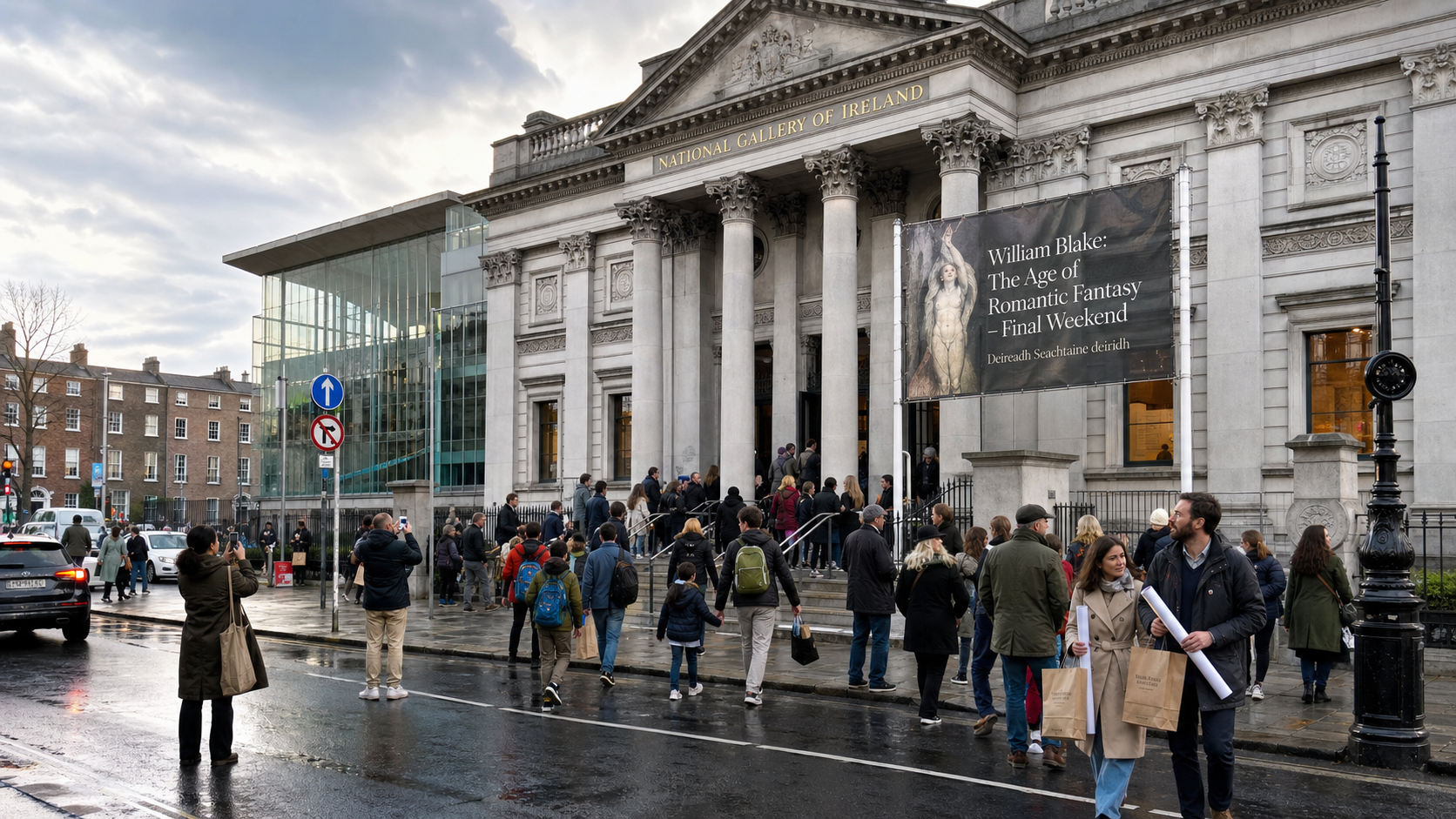
William Blake Exhibition at National Gallery of Ireland Closes Sunday After Record Attendance
The National Gallery of Ireland's landmark exhibition 'William Blake: The Age of Romantic Fantasy' closes on Sunday after a highly successful run that has attracted record attendance and introduced thousands of Irish visitors to the extraordinary visionary art of one of Britain's greatest creative figures — marking the first time Blake's work has been exhibited publicly in Ireland and cementing the National Gallery's reputation as a venue for world-class international exhibitions.
Background
William Blake (1757-1827) is one of the most extraordinary and singular figures in the history of British art and literature. A poet, painter, printmaker, and visionary, Blake created a body of work of astonishing originality and ambition, encompassing illuminated books of poetry, large-scale colour prints, watercolour illustrations, and tempera paintings. His work defies easy categorisation — it is simultaneously deeply personal and universally resonant, rooted in the specific cultural and political context of late 18th and early 19th century Britain yet speaking to concerns and experiences that remain profoundly relevant today.
Blake's poetry — including 'Songs of Innocence and of Experience,' 'The Marriage of Heaven and Hell,' and the epic prophetic books — has been a central part of the English literary canon for over a century, with poems such as 'The Tyger,' 'Jerusalem,' and 'Auguries of Innocence' among the most widely read and quoted in the language. His visual art, less well known to the general public but equally remarkable, has been the subject of major exhibitions at the Tate Britain in London and other leading international museums.
The National Gallery of Ireland's decision to mount the first-ever public exhibition of Blake's work in Ireland was a significant curatorial achievement, requiring extensive negotiation with the Tate and other lending institutions and the development of a scholarly programme that could do justice to the complexity and richness of Blake's artistic vision. The exhibition, which opened in April 2026, has been accompanied by a comprehensive catalogue, a series of public lectures and events, and an educational programme for schools and community groups.
Key Developments
The exhibition has exceeded all attendance expectations, with visitor numbers significantly above the projections made at the time of its planning. The closing weekend has seen a particular surge in attendance, with queues forming outside the gallery on Merrion Square as visitors eager to see the exhibition before it closes make their way to the museum. The gallery has extended its opening hours for the final weekend to accommodate the demand, remaining open until 9pm on Saturday and Sunday evening.
The exhibition features over 100 works by Blake and his contemporaries, including J.M.W. Turner, Henry Fuseli, and John Flaxman. The selection has been praised by critics for its scholarly rigour and its ability to contextualise Blake's work within the broader Romantic movement, helping visitors to understand the artistic and intellectual environment in which he worked. Highlights of the exhibition include Blake's celebrated colour prints of 1795, his illustrations for Dante's 'Divine Comedy,' and a selection of the illuminated books that represent his most distinctive contribution to the history of art.
The exhibition has also generated significant educational engagement, with thousands of school students having visited as part of organised programmes and the gallery's online resources — including virtual tours and educational materials — having been accessed by users across Ireland and internationally.
Why It Matters
The success of the William Blake exhibition matters for Irish cultural life for several reasons. It demonstrates that there is a substantial and enthusiastic audience in Ireland for ambitious international exhibitions of the highest quality, challenging the assumption that such exhibitions can only succeed in the largest metropolitan centres. It also demonstrates the National Gallery's capacity to mount world-class shows that can compete with the offerings of major international museums, enhancing Ireland's reputation as a cultural destination. The exhibition's focus on Blake's visionary art — work that challenges conventional boundaries between the rational and the spiritual, the personal and the political — has also provided a timely reminder of the power of art to expand our understanding of the world and of ourselves.
Local Impact
The exhibition has had a significant impact on the cultural and economic life of the Merrion Square area of Dublin, with the National Gallery reporting increased footfall not only within the museum but in the surrounding streets and public spaces. The gallery's café and shop have both reported strong trading throughout the exhibition's run, and local restaurants and hotels have benefited from the increased visitor numbers. For Dublin's cultural sector more broadly, the success of the Blake exhibition has provided a boost to confidence at a time when the sector is navigating significant challenges, including funding pressures and competition from digital entertainment. The exhibition has also strengthened the National Gallery's relationship with the Tate, opening the possibility of future collaborative exhibitions that could bring further world-class shows to Dublin.
What's Next
The William Blake exhibition closes on Sunday evening, with the gallery's final opening hours extended to 9pm to accommodate the closing weekend surge in visitors. Following the close of the exhibition, the works will be carefully packed and returned to the Tate and other lending institutions. The National Gallery will publish a full attendance report and impact assessment in August. The gallery's next major exhibition, scheduled to open in September, will focus on the work of Irish women artists of the 20th century, continuing the institution's commitment to presenting the full breadth of Irish and international artistic achievement. The Blake catalogue, published in conjunction with the Tate, will remain available for purchase through the gallery's shop and online, providing a lasting record of this landmark exhibition.