Business 2 min read

UK Consumer Confidence Hits 33-Month Low Amid Economic Uncertainty

UK consumer confidence has fallen to a 33-month low amid persistent economic uncertainty, even as retail sales posted a 1.7% rebound in March. The figures raise concerns about the outlook for consumer spending, which is a key driver of UK economic growth.

Titanic NewsSaturday, 25 April 20261 views
UK Consumer Confidence Hits 33-Month Low Amid Economic Uncertainty

UK Consumer Confidence Hits 33-Month Low Amid Economic Uncertainty

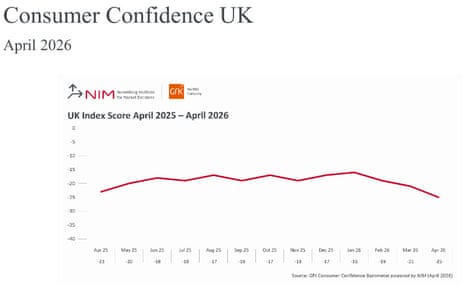
UK consumer confidence has fallen to its lowest level in 33 months, driven by persistent economic uncertainty and concerns over global instability, even as retail sales showed a modest rebound in March.

The latest figures paint a mixed picture for the British economy, with households feeling increasingly pessimistic about their financial prospects despite some positive signals in the retail sector.

Background

Consumer confidence is a key indicator of economic health, reflecting how optimistic or pessimistic households feel about their financial situation and the broader economy. A sustained decline in confidence typically leads to reduced spending, which can have knock-on effects across the retail, hospitality, and services sectors.

Key Developments

The consumer confidence index has dropped to its lowest point in 33 months, according to data published on 25 April 2026. The decline has been attributed to a combination of factors, including ongoing concerns about global instability and the cost of living pressures that have weighed on British households for several years.

Despite the gloomy confidence figures, retail sales saw a 1.7% rebound in March, partially attributed to consumers stocking up on fuel at the start of the period of heightened global tensions. However, economists caution that this uptick may prove temporary if confidence continues to deteriorate.

Why It Matters

Consumer spending accounts for a significant proportion of UK economic output, meaning that sustained low confidence could weigh on growth prospects. The figures will be closely watched by the Bank of England as it considers its next moves on interest rates, with policymakers balancing the need to support growth against the risk of reigniting inflation.

For ordinary households, the data reflects the ongoing squeeze on living standards, with many families still feeling the effects of the cost of living crisis that has dominated British economic life in recent years.

What's Next

Economists and analysts will be monitoring upcoming data releases for signs of whether confidence is stabilising or continuing to deteriorate. The government faces pressure to take action to boost household finances, while the Bank of England's next interest rate decision will be closely scrutinised for any signals about the direction of monetary policy. Read more at NewsNow.

What's Your Take?

UK economyconsumer confidenceretail salescost of livingBank of England

Related Stories

Vodafone Ireland Announces EUR 360 Million Investment and New Dublin Headquarters
Business

Vodafone Ireland Announces EUR 360 Million Investment and New Dublin Headquarters

Vodafone Ireland has announced a EUR 360 million investment programme and plans to move to a new headquarters in Dublin City Centre, reaffirming its long-term commitment to Ireland. The investment is expected to enhance the company's network infrastructure and support employment across the country.

Titanic News
2 min read25 Apr 2026
Iran War Triggers Economic Shockwaves Across UK Economy
Business

Iran War Triggers Economic Shockwaves Across UK Economy

The UK economy is reeling from the impact of the Iran war, with oil prices above $107 a barrel, inflation rising to 3.3%, and consumer confidence at its lowest since autumn 2023 as of 24 April 2026. Marks & Spencer's chairman has warned that food price inflation is now inevitable, while the government's Β£600 million business energy support scheme has been criticised as insufficient. The conflict is expected to suppress business investment and reduce the UK's fiscal buffer by up to Β£16 billion.

Titanic News
3 min read25 Apr 2026
FTSE 100 Ends Week Lower as Middle East Uncertainty Weighs on Markets
Business

FTSE 100 Ends Week Lower as Middle East Uncertainty Weighs on Markets

London's FTSE 100 fell 0.75% to close at 10,379.08 on 24 April 2026, as ongoing uncertainty over the Iran conflict and elevated oil prices weighed on investor sentiment. Retail stocks fell after warnings from Sainsbury's and WH Smith, while defence sector shares continued to outperform. Markets are watching closely for any progress in US-Iran peace negotiations that could ease pressure on energy prices.

Titanic News
2 min read25 Apr 2026
UK Sectors Show Divergent Fortunes as Iran War Reshapes Economy
Business

UK Sectors Show Divergent Fortunes as Iran War Reshapes Economy

The Iran war is creating sharply divergent fortunes across UK business sectors, with the staycation market and defence industry thriving while retail, construction, and luxury hospitality face significant headwinds as of April 2026. The government is considering nationalising British Steel and has introduced new rules requiring large companies to pay suppliers within 60 days. The Bank of England's latest Agents' Summary paints a picture of an economy under significant strain but with pockets of resilience.

Titanic News
2 min read25 Apr 2026