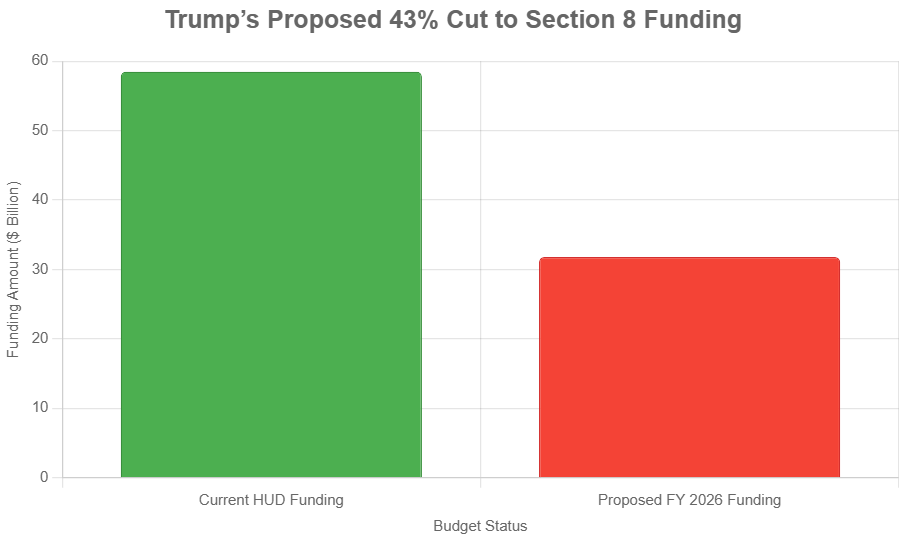
Trump Budget Proposes 44% Slash to HUD Programs, Threatening Housing Vouchers for Millions
The Trump administration released additional details of its Fiscal Year 2026 budget proposal on May 2, calling for a 44% reduction — $26.7 billion — in the Department of Housing and Urban Development's affordable housing, homelessness, and community development programs. The plan would convert Housing Choice Vouchers and Public Housing into a State Rental Assistance Block Grant, impose two-year time limits on some households receiving assistance, and eliminate or sharply reduce fair housing enforcement programs. Housing advocates are calling it the most aggressive proposed rollback of federal housing support since the Reagan era.
Background
The Department of Housing and Urban Development administers the federal government's primary tools for addressing housing affordability and homelessness. The Housing Choice Voucher program — commonly known as Section 8 — currently assists approximately 2.3 million low-income households by subsidizing the gap between market rents and what families can afford to pay. Public Housing provides direct government-owned units to roughly 900,000 households. Together, these programs represent the backbone of federal rental assistance, with roots in legislation dating to the Housing Act of 1937.
The administration's broader fiscal framework, shaped by the One Big Beautiful Bill Act passed in 2025, has already restructured student loans, Medicaid, and healthcare subsidies. The HUD cuts represent the housing component of a sweeping effort to reduce federal domestic spending and shift program administration to states.
Key Developments
The budget proposal consolidates Housing Choice Vouchers and Public Housing into a single State Rental Assistance Block Grant, giving states greater flexibility in how they distribute funds but also imposing new restrictions. Proposed two-year time limits on assistance for some households would represent a fundamental departure from the current system, under which vouchers are not time-limited. HUD's Homeless Assistance Grants face a modest reduction and a reorientation toward short-term crisis intervention rather than permanent supportive housing — a model that research has consistently shown to be more cost-effective at reducing chronic homelessness.
Programs dedicated to eviction protection and fair housing enforcement face significant reductions or complete elimination under the proposal. The Community Development Block Grant program, which funds local infrastructure and anti-poverty initiatives in cities and counties across the country, is also targeted for deep cuts. The National Low Income Housing Coalition estimates the combined reductions would affect millions of households currently receiving or waiting for federal rental assistance.
Why Americans Should Care
The proposed cuts would land hardest in cities and states already grappling with severe housing shortages. In California, where the Housing Choice Voucher waitlist in Los Angeles County alone exceeds 600,000 households, a block grant conversion with reduced funding would force local housing authorities to make impossible choices about who receives assistance. In Texas, where homelessness has risen sharply in Houston and Dallas, the shift away from permanent supportive housing funding threatens programs that have reduced chronic homelessness by measurable percentages over the past decade. Rust Belt cities like Cleveland and Detroit, which rely heavily on Community Development Block Grants to fund neighborhood revitalization, would lose a critical source of flexible local investment. Rural communities in Appalachia and the Mississippi Delta, where federal housing programs often represent the only affordable housing infrastructure, face particular vulnerability. The proposed time limits on vouchers would also affect military veterans, elderly residents, and people with disabilities who currently rely on long-term rental assistance.
Why It Matters
The scale of the proposed HUD cuts is historically significant. The Reagan administration's 1981 budget reduced HUD funding by roughly 50% in real terms over several years, contributing to a surge in homelessness that defined American cities through the 1980s and 1990s. The current proposal, if enacted, would represent a comparable structural shift. The block grant conversion model has a mixed track record: while it gives states flexibility, it also removes federal minimum standards and creates wide variation in who receives help depending on where they live. States with Republican-controlled legislatures have historically used block grant flexibility to impose stricter eligibility requirements and reduce caseloads.
The international context is also instructive — peer nations including Canada, the United Kingdom, and Germany maintain robust national housing subsidy systems and have lower rates of housing cost burden among low-income households. The US already spends a smaller share of GDP on housing assistance than most comparable economies, and the proposed cuts would widen that gap further. The second-order effects — increased homelessness, greater strain on emergency services, and reduced economic mobility for low-income workers — carry costs that extend well beyond HUD's budget line.
What's Next
The budget proposal requires congressional approval, and the HUD cuts face significant opposition from both Democratic members and some Republicans representing urban and suburban districts where housing costs are a top voter concern. The Senate Banking Committee, which oversees HUD, is expected to hold hearings on the proposal in May. Housing advocacy organizations have already launched coordinated lobbying campaigns targeting swing-district House members. The administration's track record of using budget proposals as negotiating frameworks suggests the final appropriations outcome may differ substantially from the initial request, but the direction of travel — toward block grants and reduced federal housing commitments — reflects a durable policy preference that will shape negotiations regardless of the final numbers.
Sources: National Low Income Housing Coalition; American Council on Education; US Department of Housing and Urban Development