2026 Senate Map Favors Democrats as North Carolina, Maine, and Ohio Emerge as Top Battlegrounds
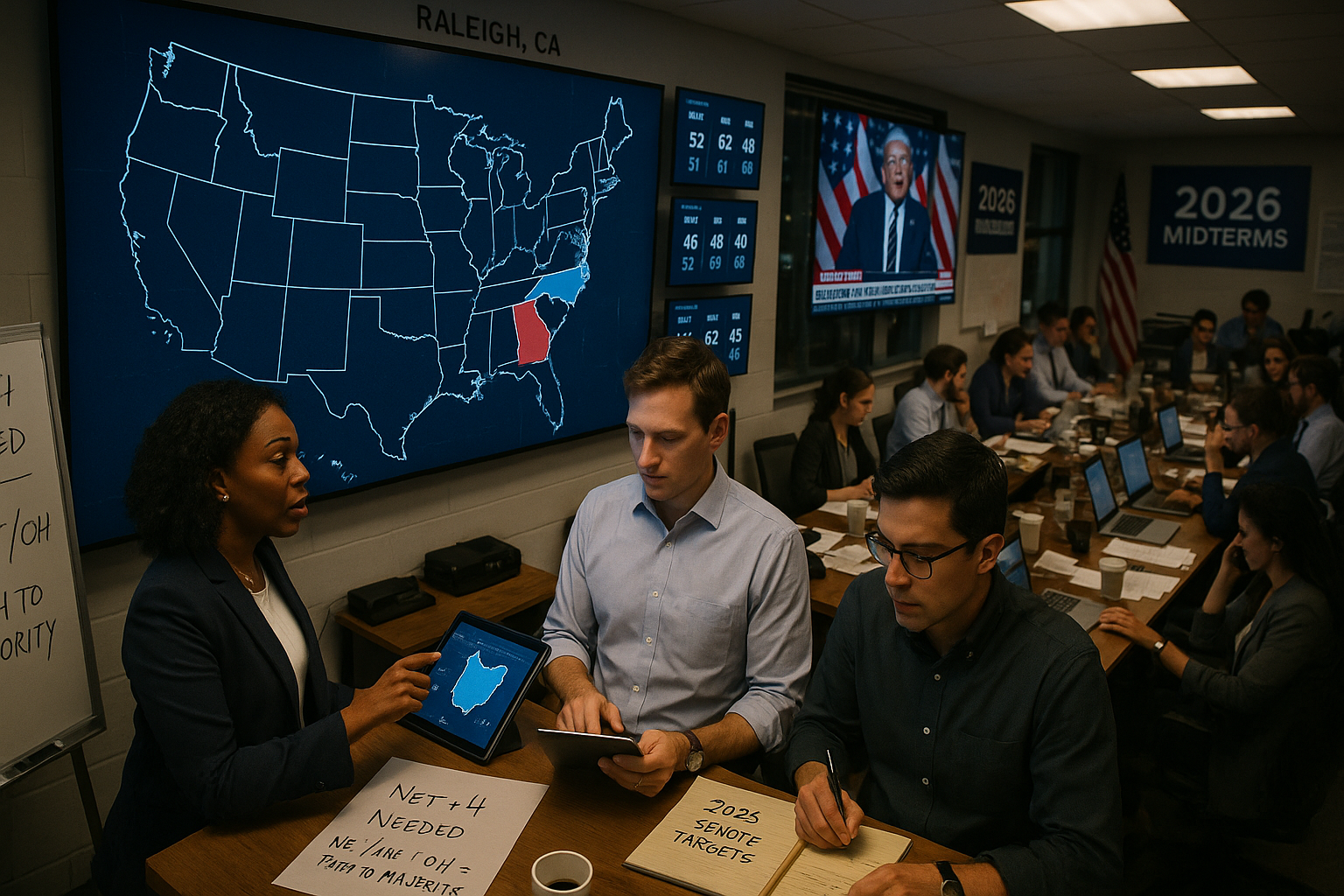
The 2026 midterm Senate map is shaping up as one of the most competitive in a decade, with Democrats targeting a net gain of four seats needed to reclaim the majority in a political environment defined by an unpopular war in Iran, elevated energy costs, and President Trump's historically low approval ratings for a second-term president. New analysis from NPR and independent forecasters identifies North Carolina — where former Democratic Governor Roy Cooper is running for the open Republican seat — as the most likely flip, with Maine's Susan Collins and Ohio's John Husted representing the next tier of competitive Republican-held seats. The outcome will determine whether Democrats can check the administration's legislative agenda for the final two years of Trump's term.
Background
The Senate's current composition gives Republicans a working majority, which they have used to confirm executive nominees and advance the administration's legislative priorities. Democrats need to flip four seats — a net gain — to take control of the chamber, a threshold that requires winning in states that have trended Republican in recent cycles. The 2026 map is more favorable to Democrats than the 2024 cycle, when the party was defending seats in red-leaning states; this time, Republicans are defending more competitive territory.
Midterm elections historically favor the party out of power, and the political environment in spring 2026 is challenging for Republicans. The Iran conflict, which began in February, has generated sustained public opposition, and the economic effects — elevated oil prices, rising consumer costs — have eroded the economic approval ratings that typically anchor a president's political standing.
Key Developments
North Carolina's open seat — created by the retirement of a Republican incumbent — is rated the most likely to flip by multiple forecasters. Former Governor Roy Cooper, who served two terms and left office with strong approval ratings, has entered the race and immediately established himself as the frontrunner in Democratic primary polling. Cooper's record on economic development and his ability to win statewide in a competitive state make him a formidable general election candidate.
Maine's Susan Collins, who has survived multiple cycles as a moderate Republican in an increasingly Democratic-leaning state, faces her most competitive race since 2020. Collins's votes in support of some administration priorities have complicated her positioning as an independent voice, and Democratic recruitment efforts have focused on finding a candidate who can appeal to the state's large independent voter bloc. Ohio's John Husted, who holds the seat previously occupied by JD Vance, faces a competitive environment in a state that has trended Republican but where economic anxieties about manufacturing and energy costs create openings for Democrats.
Why Americans Should Care
Senate control determines which party sets the legislative agenda, confirms federal judges and executive nominees, and conducts oversight of the executive branch. For voters in North Carolina, the Senate race will shape federal policy on issues from tobacco regulation — critical to the state's agricultural economy — to military base funding at Fort Liberty and Camp Lejeune. In Maine, where fishing, forestry, and tourism industries are directly affected by federal environmental and trade policy, Collins's positioning on tariffs and conservation regulations will be central to the campaign. Ohio voters, particularly in manufacturing communities in the Mahoning Valley and along the Lake Erie shoreline, will be watching candidates' positions on trade policy, infrastructure investment, and the future of the state's steel and automotive industries. Nationally, a Democratic Senate majority would restore the chamber's role as a check on executive power — including the ability to block judicial nominations and conduct subpoena-backed investigations — that has been largely dormant under Republican control.
Why It Matters
The 2026 midterms will be the first major electoral test of the Trump administration's second term and the first opportunity for voters to render a verdict on the Iran conflict, the economic effects of the administration's tariff and energy policies, and the social program changes enacted through the One Big Beautiful Bill Act. Historically, second-term midterms have been punishing for the president's party: George W. Bush lost both chambers in 2006, Barack Obama lost the Senate in 2014, and Donald Trump lost the House in 2018. The current environment — with an unpopular war, elevated inflation, and significant cuts to social programs — mirrors the conditions that produced those historical losses.
The Senate map's competitiveness also reflects a broader geographic sorting of American politics: states like North Carolina and Georgia, which were reliably Republican a decade ago, are now genuine battlegrounds as demographic change and suburban realignment reshape the electorate. Democrats are also targeting Republican-held seats in Alaska, Georgia, and New Hampshire, with longer-shot opportunities in Iowa and Minnesota. The outcome in November will set the political context for the final two years of the Trump administration and the early positioning for the 2028 presidential race.
What's Next
Primary elections in most states will be held between May and August, with general election campaigns beginning in earnest after Labor Day. The Democratic Senatorial Campaign Committee has identified 12 target seats and is expected to deploy significant resources in North Carolina, Maine, Ohio, Alaska, Georgia, and New Hampshire. Republican incumbents in competitive states will face pressure to distance themselves from unpopular administration positions while maintaining enough party loyalty to avoid primary challenges. The first major round of campaign finance disclosures, covering the first quarter of 2026, will be released in mid-May and will provide the first concrete measure of each campaign's financial strength.
Sources: NPR; Roll Call; NC Newsline