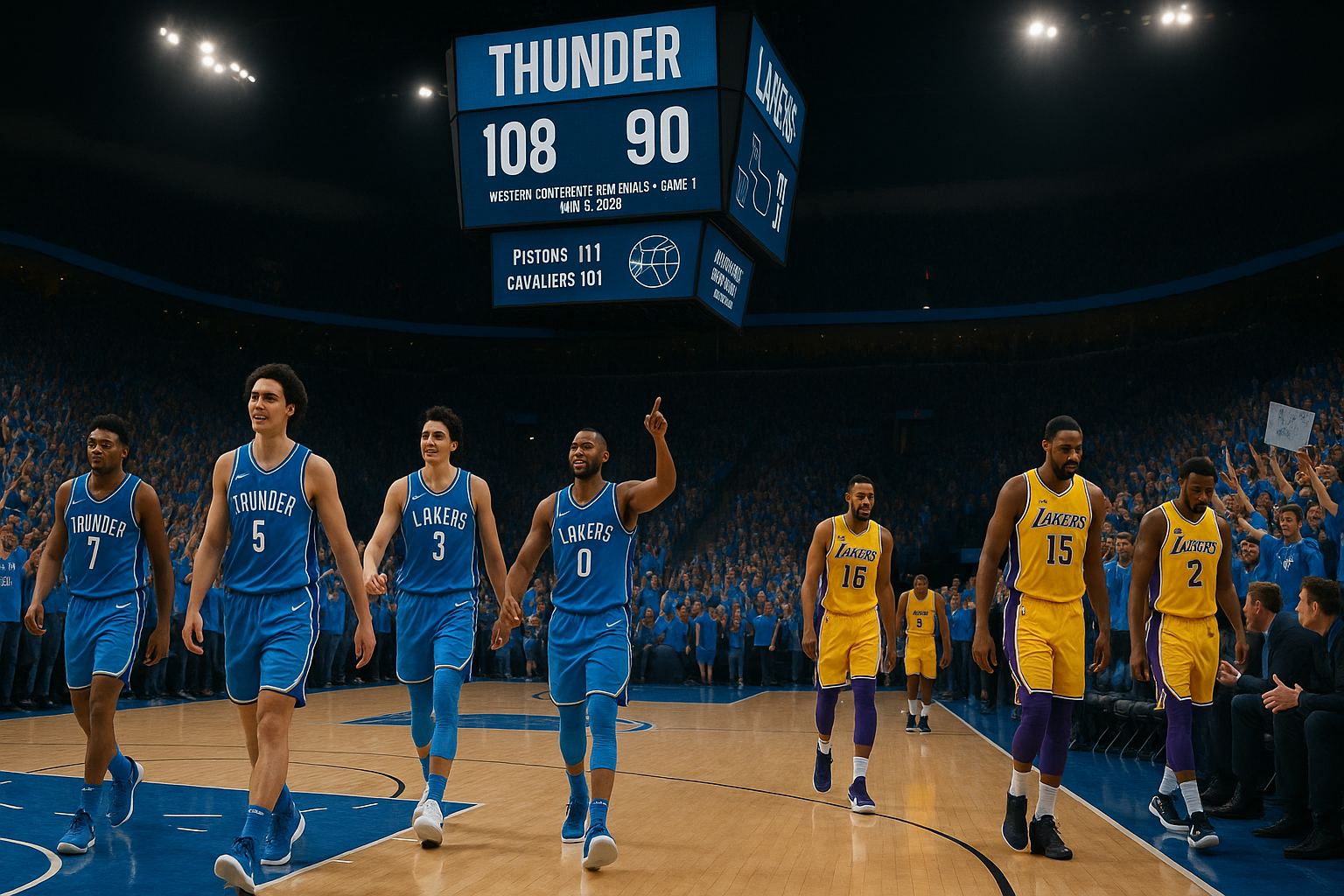
Thunder Rout Lakers 108-90, Pistons Top Cavaliers as NBA Playoffs Top Seeds Assert Control
The Oklahoma City Thunder and Detroit Pistons, the top seeds in the Western and Eastern Conferences respectively, opened the NBA Playoffs second round on May 5, 2026, with decisive home victories — the Thunder routing the Los Angeles Lakers 108-90 to extend their perfect postseason record, and the Pistons defeating the Cleveland Cavaliers 111-101 in a game that showcased Detroit's depth and defensive discipline.
Background
The 2026 NBA Playoffs have produced a second round that pits the league's two best regular-season teams against marquee opponents. The Thunder, who won the NBA championship in 2025 and posted the league's best record again in 2026, swept the Phoenix Suns in the first round without a single game decided by fewer than eight points. The Pistons, completing one of the most dramatic franchise turnarounds in recent memory, won the Eastern Conference's top seed after finishing last in the conference just three seasons ago.
The Lakers entered the series as a six-seed, having survived a grueling first-round series against the Golden State Warriors. LeBron James, now in his 23rd NBA season, remains the team's primary offensive engine at 41 years old, but the Lakers' depth and defensive consistency have been persistent concerns throughout the postseason.
Key Developments
In Oklahoma City, the Thunder controlled the game from the opening tip. Chet Holmgren led the team with 26 points and 11 rebounds, while Shai Gilgeous-Alexander added 24 points and 9 assists. The Thunder's bench outscored the Lakers' reserves 38-14, a margin that reflected the depth advantage Oklahoma City has built through five consecutive drafts. LeBron James scored 27 points for Los Angeles but received minimal support, with Anthony Davis held to 14 points on 5-of-14 shooting by the Thunder's interior defense.
In Detroit, the Pistons used a 17-4 run in the third quarter to break open a game that had been tied at 78 entering the period. Cade Cunningham finished with 28 points and 10 assists, and the Pistons' defense held Cleveland's Donovan Mitchell to 19 points on 7-of-21 shooting. The Cavaliers, who won 58 games during the regular season, looked fatigued after a seven-game first-round series against the Milwaukee Bucks.
Elsewhere in the second round, the New York Knicks lead the Philadelphia 76ers 1-0 after a dominant 137-98 Game 1 victory on May 4. The Minnesota Timberwolves hold a 1-0 series lead over the San Antonio Spurs following their 104-102 Game 1 win, in which Victor Wembanyama set an NBA playoff record with 12 blocks.
Why Americans Should Care
The Thunder's continued dominance has made Oklahoma City one of the most compelling sports stories in the country. A franchise that lost Kevin Durant in 2016 and spent years rebuilding through the draft has constructed a championship-caliber team without a single major free agent signing — a model that small-market teams in cities like Memphis, Sacramento, and Indianapolis are studying closely. For fans in Oklahoma, a second consecutive championship run would cement the Thunder as one of the defining sports franchises of the 2020s.
In Detroit, the Pistons' rise carries enormous civic significance for a city that has used sports success as a rallying point through decades of economic challenge. The team's sellout streak at Little Caesars Arena has generated an estimated $180 million in local economic activity this season, according to the Detroit Sports Commission, with playoff games adding a significant premium. For Cleveland, a loss in the second round would raise urgent questions about the Cavaliers' roster construction heading into an offseason when several key players face contract decisions.
Why It Matters
The Thunder's path to a second consecutive championship would make them the first repeat champion since the Golden State Warriors won back-to-back titles in 2017 and 2018. That Warriors dynasty reshaped the NBA's competitive landscape for nearly a decade, driving rule changes, roster construction philosophies, and a generation of players who grew up trying to replicate their style. An OKC dynasty built on homegrown talent and defensive versatility would have similarly lasting effects on how franchises approach team building.
The Pistons' rise is equally significant from a structural standpoint. Detroit's turnaround was built through patient drafting, disciplined cap management, and a coaching staff that prioritized player development over short-term results — a blueprint that stands in direct contrast to the superteam model that dominated the league from 2010 to 2020. If Detroit wins a championship, it will validate a franchise-building approach that gives hope to every small-market team currently in a rebuilding phase, from the San Antonio Spurs to the Washington Wizards.
What's Next
Game 2 of both series tips off on May 7. The Thunder host the Lakers again in Oklahoma City, where the home crowd has been one of the most electric environments in the league all season. The Pistons travel to Cleveland for Game 2, where the Cavaliers will need a strong response to avoid falling into a 0-2 hole. Game 2 of the Knicks-76ers series is scheduled for the evening of May 6 in New York, with the Timberwolves and Spurs also playing their second game on May 6.
Sources: CBS Sports; NBA.com; Bleacher Report