Taoiseach Defends Occupied Territories Bill as Opposition Accuses Government of 'Gutting' Legislation
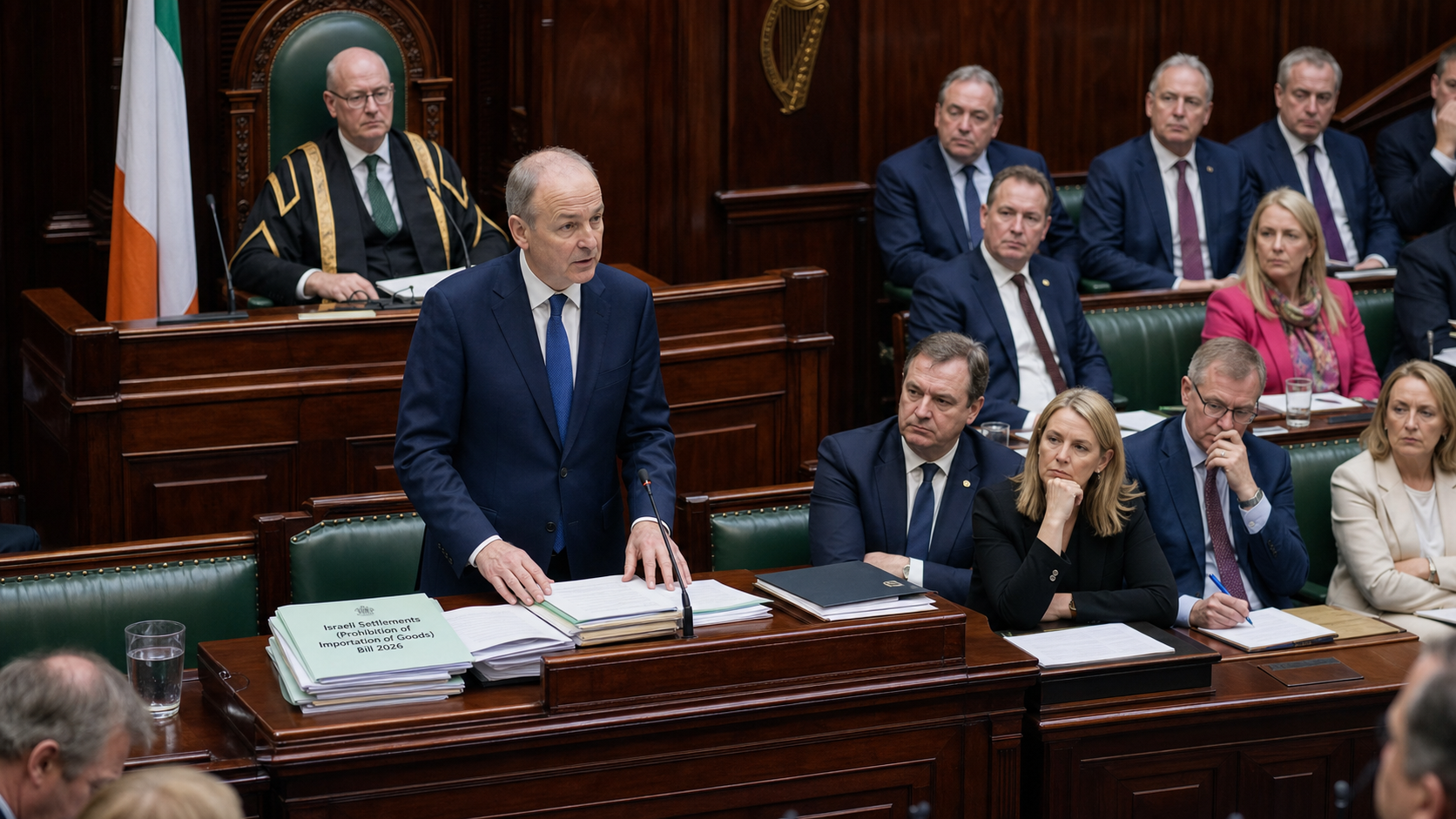
Taoiseach Micheál Martin has mounted a robust defence of the government's decision to exclude services from the Israeli Settlements (Prohibition of Importation of Goods) Bill 2026, insisting that the inclusion of services would be legally unimplementable and would expose Ireland to retaliatory action that could threaten up to 250,000 jobs — as opposition parties accused the coalition of producing legislation so narrow as to be meaningless.
Background
The Occupied Territories Bill has had a long and contested history in Irish politics. First introduced as a private member's bill by the Seanad in 2018, it has been debated, amended and delayed through successive governments, with successive administrations citing legal concerns about its compatibility with EU trade law as a reason for not advancing it. The bill's core purpose — to prohibit the importation of goods produced in Israeli settlements in the occupied Palestinian territories — has broad public support in Ireland, but the legal and diplomatic complexities involved in implementing such a prohibition have proved formidable.
The current government's decision to advance the bill in a modified form — covering goods but not services — reflects a judgment that a narrower bill is better than no bill at all, and that the legal risks associated with including services are too great to accept. The government has received legal advice indicating that a services prohibition would be vulnerable to challenge under EU law and could trigger retaliatory action from the United States, which has significant economic leverage over Ireland through the presence of major US multinationals.
The political context is also important. Ireland has been one of the most vocal European countries in criticising Israeli military operations in Gaza, and there is significant pressure from civil society and opposition parties for the government to translate that rhetoric into concrete action. The Occupied Territories Bill is seen by many as the most tangible legislative expression of Ireland's position on the conflict.
Key Developments
Speaking in the Dáil on 9 June, the Taoiseach was direct about the government's reasoning. "I am not going to apologise for ensuring that the legislation we produce is, first, implementable, and second, does not put a quarter of a million jobs in this country at risk through a whole series of political, constitutional and legal challenges that could arise," he said. He acknowledged that prohibiting only goods — estimated to be worth around €200,000 in fruit and vegetables — was "a symbolic act," but argued that it was based on "solid legal advice."
The opposition response was sharp. Sinn Féin's foreign affairs spokesperson accused the government of "gutting" the legislation, arguing that services constitute the vast majority of trade with Israeli settlements and that a goods-only prohibition was "an empty gesture." People Before Profit went further, describing the bill as "a fig leaf" designed to give the government political cover without imposing any meaningful economic pressure on Israel.
The government has indicated that it will continue to work with EU partners to develop a broader European response to the situation in the occupied territories, and that the Irish bill should be seen as part of a wider diplomatic effort rather than a standalone measure.
Why It Matters
The debate over the Occupied Territories Bill reflects a genuine tension at the heart of Irish foreign policy: between the country's strong tradition of solidarity with peoples living under occupation and its economic dependence on the goodwill of the United States and the stability of the EU single market. Ireland is uniquely exposed to US economic pressure because of the concentration of American multinationals in its economy — companies like Apple, Google, Meta and Pfizer employ tens of thousands of people in Ireland and contribute a disproportionate share of the country's corporation tax revenue.
The Taoiseach's reference to 250,000 jobs is a reminder of that exposure. Whether or not the legal risk is as acute as the government suggests, the political calculation is clear: the government is not willing to risk the economic relationship with the United States for the sake of a services prohibition that would have limited practical impact on Israeli settlements.
The opposition's criticism is also legitimate. If the bill's practical effect is limited to prohibiting the importation of a small quantity of fruit and vegetables, it is difficult to argue that it represents a meaningful response to the situation in the occupied territories. The gap between Ireland's rhetorical position and its legislative action is one that will continue to be a source of political tension.
Local Impact
The debate over the Occupied Territories Bill has resonated strongly in Irish civil society, with a number of trade unions, academic institutions and community organisations having called for stronger action. In Dublin, Cork and Galway, pro-Palestinian solidarity groups have organised demonstrations calling on the government to strengthen the bill, and several university student unions have passed motions supporting a more comprehensive prohibition.
For Irish businesses that trade with Israel — primarily in the technology and pharmaceutical sectors — the bill as currently drafted has limited practical implications. The goods covered by the prohibition represent a tiny fraction of total trade between Ireland and Israel, and the services sector, which is where the significant economic relationships exist, is explicitly excluded.
What's Next
The bill is expected to complete its passage through the Dáil and Seanad before the summer recess, with the government hoping to have it enacted by mid-July. The opposition has indicated that it will seek to amend the bill to include services, though those amendments are expected to be defeated by the government majority. Following enactment, the government will be required to establish the administrative mechanisms for enforcing the goods prohibition, a process that is expected to take several months.