Supreme Court Clears Texas Redistricting Map for 2026 Midterms in Landmark Ruling
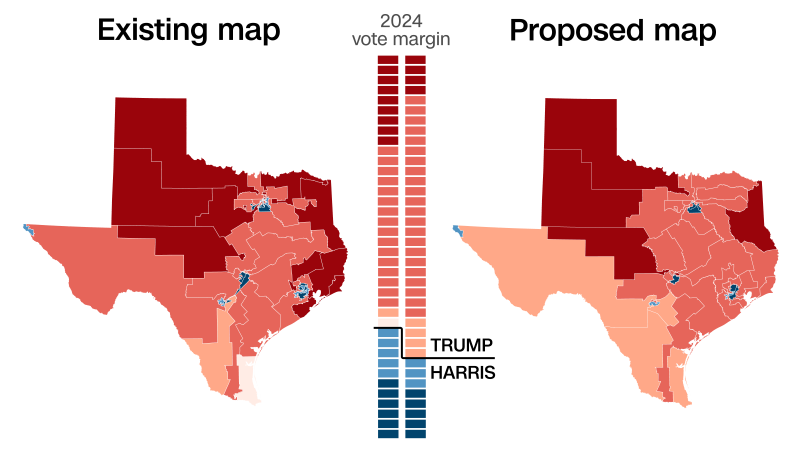
The Supreme Court handed Texas Republicans a decisive victory on April 27, issuing a summary reversal that allows the state's redrawn congressional map to take effect for the 2026 midterm elections. The ruling overturns a lower court decision that had blocked the map, clearing the way for a redistricting plan that could net the GOP multiple additional House seats and fundamentally alter the balance of power in Congress.
Background
Texas Republicans signed a new congressional map into law in August 2025, part of a wave of mid-decade redistricting efforts that followed the Supreme Court's 2023 ruling in Allen v. Milligan, which required Alabama to redraw its congressional lines to give Black voters greater representation. Texas Republicans argued their map complied with the Voting Rights Act while maximizing Republican electoral advantage — a strategy that critics immediately challenged in federal court.
A lower court blocked the map from taking effect, ruling that several districts likely violated the Voting Rights Act by diluting the voting power of Hispanic and Black communities in key urban and suburban areas. Texas Attorney General Ken Paxton appealed directly to the Supreme Court, which agreed to take up the emergency application ahead of the 2026 election cycle.
The case arrived at the Court against a backdrop of intense national scrutiny over redistricting. Six states — California, Missouri, North Carolina, Texas, Ohio, and Utah — are operating under new congressional maps for 2026, making this election cycle one of the most geographically redrawn in modern history.
Key Developments
The Supreme Court's summary reversal on April 27 came without full briefing or oral argument, a procedural move that signals the majority viewed the lower court's intervention as clearly erroneous. The unsigned order reinstates the Texas map drawn by the Republican-controlled legislature, which reconfigures several competitive districts in the Dallas-Fort Worth metroplex, Houston suburbs, and the Rio Grande Valley.
Texas Attorney General Ken Paxton praised the ruling, declaring it rejected "meritless attacks" on the state's redistricting plan. The decision means Texas will use the new map for all 36 congressional races in November 2026. Analysts at the Cook Political Report estimate the redrawn lines could shift between two and four seats from competitive to safely Republican, a significant swing in a House where Republicans currently hold a razor-thin 218-213 majority.
Florida Governor Ron DeSantis has separately proposed a new congressional map that could add up to four additional Republican seats in that state, compounding the national impact of mid-decade redistricting on House control.
Why Americans Should Care
For voters across Texas — from the rapidly diversifying suburbs of Houston and Dallas to the heavily Hispanic communities along the Rio Grande Valley — this ruling determines whose voice carries weight in Congress for the next two years. Districts that were drawn to be competitive now tilt decisively toward one party, meaning millions of Texans in redrawn areas will effectively have their congressional representation predetermined before a single ballot is cast.
Beyond Texas, the ruling signals the Supreme Court's willingness to allow aggressive mid-decade redistricting to proceed with minimal judicial interference. States like North Carolina and Ohio, which have also redrawn their maps, are watching closely. For voters in swing districts across the Midwest and South, the precedent set here could determine whether their House races remain genuinely contested. With the House majority potentially hinging on a handful of seats, the downstream effects of this ruling extend to every American who cares about the composition of the next Congress.
Why It Matters
The Supreme Court's decision accelerates a structural shift in how congressional maps are drawn and contested. Historically, redistricting occurred once per decade following the census. The current wave of mid-decade remapping — driven by state legislatures in Texas, Florida, North Carolina, and elsewhere — represents a departure from that norm, one the Court has now implicitly endorsed by declining to block it.
The practical consequence is a ratchet effect: whichever party controls a state legislature can redraw maps whenever it holds power, locking in advantages that persist for years. This mirrors tactics used in the 1980s and 1990s, but the scale and speed of modern redistricting software make the process far more precise. International comparisons are instructive — countries like Canada and the United Kingdom use independent boundary commissions to draw electoral maps, insulating the process from partisan manipulation. The United States remains an outlier in allowing legislatures to draw their own districts.
For the 2026 midterms, the ruling narrows the path for Democrats to recapture the House. With 55 House incumbents retiring — the second-highest total in modern history — and maps now tilted further Republican in Texas and potentially Florida, the structural headwinds facing Democrats have grown steeper.
What's Next
Civil rights groups and Democratic-aligned organizations are expected to pursue additional legal challenges, though the Supreme Court's summary reversal makes further injunctive relief unlikely before November 2026. The full merits of the Voting Rights Act claims may still be litigated after the election. Meanwhile, Florida's proposed redistricting map faces its own legal scrutiny, with a state court hearing scheduled for May. The cumulative effect of these redistricting battles will define the competitive landscape of the 2026 House elections and set precedents that will shape congressional maps well into the 2030s.
Sources: Texas Attorney General; Ballotpedia; CNN Politics