Stormont Budget Deadlock Deepens as Executive Fails to Agree Multi-Year Spending Plan
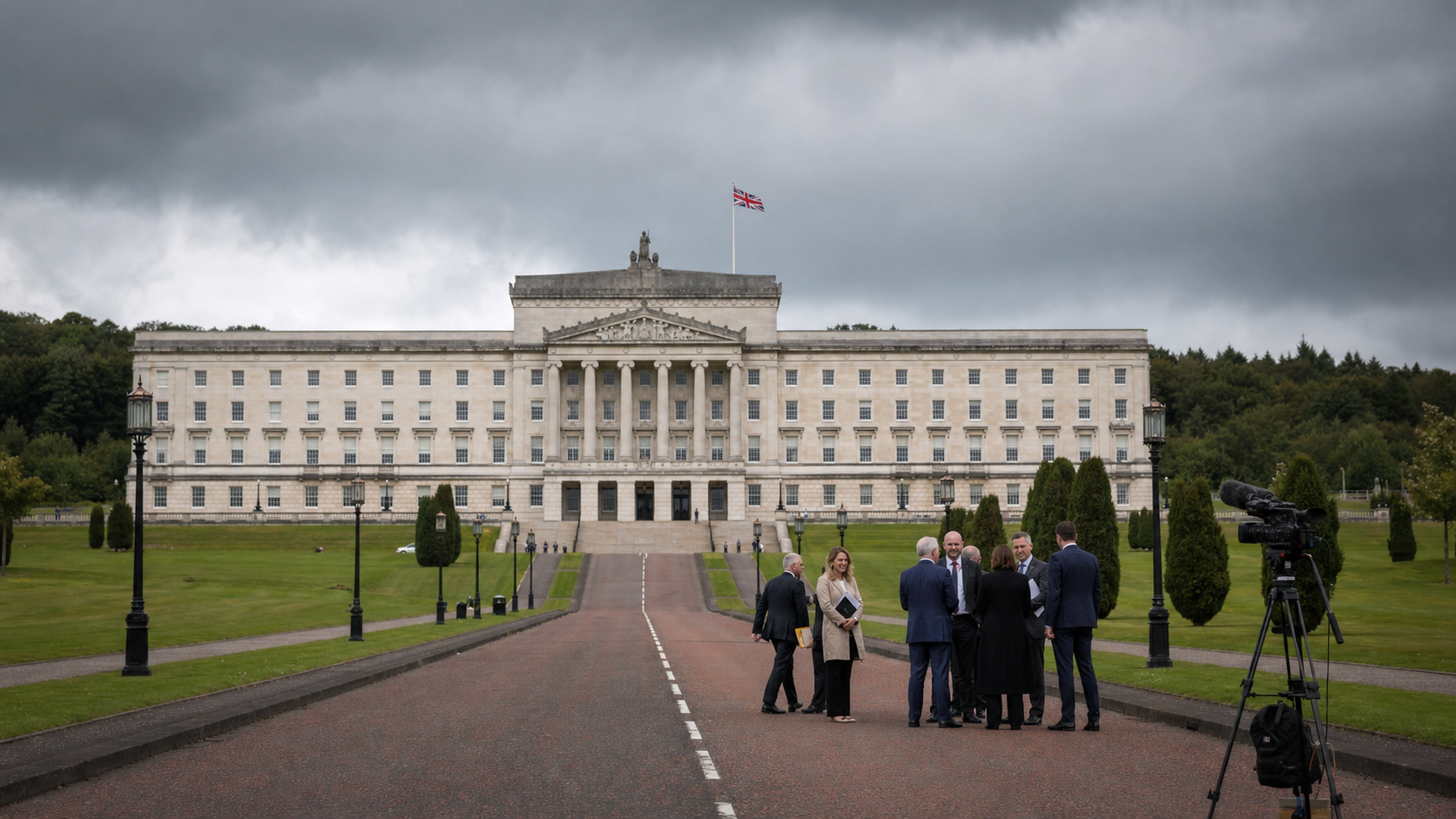
The Northern Ireland Executive has failed to agree a multi-year budget, leaving public services operating on contingency arrangements and community organisations warning of a "disaster" for vital services, as Finance Minister John O'Dowd's draft spending plan for 2026-27 to 2029-30 continues to face rejection from DUP ministers who have described it as "deeply flawed" and "unachievable", with a reported shortfall of approximately £1.4 billion for the current financial year and no resolution in sight.
Background
The Stormont budget crisis has been building for years, driven by a combination of factors that include the legacy of the Executive's prolonged collapse between 2022 and 2024, the inadequacy of the block grant from Westminster relative to Northern Ireland's public service needs, and the political difficulties of reaching cross-party agreement on spending priorities in a mandatory coalition government where parties with fundamentally different visions of Northern Ireland's future must govern together.
Finance Minister John O'Dowd published a draft multi-year budget in January 2026, covering resource spending through 2029-30 and capital investment through 2030. The proposal included significant capital allocations — over £1 billion for the A5 upgrade, £443 million for social housing, and over £100 million for the redevelopment of Casement Park — and proposed a 5 per cent annual increase in domestic regional rates. It was met with immediate rejection from DUP ministers, who described it as a "ghost budget" that failed to prioritise frontline services.
The UK Treasury provided a £400 million "reserve claim" in February 2026 to help departments balance their budgets, but this was structured as a repayable loan rather than a grant, adding to the long-term financial pressure on the Executive. A subsequent revelation that the Executive had spent less than 4 per cent of a £230 million public services transformation fund — with only £9 million of the fund utilised by April 2026 — added to the political pressure on the Finance Minister and the broader Executive.
Key Developments
As of July 2026, the Executive remains in a state of internal disagreement, with ministers engaging in talks at Hillsborough Castle with the UK government to address financial pressures. The new Northern Ireland Secretary, Chris Bryant, who was appointed to the role in the recent Cabinet reshuffle, has been briefed on the budget situation and is expected to play a more active role in facilitating discussions between the Executive parties and the Treasury.
Community organisations across Northern Ireland have been vocal about the impact of the budget uncertainty on their services. In Derry, the City and Strabane District Council has warned that the lack of a settled Stormont budget is a "disaster" for vital community services, with advice centres, community development programmes, and social support services all facing funding uncertainty. The Department for Communities, which funds many of these services, has been operating on interim allocations that do not provide the certainty needed for multi-year planning.
The Executive has approved some short-term measures — including a £100 heating oil payment for low-income households — but the absence of a settled multi-year budget means that departments cannot plan effectively, cannot recruit staff with confidence, and cannot commit to capital projects that require long-term funding certainty.
Why It Matters
The Stormont budget deadlock is not merely a political dispute; it has real consequences for the people of Northern Ireland. Public services that are already under severe pressure — health, education, housing, community development — cannot function effectively without settled funding. The uncertainty created by the budget impasse is itself a cost: it prevents departments from making efficiency improvements that require upfront investment, it demoralises public sector workers who cannot be given assurances about their jobs, and it undermines the confidence of businesses and investors who need to know that Northern Ireland's public infrastructure will be maintained.
The political dynamics of the mandatory coalition make budget agreement uniquely difficult. Unlike a single-party government or a voluntary coalition, the Stormont Executive requires the agreement of parties that may have fundamentally different spending priorities and different views about the appropriate level of public services. The DUP's rejection of O'Dowd's draft budget reflects not just a disagreement about numbers but a deeper disagreement about the role of the state in Northern Ireland's economy and society. This is the third consecutive year in which the Executive has failed to agree a multi-year budget, a record that compares unfavourably with the devolved administrations in Scotland and Wales.
Local Impact
The impact of the budget deadlock is felt across Northern Ireland, but it is most acute in communities that depend most heavily on public services. In West Belfast, North Belfast, and parts of Derry and Strabane, community organisations that provide advice, support, and development services are operating without the funding certainty they need to plan effectively. The Western Health and Social Care Trust, which serves Derry, Strabane, Fermanagh, and Tyrone, has warned that the budget uncertainty is affecting its ability to recruit and retain staff in an already challenging labour market.
What's Next
Talks between the Executive parties and the UK government at Hillsborough Castle are expected to continue through the summer. New NI Secretary Chris Bryant has indicated that he will prioritise the budget situation in his early weeks in the role. The Finance Minister is expected to bring a revised budget proposal to the Executive in September, following the summer recess. If agreement cannot be reached, the UK government may need to consider whether to intervene directly in Northern Ireland's finances — a step that would be politically sensitive but that some observers believe is becoming increasingly necessary.