Short-Term Let Register Pushed to December 2026 as Government Tightens Rules on Airbnb-Style Rentals
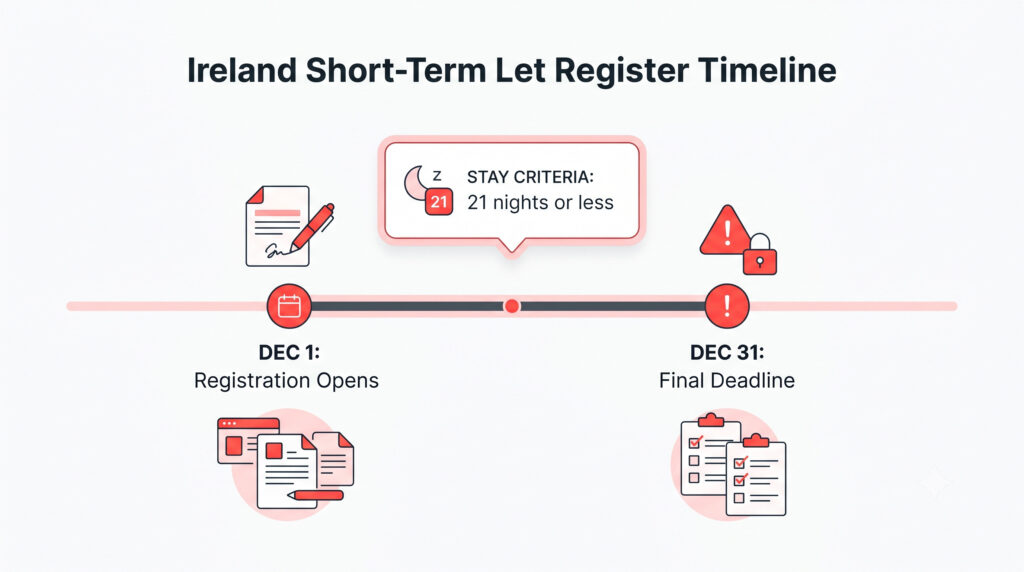
The Government has confirmed that mandatory registration for short-term holiday lets of under 21 nights will come into force in December 2026, after the original May deadline was missed, with the new register requiring all Airbnb-style operators to obtain a licence from their local authority and face significant penalties for non-compliance — a measure that housing advocates argue has been delayed too long at a cost of thousands of homes that could have been returned to the long-term rental market.
Background
The proliferation of short-term holiday lets through platforms such as Airbnb and Vrbo has been a significant factor in the reduction of long-term rental supply in Ireland's major cities and tourist destinations. Properties that were previously available for long-term rental have been converted to short-term tourist accommodation, attracted by the higher returns available in the holiday market and the greater flexibility it offers landlords.
The scale of the problem has been documented in a series of reports commissioned by the Department of Housing. In Dublin, Cork, Galway, and Kerry — the areas most affected by tourism-driven short-term letting — thousands of properties have been removed from the long-term rental market. In some popular tourist areas, the proportion of housing stock dedicated to short-term letting has reached levels that have materially affected the availability and affordability of long-term accommodation for local residents.
The Government first announced its intention to introduce a short-term let register in 2022, as part of a broader package of measures to address the housing crisis. The register was originally intended to be operational by 2024, but a series of delays — attributed variously to the complexity of the legislative framework, the need for consultation with the tourism industry, and the technical challenges of building the registration system — pushed the deadline back repeatedly.
Key Developments
The most recent delay, from May 2026 to December 2026, was confirmed by the Department of Housing following representations from local authorities and the tourism industry about the readiness of the registration system. The Department has insisted that the December deadline is firm and that the register will be fully operational by the end of the year.
Under the new system, all operators of short-term lets of under 21 nights will be required to register with their local authority and obtain a licence. The licence will specify the conditions under which the property can be let on a short-term basis, including limits on the number of nights per year and requirements relating to planning permission. Properties in Rent Pressure Zones — which cover most of the major urban areas — will face the most stringent conditions, with operators required to demonstrate that the property is their principal private residence or that they have specific planning permission for short-term letting.
Penalties for non-compliance will include fines of up to €5,000 per offence, with the possibility of criminal prosecution for persistent offenders. Local authorities will be given enforcement powers to inspect properties and to require platforms such as Airbnb to remove listings that do not have a valid registration number.
Why It Matters
The short-term let register is one of the most significant housing policy interventions of recent years, with the potential to return a meaningful number of properties to the long-term rental market. Estimates of the number of properties that could be affected vary, but housing researchers have suggested that effective enforcement of the register could return between 5,000 and 10,000 properties to the long-term market nationally — a significant addition to supply in a market where every additional unit matters.
The repeated delays in implementing the register have been a source of considerable frustration for housing advocates, who argue that each month of delay represents additional hardship for renters who cannot find affordable accommodation. The May-to-December slip is the latest in a series of missed deadlines that have undermined confidence in the Government's ability to deliver on its housing commitments.
The tourism industry has lobbied strongly against the register, arguing that short-term lets provide essential accommodation capacity in areas where hotel supply is insufficient and that the register will damage Ireland's competitiveness as a tourist destination. The Government has sought to balance these concerns by maintaining a pathway for legitimate tourist accommodation operators to continue operating, while targeting the register primarily at properties that have been converted from long-term residential use.
Local Impact
The impact of the register will be felt most acutely in the areas where short-term letting has been most prevalent. In Dublin, the Temple Bar, Portobello, and Rathmines areas have seen significant concentrations of Airbnb-style properties, and the register is expected to return a meaningful number of these to the long-term market. In Galway, the city centre and the Salthill area have been particularly affected, with local residents and community groups having campaigned for years for action on short-term letting.
In Kerry, the register raises more complex questions about the balance between housing needs and tourism. The county's economy is heavily dependent on tourism, and short-term letting has been an important source of income for many rural households. The register's provisions for principal private residences — which allow homeowners to let their own homes for up to 90 nights per year without planning permission — are intended to protect this type of legitimate tourist accommodation while targeting the conversion of residential properties to full-time tourist use.
What's Next
The Department of Housing has committed to publishing detailed guidance for operators and local authorities in September 2026, giving the sector three months to prepare for the December implementation date. Airbnb and other platforms have been in discussions with the Department about the technical requirements for sharing data with the register, and an agreement on data-sharing protocols is expected to be finalised before the end of the summer. Local authorities are expected to begin recruiting enforcement officers in the autumn, with the first enforcement actions anticipated in early 2027.