Shankill and Ardoyne Youths Unite to Clean Up Belfast Interface in Powerful Show of Cross-Community Spirit
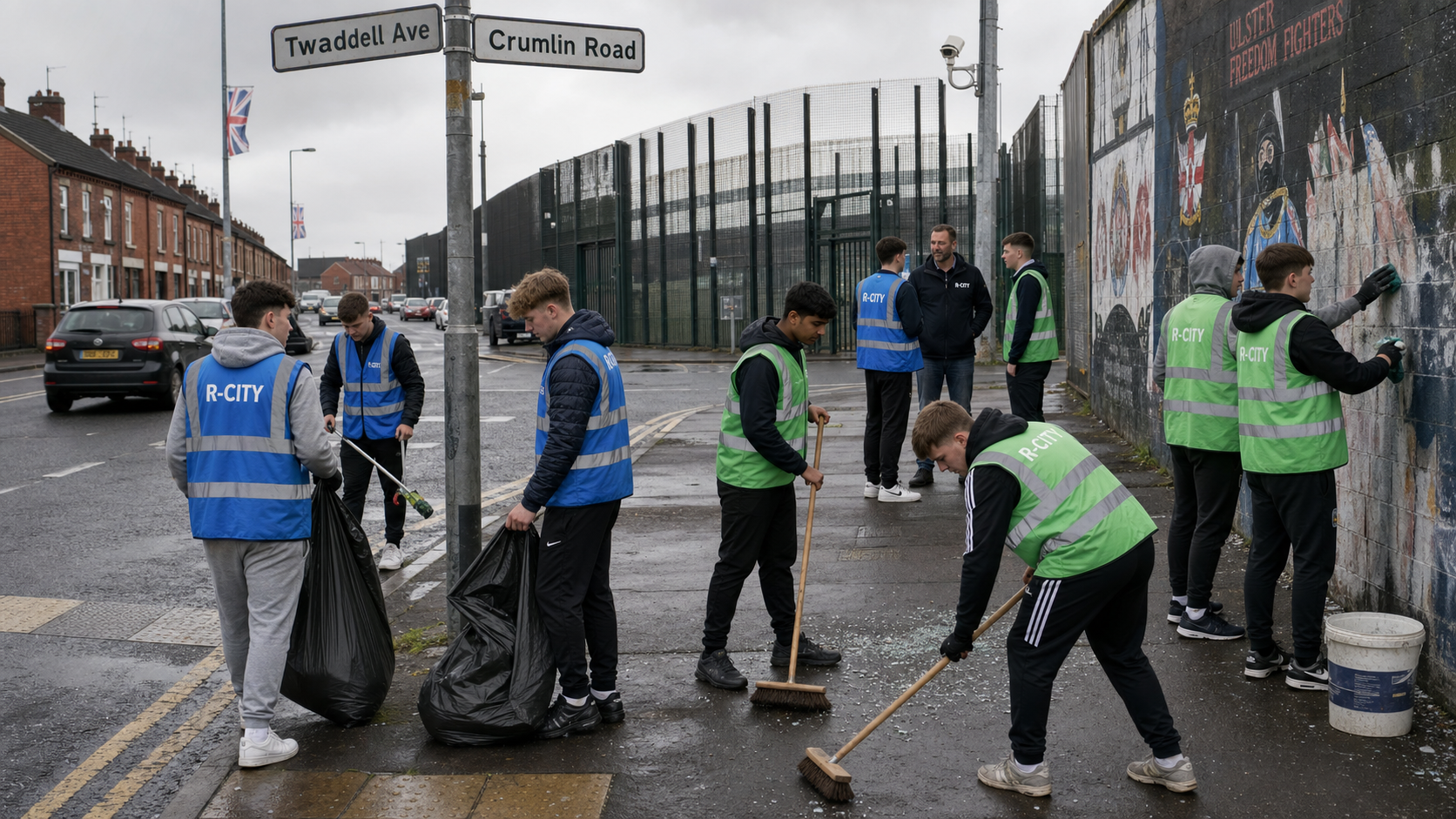
As Belfast grappled with some of its most serious civil unrest in years, a group of young men from the Shankill and Ardoyne areas quietly gathered at the Twaddell Avenue and Crumlin Road interface to do something altogether different: they cleaned it up. The initiative, organised through the R-City project and the Holy Cross Parish's Passionist Peace Office, brought together young people from communities that have historically been divided by one of the city's most contested interfaces, and in doing so offered a striking counterpoint to the week's dominant narrative of division and disorder.
Background
The Twaddell Avenue and Crumlin Road interface has been one of the most symbolically charged spaces in Belfast for decades. Situated at the boundary between the predominantly unionist Shankill area and the predominantly nationalist Ardoyne, it has been the site of repeated tension, particularly during the marching season. Peace walls, security cameras, and the physical architecture of division have long defined the space — a landscape that young people growing up on either side have inherited without having chosen it.
The R-City project, which works with young people across North and West Belfast, has been quietly building relationships across these divides for several years. Its approach is practical rather than theoretical: bringing young people together around shared activities, from sport to community projects, and allowing relationships to develop organically rather than through structured dialogue sessions. The Holy Cross Parish's Passionist Peace Office has similarly been engaged in long-term reconciliation work in the area, drawing on the parish's own painful history — the Holy Cross school dispute of 2001 remains one of the most distressing episodes in post-Good Friday Agreement Belfast.
Cross-community youth work in Belfast operates in a complex environment. Funding is often precarious, political support can be inconsistent, and the communities themselves sometimes view such initiatives with suspicion. That young men from the Shankill and Ardoyne were willing to come together publicly, at a moment of heightened tension, to clean a shared space speaks to the patient, sustained work of the organisations involved.
Key Developments
The cleanup took place on June 11, with participants from both communities working alongside each other at the interface. The practical work — collecting litter, clearing debris, tidying the shared space — was straightforward, but its symbolic weight was considerable. Young men who might otherwise have encountered each other only across a peace wall were working side by side, sharing the mundane labour of community maintenance.
The initiative was reported by The Irish News, which noted that the participants described the effort as an attempt to take ownership of a space that had too often been defined by others — by paramilitaries, by politicians, by the architecture of division. The group is now planning an educational trip to South Africa, where they will participate in peace and reconciliation workshops, drawing on the experience of communities that have navigated their own profound divisions.
The timing of the initiative — during a week of significant civil unrest in Belfast — was not accidental. Organisers were conscious that the city needed visible evidence of young people choosing a different path, and that the interface itself needed to be reclaimed as a shared space rather than a flashpoint.
Why It Matters
Cross-community initiatives in Belfast have a long and sometimes difficult history. Many well-intentioned programmes have struggled to translate short-term contact into lasting relationship change, and the structural conditions that produce division — segregated housing, segregated schooling, economic deprivation — remain largely intact. Against this backdrop, it would be easy to dismiss a single cleanup event as symbolic rather than substantive.
But that would be to underestimate what is actually happening here. The young men involved are not participating in a one-off event; they are part of ongoing programmes that have been building relationships over months and years. The South Africa trip is not a reward for a day's work — it is the next stage in a sustained process of engagement. And the choice to act publicly, at a moment when the city's divisions were being amplified by violence and media coverage, required a degree of courage that should not be underestimated.
Research on contact theory — the idea that meaningful interaction between divided communities can reduce prejudice and build understanding — consistently shows that sustained, structured contact is more effective than brief encounters. The R-City project and the Passionist Peace Office are doing exactly this kind of work, and the cleanup at Twaddell Avenue is one visible expression of it.
Local Impact
The immediate impact of the cleanup was felt in the physical space itself — a tidier, more cared-for interface that signals community ownership rather than abandonment. But the broader impact is harder to quantify and more significant. Young people in Ardoyne and the Shankill who saw their peers working together at the interface received a message about what is possible, about the choices available to them beyond the inherited divisions of their neighbourhoods.
Community workers in both areas have noted that the week's violence, while deeply damaging, has also prompted a renewed commitment to cross-community work among many residents. The cleanup was one expression of this; there have been others, including fundraising efforts and public statements from community leaders on both sides of the interface. The challenge now is to sustain this momentum beyond the immediate crisis.
What's Next
The South Africa trip is being planned for later in 2026, with organisers working to secure funding from the Community Relations Council and other bodies. The R-City project is also exploring additional cross-community activities at the Twaddell Avenue interface over the summer months, with the aim of establishing a regular programme of shared use. The Holy Cross Parish's Passionist Peace Office has indicated it will continue to support the initiative and is in discussions with other community organisations about expanding the model to other interface areas in North Belfast.