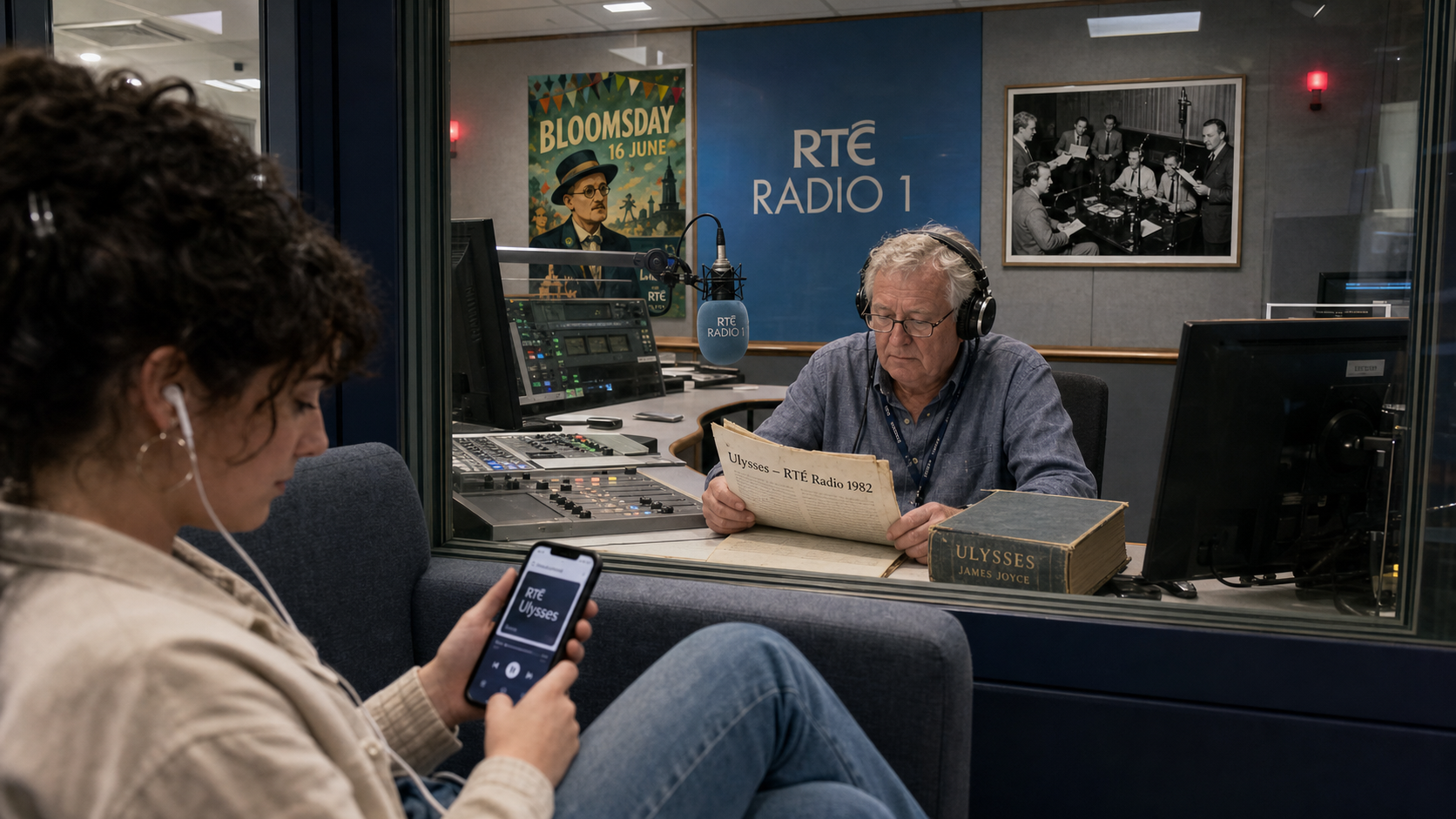
RTÉ's Landmark Ulysses Dramatisation Finds New Audiences as Bloomsday Legacy Endures
In the week after Bloomsday — the annual celebration of James Joyce's Ulysses on 16 June, the date on which the novel is set — RTÉ's decision to make its landmark 1982 radio dramatisation of the novel available as a podcast series has introduced one of the most ambitious productions in Irish broadcasting history to a new generation of listeners, demonstrating that Joyce's masterwork remains a living cultural force rather than a literary monument to be admired from a distance.
Background
James Joyce's Ulysses, published in 1922, is widely regarded as one of the greatest novels ever written in the English language — a work of extraordinary ambition, linguistic invention, and human insight that follows Leopold Bloom, Stephen Dedalus, and Molly Bloom through a single day in Dublin on 16 June 1904. The novel's complexity has made it both celebrated and feared: celebrated for its technical brilliance and its profound engagement with the textures of everyday life, feared for its difficulty and its demands on the reader's patience and attention.
Bloomsday — the annual celebration of the novel on 16 June — has become one of the most distinctive events in the Irish cultural calendar, a day when Joyce enthusiasts across Dublin and around the world dress in Edwardian costume, read passages from the novel aloud, and retrace the routes taken by the novel's characters through the streets of the city. The celebration has grown significantly in recent decades, attracting tourists from across the world and generating significant media coverage that keeps Joyce's work in the public consciousness.
RTÉ's 1982 radio dramatisation of Ulysses is one of the most remarkable productions in the history of Irish broadcasting. Running to almost 30 hours, it involved a cast of more than 200 actors and was produced over several years by a team that included some of the most distinguished figures in Irish radio drama. The production was broadcast in its entirety on RTÉ Radio 1 in 1982 and has been repeated on several occasions since, but its availability has been limited by the practical constraints of its length and the complexity of its rights situation.
Key Developments
RTÉ's decision to make the 1982 dramatisation available as a podcast series represents a significant act of cultural stewardship. By releasing the production in episodic form — structured to follow the novel's eighteen episodes — RTÉ has made it accessible to listeners who might be daunted by the prospect of engaging with the full 30-hour production in a single sitting. The podcast format also allows listeners to engage with the production at their own pace, pausing to consult the text or to look up references before continuing.
The response to the podcast release has been enthusiastic, with the production attracting significant downloads in the week after Bloomsday. Listeners have been sharing their experiences on social media, with many reporting that the dramatisation has given them access to a work they had always wanted to engage with but had found too daunting to approach through the printed text alone. The production's cast — which includes many of the most distinguished Irish actors of the 1980s — has been praised for the quality of its performances, and the production values, while inevitably dated in some respects, have been found to be remarkably effective in bringing Joyce's language to life.
The Bloomsday Festival itself, which ran from 11 to 16 June in Dublin, attracted significant audiences to events across the city, including readings at the James Joyce Centre on North Great George's Street, performances at the National Library, and the traditional breakfast at the Martello Tower in Sandycove — the setting for the novel's opening episode. The festival has grown considerably in recent years, and its success reflects a broader renewal of interest in Joyce's work among younger Irish readers and audiences.
Why It Matters
The enduring vitality of Bloomsday and the success of the RTÉ podcast release speak to something important about the relationship between Irish culture and its literary heritage. Joyce is, in many ways, the most challenging of Ireland's great writers — more demanding than Beckett, more politically complex than Yeats, more linguistically adventurous than any of his contemporaries. The fact that his work continues to attract new audiences, to generate new productions and adaptations, and to inspire new scholarship and criticism is a testament to its inexhaustible richness.
The RTÉ dramatisation is also a reminder of the importance of public broadcasting as a custodian of cultural heritage. The 1982 production was made possible by the resources and the institutional commitment of a public broadcaster that was willing to invest in a project of extraordinary ambition without any guarantee of commercial return. The decision to make it available as a podcast — free of charge, accessible to anyone with a smartphone — is a continuation of that public service ethos in a digital age.
Local Impact
In Dublin, the Bloomsday celebrations have a direct economic impact on the city's tourism and hospitality sectors, with visitors from across the world travelling to the city specifically for the festival. The James Joyce Centre, the National Library, and the various pubs and restaurants associated with the novel's geography all benefit from the increased footfall that Bloomsday generates. Beyond the economic impact, the festival has a cultural significance for Dublin that is hard to quantify: it is one of the occasions on which the city most consciously celebrates its literary identity and its connection to a writer who, despite spending most of his adult life in exile, never stopped writing about Dublin with an intimacy and precision that no other city has inspired in any other writer.
What's Next
The RTÉ Ulysses podcast series will remain available on the RTÉ Radio Player and on major podcast platforms indefinitely, providing a permanent resource for listeners who want to engage with the production at their own pace. RTÉ has indicated that it is considering further digital releases of archive radio drama productions, with the Ulysses dramatisation serving as a test case for the appetite for this kind of content. The James Joyce Centre in Dublin is planning a series of events for the autumn that will build on the interest generated by Bloomsday, including a symposium on the novel's centenary of publication in 2022 and its continuing relevance to contemporary Irish culture.