Rhasidat Adeleke Targets European 200m Glory in Birmingham as Irish Sprint Star Chases Redemption
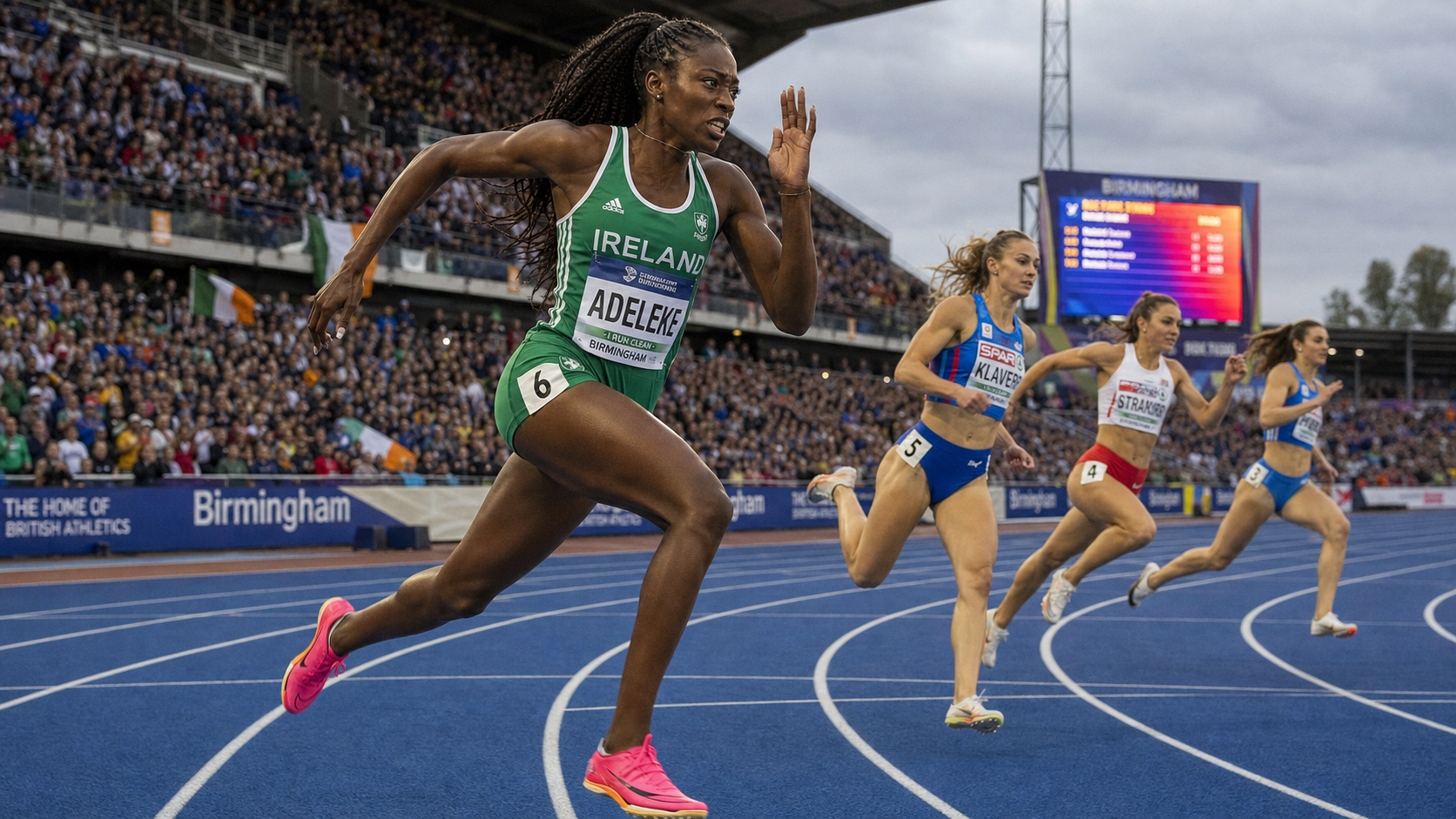
Rhasidat Adeleke is competing in the 200m at the European Athletics Championships in Birmingham this week, having secured her qualification at the Irish National Track and Field Championships in Santry after a summer that tested her resilience to its limits. The 23-year-old, who describes the 200m as her "first love" after a difficult period focused on the 400m, is targeting her first European long-course medal in a field that includes Dina Asher-Smith and Amy Hunt.
Background
Rhasidat Adeleke's journey to the 2026 European Athletics Championships has been one of the most compelling stories in Irish sport this summer. The Dublin-born, Texas-raised sprinter — who holds dual Irish and American citizenship and competes for Ireland — arrived at the season carrying the weight of expectations that had been building since her near-miss for a medal in the 400m at the Paris Olympics in 2024.
The 2025 season was difficult. Recurring hamstring injuries disrupted her training and racing schedule, and the pressure of high expectations — from the media, from sponsors, and from herself — created a psychological burden that she has spoken about with unusual candour. The decision to shift her focus back to the 200m for 2026 was, in her own words, an attempt to rediscover the joy of running that had been obscured by the relentless focus on the 400m.
The 200m is the event in which Adeleke first made her name at collegiate level in the United States, where she competed for the University of Texas at Austin. Her natural speed and her ability to maintain form through the bend make her a genuine threat at the distance, and analysts who have tracked her development believe that her ceiling in the 200m may be higher than her ceiling in the 400m — a view that Adeleke herself appears to share.
Key Developments
The qualification campaign was not straightforward. Adeleke failed to meet the 22.85-second standard at the Spitzen Leichtathletik meeting in Lucerne on 16 July, clocking 23.07 in fourth place. The setback was a significant one, coming at a meeting where she had been expected to secure her place at the championships comfortably.
She responded by entering the 200m at the Irish National Track and Field Championships at Morton Stadium in Santry — her final opportunity to qualify. The performance she delivered there was described by RTÉ as a "clutch run": a 22.80-second victory that not only secured her place at the European Championships but demonstrated that the speed and competitive instinct that had made her one of the most exciting sprinters in Europe were still very much intact.
The European Athletics Championships in Birmingham opened on 10 August, with Ireland's largest-ever team at the event — 47 athletes — competing across a range of disciplines. Adeleke's 200m event is one of the most anticipated on the programme, with the semi-finals and final scheduled for the middle days of the championships. Her preparation has been described by her coaching team as the best of her career, with the shift back to the 200m allowing her to train with a freedom and enthusiasm that had been absent during the more pressured 400m campaign.
The competition is formidable. Dina Asher-Smith, the British sprinter who has dominated European 200m competition for the past decade, is the clear favourite, while Amy Hunt — the young English sprinter who has emerged as one of the most exciting talents in world athletics — is expected to challenge strongly. Adeleke's best chance of a medal may depend on the form of the field on the day, but she has demonstrated repeatedly that she is capable of producing her best performances when the stakes are highest.
Why It Matters
Adeleke's story resonates beyond the athletics track because it speaks to questions about identity, belonging, and the pressure that elite sport places on young athletes. Born in Dublin to Nigerian parents, raised partly in Texas, competing for Ireland — her journey has been shaped by a complexity of influences that she navigates with a maturity that belies her twenty-three years. Her willingness to speak openly about the mental health challenges of elite sport, and about the difficulty of managing expectations that can feel crushing, has made her a figure of genuine significance in Irish sporting culture.
For Irish athletics, her presence at the European Championships is part of a broader story of growth. Ireland's 47-strong team in Birmingham is the largest the country has ever sent to the championships, reflecting the depth of talent that has developed across the disciplines over the past decade. Nick Griggs, Darragh McElhinney, and Brian Fay have already competed in the 5,000m; Sarah Healy finished fourth in the 5,000m final; and the relay teams are expected to challenge for medals in the sprint events. Adeleke's 200m campaign is the centrepiece of Ireland's sprint programme.
Local Impact
Adeleke's profile in Dublin — where she grew up in Tallaght before moving to the United States — has grown significantly since her Olympic near-miss in Paris. Athletics Ireland has reported a surge in participation in sprint events among young girls in the capital, a development that coaches attribute in part to the visibility that Adeleke's success has provided. The Morton Stadium in Santry, where she qualified for Birmingham, has become a focal point for Irish athletics development, and the investment in its facilities over the past decade has created an environment where world-class performances are now a regular occurrence.
What's Next
The 200m semi-finals at the European Championships are scheduled for Wednesday, 12 August, with the final on Thursday, 13 August. Adeleke will need to finish in the top three of her semi-final, or achieve a time fast enough to qualify as one of the fastest losers, to reach the final. If she makes the final, she will be competing for Ireland's first European Championship medal in the women's 200m. Athletics Ireland has confirmed that she is also entered in the 4x100m relay, which takes place later in the week.