Orange Order Confirms 19 Venues for Twelfth 2026 as Main Parades Set for July 13
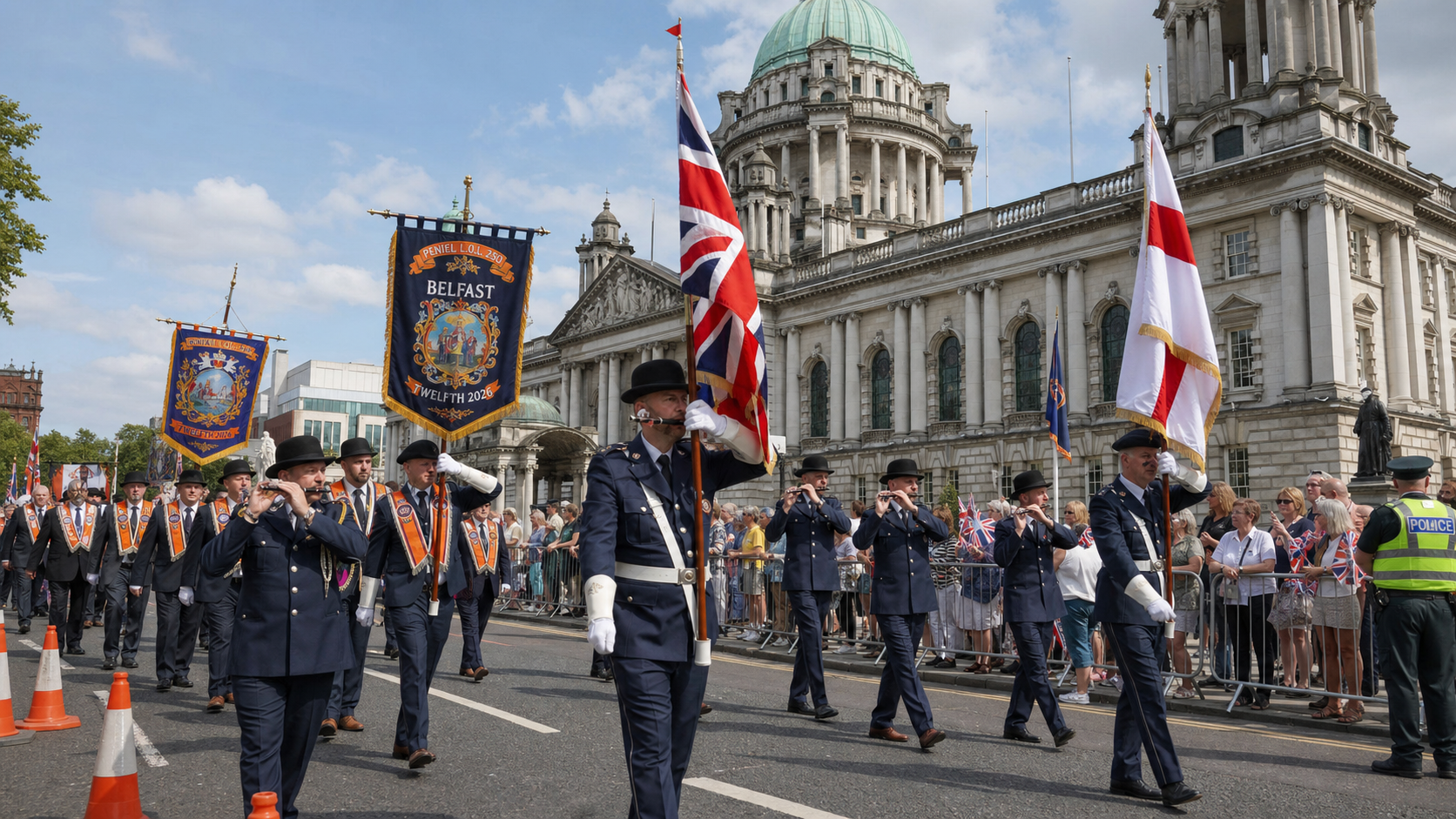
The Orange Order has confirmed 19 venues across Northern Ireland for this year's Twelfth of July demonstrations, with the main parades taking place on Monday July 13 and the Belfast demonstration — the largest of the day — expected to attract more than 10,000 participants from lodges across the province and from the Orange diaspora in Scotland, England, and further afield.
Background
The Twelfth of July is the most significant date in the Ulster Protestant and unionist calendar, commemorating the victory of King William III of Orange over King James II at the Battle of the Boyne in 1690. The Orange Order, which was founded in 1795, organises demonstrations across Northern Ireland and in parts of the Republic of Ireland, Scotland, and other countries with significant Ulster Protestant diaspora communities. The demonstrations involve marching bands, lodge members in regalia, and religious services, and are a central expression of Ulster Protestant cultural identity.
The Twelfth has been a source of controversy in Northern Ireland for decades, particularly in areas where parade routes pass through or near nationalist communities. The Parades Commission for Northern Ireland has the power to impose conditions on or prohibit parades that are deemed likely to cause public disorder or community tension. In recent years, the number of contentious parades has reduced significantly, reflecting both improved community relations and the Orange Order's greater willingness to engage with residents' groups.
Key Developments
The Orange Order's Grand Secretary Mervyn Gibson confirmed on Friday that 19 venues had been designated for this year's Twelfth demonstrations, covering all parts of Northern Ireland. The venues include Belfast, Londonderry/Derry, Ballymena, Bangor, Newtownards, Portadown, Armagh, Enniskillen, Omagh, Strabane, Dungannon, Cookstown, Magherafelt, Antrim, Larne, Ballymoney, Coleraine, Downpatrick, and Newry.
Gibson said the Belfast demonstration, which will assemble at Carlisle Circus and march to the demonstration field at Barnett Demesne in south Belfast, was expected to be the largest in several years, with lodges from across Northern Ireland and from Scotland, England, Canada, and Australia expected to participate. He said the Order was "looking forward to a peaceful and dignified demonstration that celebrates our culture and our faith."
The Parades Commission has issued determinations for all 19 venues, with conditions attached to several parades in areas where there is a history of tension. In Portadown, where the Drumcree dispute dominated Northern Ireland politics in the 1990s, the parade has been permitted to proceed on its traditional route, subject to conditions including a ban on music within 200 metres of Garvaghy Road. In Londonderry/Derry, the parade has been permitted to proceed on the city's west bank, with conditions relating to the behaviour of participants and the timing of the march.
The Police Service of Northern Ireland has confirmed that it will deploy significant resources to support the Twelfth demonstrations, with officers from all districts involved in the policing operation. Assistant Chief Constable Bobby Singleton said the PSNI was "committed to facilitating the right to peaceful assembly while also protecting the rights of all communities."
Why It Matters
The Twelfth of July demonstrations are one of the most significant cultural events in Northern Ireland's annual calendar, and their peaceful conduct is an important indicator of the state of community relations in the province. The fact that 19 venues have been confirmed with Parades Commission determinations in place — and that the most contentious historical flashpoints, such as Drumcree, are proceeding without the level of dispute that characterised the 1990s — is a positive sign of how far Northern Ireland has come in managing cultural expression and community relations.
The demonstrations also matter as an expression of Ulster Protestant and unionist cultural identity at a time when that identity is under pressure from demographic change, the legacy of Brexit, and the ongoing debate about Irish unity. For many participants, the Twelfth is not primarily a political statement but a cultural and religious tradition that connects them to their community and their history.
Local Impact
The Twelfth demonstrations will affect traffic and public transport across Northern Ireland on July 13, with Translink confirming that bus and rail services will be modified to accommodate the parades. In Belfast, the city centre will be largely closed to traffic from 9am to 4pm, with diversions in place for vehicles travelling through the city. Local businesses along the parade routes in Belfast, Ballymena, and Bangor have reported strong advance bookings for the day, with the demonstrations traditionally generating significant economic activity for town centre retailers and hospitality businesses. In Portadown, the local business community has welcomed the Parades Commission's determination, which provides certainty for planning purposes.
What's Next
The Twelfth demonstrations take place on Monday July 13. The Orange Order will hold its annual church services on Sunday July 12, with the main service in Belfast at St Anne's Cathedral. The Parades Commission will monitor the conduct of all 19 demonstrations and has the power to take enforcement action if conditions are breached. The PSNI will publish a post-event report on the policing of the demonstrations within four weeks of the Twelfth.