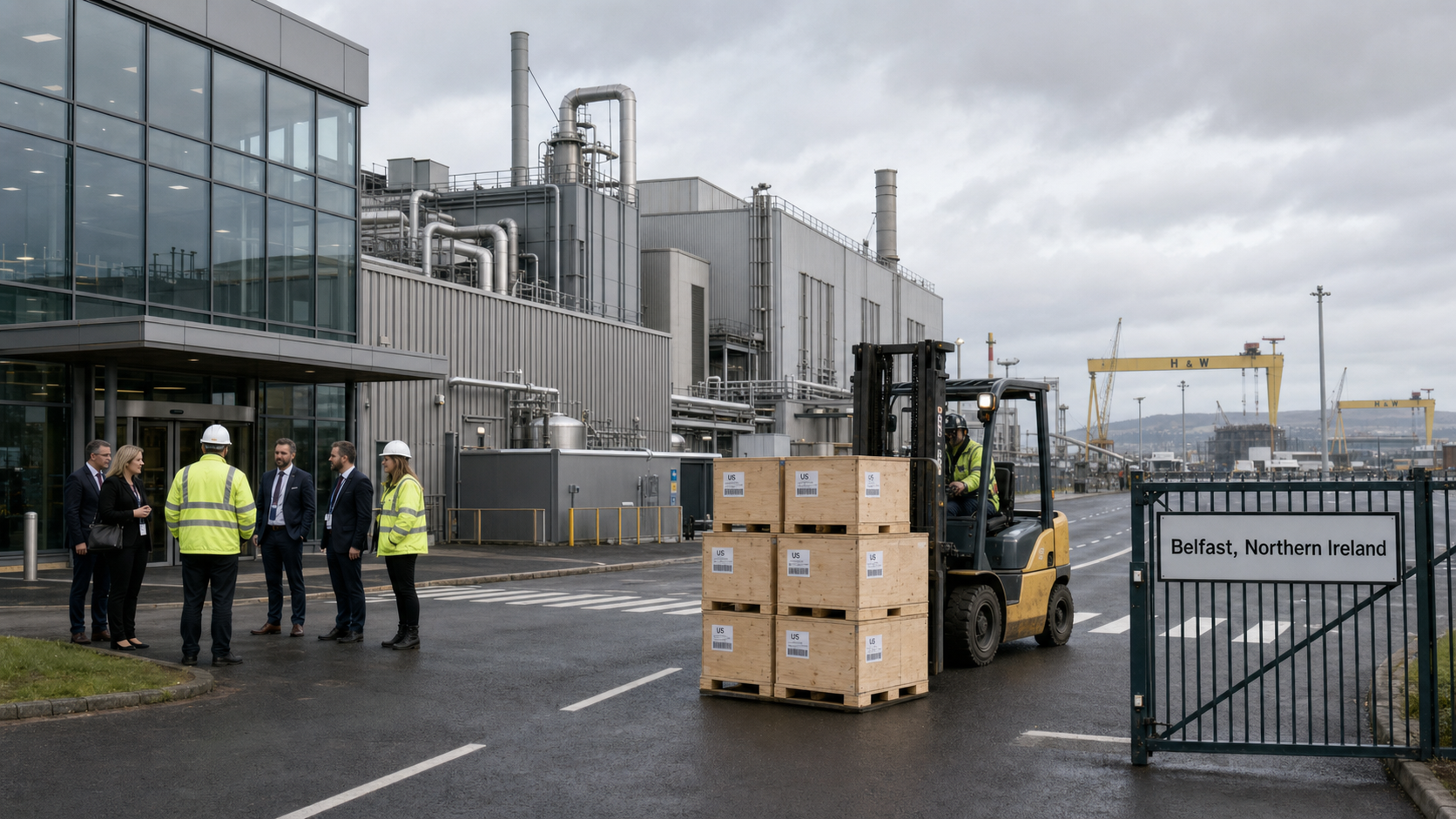
Northern Ireland Exports Face 15% Drop as US Tariffs Hit Pharmaceutical Sector Hardest
New research commissioned by Stormont's Department for the Economy has found that US tariffs could reduce Northern Ireland's exports to the United States by approximately 15%, with the pharmaceutical sector expected to bear the heaviest burden. The findings, published jointly by the Economic and Social Research Institute and the National Institute of Economic and Social Research, paint a sobering picture of the vulnerability of Northern Ireland's export-dependent economy to shifts in American trade policy, even as the region's Windsor Framework dual-market access provides some degree of structural resilience.
Background
Northern Ireland's economic relationship with the United States is substantial and multifaceted. American companies are among the largest employers in the region, with major investments in financial services, technology, and manufacturing. The pharmaceutical sector, in particular, has a significant US-linked presence, with several major American pharmaceutical companies operating production facilities in Northern Ireland that export to markets on both sides of the Atlantic.
The tariff environment has shifted dramatically since 2025, when the United States began implementing a series of trade measures that have fundamentally altered the trading landscape for exporters across the world. Northern Ireland, as part of the United Kingdom's customs territory, is subject to the same US tariff rates applied to the rest of the UK — currently a 10% reciprocal tariff on goods entering the US, alongside specific tariffs of 25% on steel and aluminium. The Windsor Framework's dual-market access provides some flexibility, but it does not insulate Northern Ireland from the broader impact of US trade policy.
The ESRI and NIESR research, commissioned specifically to assess the impact on Northern Ireland, represents the most detailed analysis yet of how the tariff regime is affecting the region's export economy. Its findings are more granular than previous UK-wide assessments and provide Stormont policymakers with a clearer picture of where the vulnerabilities lie.
Key Developments
The research projects a 15% reduction in Northern Ireland's exports to the United States as a result of the current tariff regime. The pharmaceutical sector is identified as the most exposed, given the high value of pharmaceutical exports and the sensitivity of that sector to price changes driven by tariff costs. Chemicals and non-motor vehicle transport equipment are also identified as sectors facing significant long-term trade impacts.
Economy Minister Dr. Caoimhe Archibald acknowledged the findings while noting that Northern Ireland's dual-market access under the Windsor Framework provides a degree of resilience that is not available to other UK regions. The framework allows businesses to navigate some complexities of importing third-country goods, and Invest NI has been actively promoting the dual-market advantage to potential investors. However, Archibald conceded that these advantages are unlikely to fully mitigate the negative consequences of increased global trade barriers.
The research also projects broader macroeconomic impacts: economic output and household consumption are expected to decline over time as trade costs rise and external demand weakens, while inflation is projected to increase in the short term and employment levels are expected to see a modest decline between 2025 and 2030. New developments in June 2026, including a US Trade Representative report on forced labour that could introduce an additional 10% duty on goods from the UK and EU, have added further uncertainty to the outlook.
Why It Matters
The tariff research matters because it quantifies, for the first time in a Northern Ireland-specific context, the scale of the economic risk posed by US trade policy. A 15% reduction in exports to the United States is not a marginal adjustment — it represents a significant contraction in one of Northern Ireland's most important export markets, with consequences for employment, investment, and the broader economic trajectory that the UUEPC has been projecting with cautious optimism.
The findings also have implications for Stormont's economic strategy. The Department for the Economy has been promoting Northern Ireland's dual-market access as a competitive advantage, and that advantage remains real. But the tariff research suggests that the advantage is insufficient to offset the broader headwinds created by US trade policy, and that Stormont will need to develop more targeted support measures for the sectors most exposed to tariff impacts.
Local Impact
The pharmaceutical sector's exposure to US tariffs has direct implications for employment in the greater Belfast area and in the Antrim corridor, where several major pharmaceutical manufacturing facilities are located. Companies including those in the Titanic Quarter's life sciences cluster and along the M2 corridor have been monitoring the tariff situation closely and assessing the impact on their export pricing and competitiveness. Invest NI has been working with affected companies to identify mitigation strategies, including supply chain diversification and tariff classification reviews.
What's Next
The Department for the Economy is expected to publish a response to the ESRI/NIESR research within the coming weeks, setting out the measures it intends to take to support affected sectors. Invest NI will hold a series of briefings for exporters in the pharmaceutical, chemicals, and manufacturing sectors in August. The Stormont Executive's economic strategy review, due before the end of 2026, will incorporate the tariff research findings into its assessment of Northern Ireland's economic vulnerabilities and opportunities.