Northern Ireland Economy Defies UK Trend with Record-Low 1.7% Unemployment as Windsor Framework Boosts Trade
Northern Ireland's economy is demonstrating remarkable resilience in mid-2026, with unemployment at a record low of 1.7% — significantly below the UK average — and cross-border trade with the Republic of Ireland growing substantially under the Windsor Framework's dual-market access arrangements. However, economists and business leaders are warning that the region's structural weaknesses — including significant deficits in infrastructure, skills, and energy costs — remain significant barriers to the long-term growth that Northern Ireland needs to close the productivity gap with the rest of the UK and with the Republic.
Background
Northern Ireland's economic performance has been a source of cautious optimism in recent years, particularly given the political turbulence that has characterised the region's governance. The restoration of the Stormont Executive in early 2024, following the DUP's two-year boycott over post-Brexit trading arrangements, provided a degree of political stability that has been broadly welcomed by the business community. The Windsor Framework, which resolved the most contentious aspects of the post-Brexit trading arrangements for Northern Ireland, has been particularly significant for businesses that trade across the border with the Republic of Ireland and across the Irish Sea with Great Britain.
The Framework's dual-market access provisions — which allow Northern Ireland businesses to sell into both the UK internal market and the EU single market — have been described by business leaders as a "unique competitive advantage" that no other part of the UK or EU enjoys. This advantage has been particularly valuable for Northern Ireland's agri-food sector, which exports significant volumes of product to both markets, and for its advanced manufacturing sector, which relies on components and materials sourced from both the UK and the EU.
The record-low unemployment rate of 1.7% reflects both the strength of the labour market and the structural characteristics of Northern Ireland's economy, which has a large public sector that provides a degree of employment stability that is not present in more market-oriented economies. However, economists have noted that the low unemployment rate masks significant underemployment and economic inactivity, with a higher proportion of the working-age population outside the labour market in Northern Ireland than in any other part of the UK.
Key Developments
The latest economic data, published by the Northern Ireland Statistics and Research Agency (NISRA) this week, confirms that the region's labour market remains exceptionally tight, with the unemployment rate of 1.7% representing the lowest figure on record. The data also shows that average weekly earnings in Northern Ireland have grown by 4.2% over the past year, outpacing inflation for the first time since 2021 and providing a modest improvement in real living standards for workers across the region.
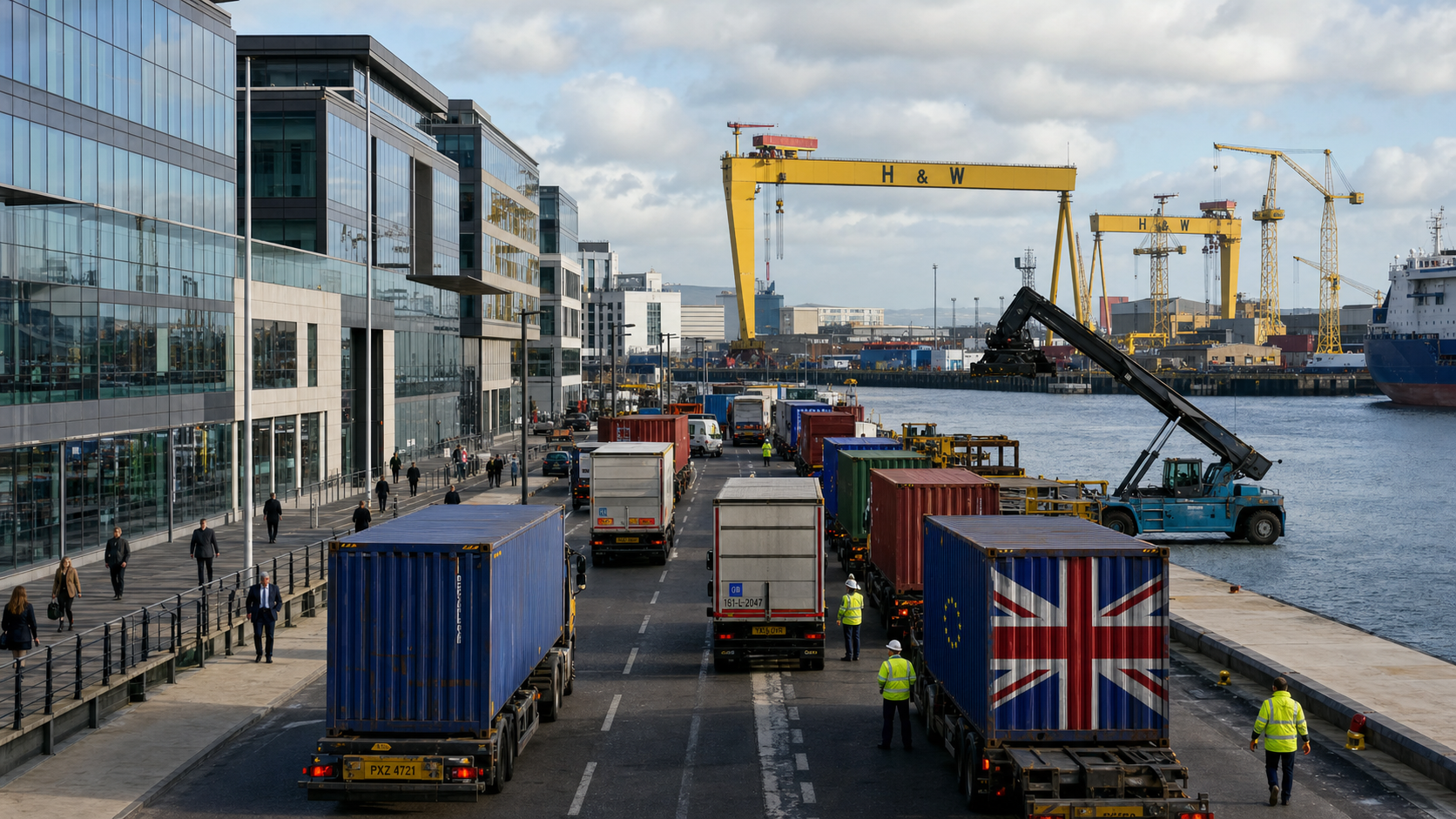
Cross-border trade data, published by the Central Statistics Office in Dublin and by HMRC in London, shows that trade between Northern Ireland and the Republic of Ireland has grown by approximately 12% over the past year, with the agri-food, pharmaceutical, and technology sectors all recording significant increases. The Windsor Framework's role in facilitating this growth has been acknowledged by business leaders on both sides of the border, with the Irish Business and Employers Confederation (IBEC) and the Confederation of British Industry (CBI) Northern Ireland both publishing reports highlighting the Framework's positive impact on cross-border trade.
However, the economic picture is not uniformly positive. The Northern Ireland Executive's severe budgetary crisis — which has led to warnings of "apocalyptic" cuts to public services — is creating significant uncertainty for businesses that depend on public sector contracts and for workers in the public sector. The region's infrastructure deficit, which includes significant gaps in road, rail, and digital connectivity, continues to act as a brake on economic development, particularly in rural areas of counties Tyrone, Fermanagh, and Armagh.
Why It Matters
Northern Ireland's economic performance matters because it has direct implications for the quality of life of the region's 1.9 million people. A strong economy generates the tax revenues that fund public services, creates the jobs that provide livelihoods, and attracts the investment that drives innovation and productivity growth. The record-low unemployment rate is genuinely good news, but it needs to be seen in the context of the broader economic challenges that Northern Ireland faces. The productivity gap between Northern Ireland and the rest of the UK — which has persisted for decades and which reflects the region's structural weaknesses — means that even a tight labour market does not translate into the levels of prosperity that comparable regions in Great Britain or the Republic of Ireland enjoy. Closing this productivity gap requires sustained investment in infrastructure, skills, and innovation — precisely the areas where the current budgetary crisis is creating the most pressure.
Local Impact
The economic data has different implications for different parts of Northern Ireland. In Belfast, where the technology and financial services sectors have been growing strongly, the tight labour market is creating genuine competition for skilled workers, with employers reporting difficulty in recruiting for specialist roles. In the north-west, where Derry and Strabane have historically had higher unemployment rates than the rest of the region, the improvement in the labour market has been particularly welcome, though the area continues to lag behind Belfast in terms of economic dynamism. In rural areas of Tyrone, Fermanagh, and Armagh, the economic picture is more mixed, with the agri-food sector performing well but the lack of infrastructure investment limiting the development of other sectors. The City and Growth Deals, which are providing significant investment in infrastructure and economic development across Northern Ireland, are expected to have a positive impact on these areas over the coming years.
What's Next
The Northern Ireland Executive is expected to publish its Economic Strategy for 2026-2030 in September, setting out its priorities for economic development over the medium term. The strategy is expected to focus on infrastructure investment, skills development, and the promotion of Northern Ireland's dual-market access advantage to attract foreign direct investment. The Department for the Economy has also indicated that it will publish a review of the Windsor Framework's economic impact in October, providing a detailed assessment of its effects on trade, investment, and employment across different sectors of the Northern Ireland economy.